Showing posts with label omniture. Show all posts

Thursday, August 1, 2013

Tracking individual users in Google Analytics

Several people have recently asked me if it is possible to use Google Analytics to track and store information on specific individual visitors to their site. Usually the popular analytics package only reports trends and grouped user behaviour, you never get to see the granular detail of each person (e.g. their specific browsing path around the site, etc.). However this can be quite annoying for some marketers who want this information and who have used competitive packages from companies such as WebTrends or Adobe (Omniture) in the past.

If you read the Google Analytics support documentation on Google’s website, you will see in several places there is a reference to NOT using PII (Personally Identifiable Information). This is data that can be used by Google to identify an individual and includes info such as: Name, Address & Email address. However PII can also be a mobile phone’s unique identifier or some other way to recognise a specific device.

There are work-arounds to this restriction (such as using Custom Variables that hold randomly-generated reference for each specific user), but these come very close to violating Google’s End User License Agreement and are definitely not in the spirit of the platform.

So can you upgrade to Google Analytics Premium (the paid-for version of GA) and then start to store important user data? No. The collection of personally identifiable information (PII) is in violation of Google Analytics entire EULA and therefore paying $150k still doesn't let you use the platform as you might have hoped.
Google has therefore been pretty specific in its user agreement (with its new Universal Analytics product also currently having the same restrictions) and even gives the warning that:
Your Google Analytics account could be terminated and your data destroyed if you use any of this information.
However, I have one important point to raise that has been bugging me…

In GA there is the feature to understand your Multi-Channel Funnels. This is lets a site manager understand the interactions between different online media and see how the channels work together to trigger sales. Since this report gives a breakdown of all the multiple digital customer touch-points over the last 30 days… if Google doesn't uniquely identify individuals, how does it know when specific people use each channel and then join them up to create a complete picture of the steps customers take before actually converting?

Thursday, November 8, 2012

How much value is your website data giving you?

I'm on a mission to make sure companies get more value from the online data they collect. Why?
Well most companies now know that they can plug analytics into their website, ranging from the free (but still incredibly useful) Google Analytics, to paid for products such as: Coremetrics, Adobe [yes, we do still call it Omniture] and WebTrends.

For me the diagram below highlights the increasing value of website analytics and their importance to the business.
Reading the diagram from the bottom up, you firstly move on from a position of no data (or badly collected data) by setting up correct data capture processes. This can be anything as simple as collecting log files from your web server of visitor traffic. However by taking the next step (e.g. implementing website analytics) an organisation makes the move to having information it can use, now typically presented in the form of tables, diagrams, etc.

But, that is typically where most companies stop. However there's an additional layer above that, delivered by carrying out data analysis on the available information and creating valuable online insight.

Monday, October 22, 2012

Where have all the website analysts gone?

All to often I speak with clients who have great websites and have therefore implemented analytics, such as those by Google, Webtrends, Omniture / Adobe, etc. However a lot of them also admit that they are not getting as much from these analytics packages as they should be.

They often claim that they either don't have the skills in-house or an aligned digital agency who can give them timely and relevant insight. This is a real shame, as these organisations usually understand that their business could be that much better if they could just gain better explanation of what their customers are doing (or not doing).

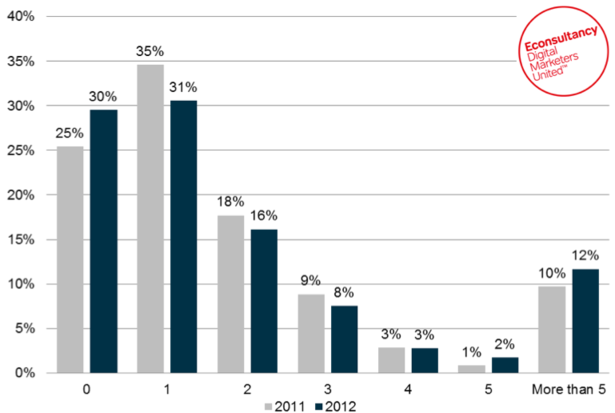
To back this up, a recent posting from eConsultancy highlighted an important and worrying trend..... website analysts are disappearing.

If you look at the graph above, you will see that in the recent survey, for a question asking "How many dedicated employees does your organisation have doing analysis of web data?" the number of organisations with zero staff responsible for web analytics has actually increased.

Increased? Surely it doesn't make sense that, in an increasingly digitally-savvy business environment, companies are downsizing their online analytics capability? It would seem so, and this is further backed up by the other data in this survey.... that clearly shows that most companies (i.e. those with up to 3 people responsible for online insight) have been reducing their focus on this important function in the last year. Perhaps unsurprisingly, only those large companies with five of more dedicated website analysts have increased their numbers.

It seems that the either role of website analyst is disappearing, or the smart staff required to fill these roles just aren't around any more. Where have all these people gone?

Thursday, November 5, 2009

Google enters the commerce search arena

Yesterday Google announced their own Commerce Search application which competes with the likes of Omniture Merchandising (previously Mercado Search)

This is an enterprise product search service that is hosted by them.

It is similar to Mercado, in that is has:
- Facetted navigation
- Business rules for prioritisation
- Spellchecker, synonyms & recommendations
- An XML API for exporting results back into your own website

It even has a built-in shopping cart if required and pricing is based on number of products/SKU's and the number of searches.

Tuesday, April 22, 2008

The path to acceptance

I watched Shar VanBoskirk from Forrester present today at the Omniture Analytics Summit in London. Aside from giving a well-polished and highly involving presentation, she covered the subject of ‘the complex life of the online marketer’.

What was most interesting to me was the path that an online / interactive marketer needs to take in order to gain acceptance of the changing role and how it can create lasting business benefit.

Her path gave these 4 steps:

  1. Acceptance
  2. Integration
  3. Optimisation
  4. Strategic

Foremost in her presentation was the need to use a ‘central hub’ of data, for example provided by a product from a company such as Omniture (no surprise there), to provide consolidated analytics to understand what customers are doing.

Her steps were a simple but effective roadmap and covered the key tools & drivers an online marketer should use :


1. Acceptance
Companies should understand that the World is now different and customer conversation has changed from only a few years ago. Customers now talk to other customers about products without necessarily involving the companies concerned. Companies must at least engage in this dialogue. This is driven by a proper interactive programme, an understanding of the data a company already has and an understanding of Social Media


2. Integration
Having got buy-in, a marketer needs to realise the benefits from integrated programmes. Identification of the 'low hanging fruit' is key (note: at 6"6' tall, a lot of fruit for me is 'low hanging') and they need to start linking data together.
E.g. finding out who your most valuable customers are, or conducting behavioural/demographic targetting


3. Optimisation
Create customer-centric cross-channel programmes that generate financial results. You should make your work smarter and more relevant, in an effort to collaborate & streamline your efforts.


4. Strategic
This is where interactive marketing drives business success and in-turn informs the business about future direction. This is where planning & modelling comes to the fore.
Most importantly this is the Exec-level buy-in where you are affecting the company value.

She makes it all seem so easy......