Showing posts with label insight. Show all posts

Friday, October 19, 2018

Is data driven marketing that simple

In a Linkedin.com post recently I commented about the increased adoption of data driven marketing ...

It's simple really:
1. Build insight with real data
2. Foster loyalty
3. Communicate creatively
4. Analyse to improve

But is it that simple?

Monday, September 8, 2014

Build a Digital Platform not a website

I still hear a lot of businesses talk about “building a new website” or “creating an online presence”. Now by itself this is not a bad thing and these organisations will no doubt join the ranks of those that regularly move pixels about to create more impact or sell more.

But your web presence should be only one part of an entire toolbox that larger organisations should be using to influence more, engage more, sell more and retain more. But in my experience, a lot of them don’t understand that to have a joined up online customer experience and you need to have a joined up collection of tools that all work well together.

In other words you need a Digital Platform not a website.

So what can a Digital Platform do for you?

Provide ubiquitous online access
It should give as many users as possible easy access regardless of: device, connection speed and ability.

Improve the Customer Experience
It should create a relevant & consistent digital interface for each user segment, allowing all interactions to be as efficient & intuitive as possible, allowing your business to understand customers better.

Improve revenue
It should maximise any online revenue opportunities through better marketing campaigns, improved conversion and opportunities for additional revenue optimisation

Improve insight
It should allow you to understand digital visitor behaviour with the intention of informing and optimising future digital activity.

Provide consistent content
It should allow the central management of content (text, imagery, etc.) across all online devices and interfaces.

Friday, February 7, 2014

You can't answer everything with analytics

I'm a big believer in the use of digital analytics to inform business decision making. And this isn't just the correct presentation of data in the right format, but in the delivery of insight from this data.

But statistician John Tukey had a different perspective. He once stated:
“Data may not contain the answer. The coordination of some data and an aching desire for an answer will not ensure that a reasonable answer can be extracted from a given body of data.”

In other words... sometime the data you have collected just isn't enough. Or more pointedly... if you have not originally set-out to collect the data you need to make the right decision, then no amount of analysis effort can generate the answer.

So how do you resolve this? Collect everything you possibly can, in the hope that you will one day find a use from  it?


Wednesday, July 24, 2013

eCommerce and the dehydrated mare

Ever heard the phrase “You can lead a horse to water, but you can’t make it drink”?

Well, if you leave a thirsty horse right by the water trough, make it as easy as possible for them to take what they want and show the water off in the best way possible… you are more likely to get it drinking.
The same goes for eCommerce websites, where the you have no control over the actions of a specific user… but by a clever combination of: thought-out usability, customer insight & segmentation, an acute focus on maximising customer revenue and a ‘test & learn’ approach, you stand a far more likely chance of converting prospects into customers and makin more money in the process.
There's unfortunately no one-size-fits-all model for eCommerce, but typically there are best-practice models to follow in each market sector. Understanding what works for your business is then a process of trial and error to establish what combination works best.

Remember, you may drag your customers to your site via a number of different marketing channels; but what they do when they are there is yours to shape and persuade.

Friday, May 10, 2013

Insight, the one digital metric we don’t measure

I hope that by now most large company execs by now will have heard of the existence of website analytics. Some (especially the more marketing and technology focused) may even have seen dashboard reports from their analytics suites.

These displays of graphs and numeric tables can help the senior team quickly get an idea of the value of their digital channels, with ‘Goals’ (online results such as sign-ups or purchases) and ‘CPA’ (Cost per acquisition) figures being obvious KPI’s to get regular updates on.

These hard and fast numbers can go a long way to dispelling half-truths, rumours and ‘gut feel’ that humans instinctively use when there are gaps in their knowledge.
Note: I still see and hear of execs citing ‘hits’ as a great indicator of online greatness, with no understanding of how this figure is derived nor the understanding that traffic without purpose just creates a burden on IT infrastructure more than anything else.

Receiving and reviewing these dashboards might be one way of checking the digital success of an organisation, but a few pie charts and year-on-year comparisons does not even start to show the key output that needs comes out of these figures… insight. Insight that your digital analytics team (perhaps only made up of one person or even just part of a role somewhere) should be craving to provide

Measuring facts from all your digital touch-points is now possible and relatively easy in the online world. You insert a tag or two into each page (or action) of your website and sit back and watch the numbers scroll before your very eyes. Real-time reporting is now a reality, with even the free packages such as Google Analytics telling you where, when and what your visitors are doing at every step of their connected customer journey. But gaining insight from these figures is a different matter and measuring the value of this insight is exponentially more difficult still. Perhaps that’s why to-date it isn’t measured

But actually, it is...kind of. Insight derived online reports can show up in all sorts of ways, usually when there is a feedback loop from this data back into the business, for example:
  • Geographic data about where website or app visitors are coming from can inform business strategy. Imagine the mergers and acquisitions team knowing which counties the biggest increases in valuable business traffic have recently come from
  • Significant differences in the search engine keywords entered by users to reach your sites can predict market or investor trends. Data that could be of potential use to many central functions, including finance, proposition and commercial teams
  • Site bounce rates can not only inform your User Experience team of potential issues, but can reflect on product price, content quality or site speed (or a possible combination of all three plus other factors
It’s a shame however that this contribution to the organisation can’t be effectively measured. You can’t really put a price on the provision of internal data within a company, without coming up with some sort of mad model that will be more hypothesis than fact… the very thing thatdigital analytics tries to constantly minimise

Wednesday, March 20, 2013

Nobody sets out to read ‘content’ online

It seems that everyone is panning for virtual gold in the Content Marketing sector like it's San Francisco in the 1850's. Taking a look at Google Trends for Search, the term "Content Marketing" is currently reaching a feverish peak... somewhat helped perhaps by Google recently clamping down on paid-for advertorial links

It seems that content is having a bit of a Renaissance right now (deservedly so) and the pendulum has swung back away from "design first, content later" to "content first, design later".

But here's my revelation... Most normal people when they use the web don't start by thinking "My, I must consume some content", instead they want to:
  • Read opinions
  • Gain insight
  • Chuckle at rants
  • Understand products
  • Learn from ‘how to’ guides
  • Take a peek at useful information
  • Compare reviews
  • Watch news
  • Hear another person tell stories
  • plus many other combinations of the above and more.
So prior to setting out to "do some content marketing" and before considering: search engines, your 'tone of voice guidelines', the design of the page and even your boss or client's feedback... Think about the most important person. Your reader.

Thursday, November 8, 2012

How much value is your website data giving you?

I'm on a mission to make sure companies get more value from the online data they collect. Why?
Well most companies now know that they can plug analytics into their website, ranging from the free (but still incredibly useful) Google Analytics, to paid for products such as: Coremetrics, Adobe [yes, we do still call it Omniture] and WebTrends.

For me the diagram below highlights the increasing value of website analytics and their importance to the business.
Reading the diagram from the bottom up, you firstly move on from a position of no data (or badly collected data) by setting up correct data capture processes. This can be anything as simple as collecting log files from your web server of visitor traffic. However by taking the next step (e.g. implementing website analytics) an organisation makes the move to having information it can use, now typically presented in the form of tables, diagrams, etc.

But, that is typically where most companies stop. However there's an additional layer above that, delivered by carrying out data analysis on the available information and creating valuable online insight.

Monday, October 22, 2012

Where have all the website analysts gone?

All to often I speak with clients who have great websites and have therefore implemented analytics, such as those by Google, Webtrends, Omniture / Adobe, etc. However a lot of them also admit that they are not getting as much from these analytics packages as they should be.

They often claim that they either don't have the skills in-house or an aligned digital agency who can give them timely and relevant insight. This is a real shame, as these organisations usually understand that their business could be that much better if they could just gain better explanation of what their customers are doing (or not doing).

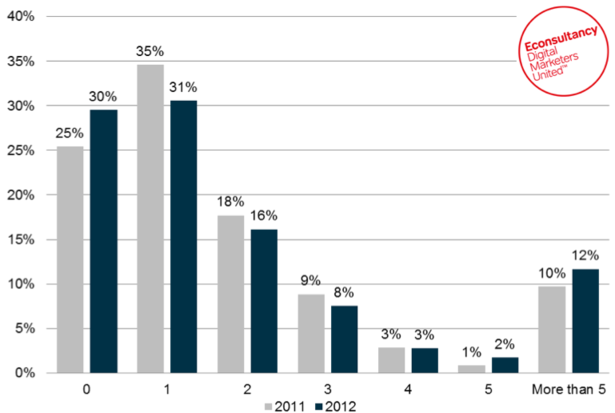
To back this up, a recent posting from eConsultancy highlighted an important and worrying trend..... website analysts are disappearing.

If you look at the graph above, you will see that in the recent survey, for a question asking "How many dedicated employees does your organisation have doing analysis of web data?" the number of organisations with zero staff responsible for web analytics has actually increased.

Increased? Surely it doesn't make sense that, in an increasingly digitally-savvy business environment, companies are downsizing their online analytics capability? It would seem so, and this is further backed up by the other data in this survey.... that clearly shows that most companies (i.e. those with up to 3 people responsible for online insight) have been reducing their focus on this important function in the last year. Perhaps unsurprisingly, only those large companies with five of more dedicated website analysts have increased their numbers.

It seems that the either role of website analyst is disappearing, or the smart staff required to fill these roles just aren't around any more. Where have all these people gone?

Thursday, August 9, 2012

What it means to be Head of Digital

I've had senior online roles for way over a decade now and have met some of the best people in the UK digital industry along the way. This also includes individuals who have been given or earned the title of Head of Digital (as well as having done the role myself).

I therefore thought I would explain what I think the Head of Digital's role encompasses and perhaps give some food for thought on the subject:
Note: it should go without saying that this also refers to a significant extent to other similar titles such as head of online, vp of ecommerce or director of digital and multi-channel.

1. Leadership
First and foremost, any Digital head must possess leadership. Just because online is a relatively new route up the corporate ladder, it doesn't mean we have to ignore one of the key characteristics needed. I will also go as far as saying that they also need to have two specific leadership qualities:
a) To lead change wherever and whenever they can
b) To provide thought leadership (and not just by repeating and re-processing the ideas of others, I mean by having new and original ideas that are innovative and still add business value - and you though this stuff was easy?)

2. Strategic vision
Clarity of what online success looks like and how to get there is key. You don't necessary need an MBA from one of the top business schools, but you need to have the ability to understand where digital is going within your market and what the latest trends are. Also being able to communicate this vision is also really important (as there's no point having a vision if you don't share it).

3. User Experience insight
Its imperative to have an understanding of the key ways to optimise the online customer journey. From minimising bounce rates on the homepage, through to sharpening up the conversion processes across your site. Note: I'm not saying you need to be a leading information architect (and very few Head of Digital people I have met have actually come directly from this route), but an appreciation of the main concepts and having an understanding of when to focus on this is essential.

4. Advanced Digital Marketing skills
Yes, an understanding of the main digital marketing channels is vitally important for this role. However more and more I'm seeing the combination of data and marketing to optimise the customer contact opportunity (and therefore the revenue).

5. A passion for numbers
Sure, there's all the great innovative stuff to look at, but the data you can now pull from your web analytics and associated packages is immense, not including the challenge that comes from 'big data'. If you're a Head of Digital and you're not prepared to stick your nose into a cross-tabulated spreadsheet now and then.... you're probably in the wrong job.

6. Technical expertise
How to split your readership in one easy way..... by insisting that the most senior digitally-orientated person in an organisation has to have some technical nous. But its true!
Note: I'm not stating that the VP of Internet needs to have the same level of technical competence as your Development Manager, but I'm definitely suggesting they should at least be able to confer on a lot of technical issues.

Have I missed anything?

Monday, March 7, 2011

Are you a Social Media Rebel (without a cause)?

These days every PR consultant and social media expert is talking about monitoring the different online platforms for brand mentions and advocates (or badvocates).

Yes, every company needs to tune into what their consumers are saying and creating. But more than this.... organizations need to generate actionable insights and act upon these quickly.

I've mentioned in this blog for several years now that companies need to use their ears and listen to what's being said. However they also need to use the grey matter between those ears to process this information to be of use throughout the business.

So in the same way that passion or rebellion is nothing without a purpose or cause... insight is useless unless it creates actions that improve the situation for the customer (and not just the bottom line).
Published with Blogger-droid v1.6.5