Showing posts with label forrester. Show all posts

Monday, August 31, 2015

eCommerce Must Put Mobile First

In my mind there's no doubt that the main device to design a company experience for (both now and in the near future) is the smartphone.... especially as far is eCommerce is concerned. This is what Forrester calls "The Mobile Mind Shift" - the customer need to browse, buy and engage with a retailer vie their device of choice. And these days this is typically their mobile phone.

Consumers are increasingly demanding online experiences that work on any device at any time.  But with smartphone decision making and purchasing on the increase... the mobile web must now be the primary concern of any retailer. 

It's my observations that:
  • Regardless of where the customer is (at home, at work, on the go, in a store, etc.) they use their smartphone to shop. Sure, they may still use a tablet or desktop & laptop PC, but the mobile is what they have immediately to-hand... literally.
  • The customer is often either cautious about downloading retailer apps or doesn't update them often when they have them. This is different for essential apps they my use day-to-day (e.g. Social Media platforms) which preoccupy their mobile time.
So where does this leave a retailer that doesn't deliver a site that works correctly on the small screen?

Lagging behind.

Monday, November 11, 2013

Content Marketing : owned, paid & earned doesn't work

As the subject of content marketing grows into more of a discipline, I've been looking at ways to categorise the different types of CM activity you can engage in.  I therefore wanted to see if these categories mapped to the three classifications of marketing originally developed by Forrester Research. Those of Paid, Owned and Earned.

Note: For those of you that want a better perspective of this general topic of Paid, Owned and; Earned, I produced a blog post on the merging between these 3 area a few months back.
http://press20.blogspot.co.uk/2012/04/paid-owned-and-earned-blurring.html

However, I have to be honest on this occasion and say "no, I don't think that Content Marketing and the Paid, Owned & Earned classification work in this context"


Thursday, February 23, 2012

Don't declare the death of F-Commerce just yet


News that several major retailers have recently shut down their Facebook stores has led to a lot of predictions about the death of f-Commerce (the term used for eCommerce on the World's biggest social networking platform and therefore the most visited website).
See this article on Bloomberg for a touch of hype generation (and link baiting... dammit):

One Forrester Researcher was also quoted as stating:
“There was a lot of anticipation that Facebook would turn into a new destination, a store, a place where people would shop. But it was like trying to sell stuff to people while they’re hanging out with their friends at the bar.”

People please...... before we go around proclaiming the end of social commerce, can we please get a bit of perspective here?

Yes, it is true that some big US retailers such as Gap and Nordstrom have closed their Facebook retail channels. But it is still very early days for f-Commerce and a lot of companies are still finding their feet with this stuff. Its currently the same as web-based selling was back 10 or so years ago.
Back then customer confidence was low and the methods and tools & best-practice are still being learnt.

It is also true that users have a big security issue with using their credit cards via Social Networks:
And even less trust Facebook stores to prevent fraud.

However the race hasn't been run yet. Given the speed of change in both the eCommerce and Social Networking space, I wouldn't declare the death of f-Commerce straight away. In fact Gap have stated: “We will continue to evaluate if this is something we want to bring back in the future”

My suggestion is therefore to ask yourself one simple question 
"does your Facebook store make a decent ROI without cannibalising other sales channels?". 
And if the answer is "Yes"...  then I suggest you keep it going.

Monday, June 27, 2011

Social Media Maturity

Companies of all shapes and sizes have been venturing into Social Media for a few years now and the case studies from their agencies are coming thick & fast. The leaders in each of their respective markets have been continually breaking new ground online and laying the path for others to follow. In fact, you would be hard-pressed to not see Social Media on the communication and/or technology agenda of most decent sized companies, with some displaying a fair degree of advanced implementation and feedback.

But as I've posted about before, Social Media maturity isn't equal in all companies and I even developed the social media maturity matrix last year as a way of benchmarking a company's evoloution and adoption.

So it was good to see Forrester research releasing this post earlier this month as asking "Where is your company on the social maturity scale?"
http://forrester.typepad.com/groundswell/2011/06/where-is-your-company-on-the-social-maturity-scale.html

This piece, a mere taster of the huge research that Josh Bernoff and Ted Schadler have done as part of their analysis into the social media maturity of organizations also forms an additional chapter to the incredibly popular Groundswell book.


The diagram they have provided shows a four point scale progressing from early adopters through to laggards and describes the various stages along the way of:
  • Dormant stage (laggards)
  • Testing (late majority).
  • Coordinating (early majority).
  • Scaling and Optimizing (early adopters).
I've not read the full report that Bernoff and Schadler have done, but I'm sure there is far more depth and evolution of this diagram in their work.

I guess I'd also like to see how my model of social media maturity stacks up against theirs.

Wednesday, May 27, 2009

Growth predicted in Interactive Advertising

Despite all the doom and gloom of the current recession, Forrester Research are predicting that interactive marketing spending will hit $25.6 billion in 2009. This will be an increase on the 2008 total of $23.1 billion by 11%

Even better news that Shar VanBoskirk predicts:

We expect marketer spend on display media, search, email, mobile and social media to reach nearly $55 billion by 2014.
However, this growth witll not come without casualties, mainly from direct mail and print advertising.

The full article is here:

Tuesday, March 3, 2009

UK online retail & travel future looks rosy

According to Forrester's research report, the future of online travel and retail in the UK looks quite good.
http://www.forrester.com/Research/Document/Excerpt/0,7211,45345,00.html
"Despite the current recession, we expect online retail and travel sales in the UK to continue growing strongly over the next six years as consumers move their spending online. By 2014, 37 million UK online buyers will spend £56 billion online "

Wednesday, February 18, 2009

Customer Experience Maturity

Having previously menioned how customer experience (e.g. a bad multi-channel experience) can make the difference between financial success and failure, I'm amazed to see some companies making obvious mistakes that affect have a business impact.
Note:
For those that want proof of this, you should really read Forrester's report from 24th March last year - incidentally my wedding date - that shows how a better Customer Experience can "Generate Significant Revenue"

Bruce Temkin, who produced this report ,also recently presented further work on this theme at the Net Promoter Conference in San Francisco. As well as covering additional customer experience research, Bruce covered the essential question:

"Why is it that firms let customers down?"
He also walked-through his 5 levels of corporate customer experience maturity. In essence, how tuned-in are companies to the needs/wants/thoughts/perspective of their customers, rather than just the 'how do we sell more stuff to them?' mentality? Here's his scale along with the percentage of companies he believes are at that point:
  1. Interested
    customer experience is important, but funding and upper-level support is minimal.
  2. Invested
    customer experience is important and initial programs are being put in place -- but the effort is still not connected with profitability for the organization.
  3. Committed
    customer experience is critical to the company and executives understand how it's connected to fundamental results: It's not customer experience for customer experience's sake.
  4. Engaged
    customer experience is a core part of the company's strategy and objectives.
  5. Embedded
    it's in the company's DNA, the essence of everything and anything the company does.
I'll leave it to Jessica Tsai Assistant Editor at CRM magazine to give you the full low-down on the presentation:
http://www.destinationcrm.com/Articles/CRM-News/Daily-News/The-5-Levels-of-Customer-Experience-Maturity-52417.aspx

So where does your organisation rank?

Monday, August 4, 2008

Enterprise Social Network?

So, can a social network exist and work within a company? Well, some believe that it can be and along with other web2.0 technologies/ideas (e.g. wiki’s, image galleries & tagging/rating content) have loosely called this subject "Enterprise 2.0" or 'Socialprise' a term apprently invented by http://www.insideview.com. However its worth mentioning that some people still debate the existence of an Enterprise 2.0 market and others claim the term is an oxymoron.

But Forrester Research believes 50% of the Global 2000 are planning to adopt some type of Enterprise 2.0 solutions by 2013 and According to ABI Research, this market will be worth nearly $1.3 billion by then. In fact, Forrester's latest report "Facebook for the Enterprise" shows how some companies are already using some social networking features for:

harnessing the network to optimize workforce utilization, develop professional staff, retain talent, and locate expertise

To meet this apparent demand, even Oracle's On-demand CRM Rel15 [its Software-as-a-service (SAAS) response to Salesforce.com] now includes social media functionality such as 'Message Center', which facilitates real-time commentary like a wiki and ‘Sticky Notes’. This allows users to tag objects with a comment, subscribe to the related message stream and expose this as a portlet or gadget for embedding in an external home page such as iGoogle. (Apparently there's "even more to come" from Oracle). And with the adoption of Open Social, it means companies looking to include Social Networks in their Enterprise software now only have to include one standard.

Awareness Inc. claim to be the leader in enterprise social media. They have developed a social media on-demand application that combines the full range of Web 2.0 technologies - blogs, wikis, discussion groups, social networking, podcasts, RSS, tagging, photos, videos, mapping, etc. - with security, control, and content moderation. They even have major corporations such as: McDonald's, the New York Times, Northwestern Mutual, and Procter and Gamble as clients.
Conversing with Kevin Andrew from Awareness recently, he claims that his clients:

build brand loyalty, generate revenue, drive new forms of marketing, improve collaboration, encourage knowledge-sharing, and build a "corporate memory."

However, just having the technology or services available to you doesn't mean you have a valuable tool instantly on your hands. For years companies have had different "Enterprise Collaboration" tools available in the form of software such as Microsoft's Office SharePoint Server, but are these really "social networking" platform? (Some companies such as Scotiabank think they are, perhaps because they make good headlines). I'd suggest that they are not.

So "social networks are open for business", but are there any examples of companies who have actually implemented a social network within their company? Well yes, Kodak employees who take photos in their personal lives now share pictures online about their hobbies, families, and travels. http://blog.ogilvypr.com/?p=323

Does anyone have any further examples?

Friday, May 30, 2008

Alls well that Groundswell

Apologies for the bad title of this posting... its been a busy day so far!

I've started reading the book 'Groundswell' , by Charlene Li and Josh Bernoff at Forrester, as well as several friends of mine who have found it as well.

But just how do you start a social media project within a company? Josh Bernoff's interview by Harvard Business has some great simple steps to follow to try and achieve this:
  1. Start small with one idea (not loads)
  2. Get executive buy-in
  3. Communicate what you are doing
  4. Get a quick win, quickly
  5. Learn from others (within company, peers, your own social network, etc.)
  6. Measure your success

Here's the video of the interview

Wednesday, April 30, 2008

Trust and blogs

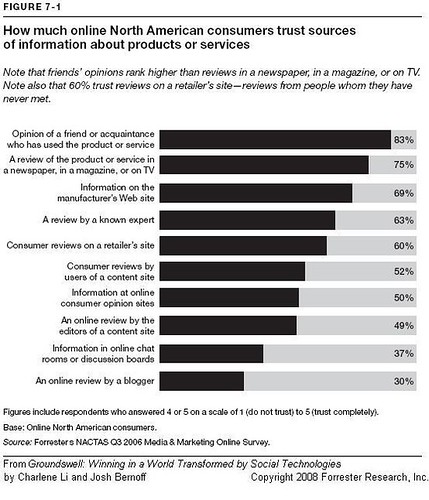
I have previously mentioned that consumers 'trust others like themselves' and the recent report from Forrester researchers Charlene Li and Josh Bernoff backs this up:


However, what both this research from Forrester and the Edelman Trust Barometer also shows, is that people don't really trust bloggers.

Jeremiah has commented on this research, but I'm also going to give my view on this.

1. These terms are not mutually exclusive

I don't know enough about how these figures are put together, but I do know that it is possible for a person to be in two categories at once. E.g.
  • An expert and a participant on a consumer information site
  • An aquantance who blogs about using the product

I think these categories would be better as weighting for different amounts of influence and by combining them you could get a better measure of the impact of an opinion about a product or brand.


2. There are missing assessment criteria
Whist the categorisation of the research conveys a lot, there are some information gaps, such as:

  • Transparency:
    Is there anything in the blog that would cause the consumer to believe it was from anyone other than who it was supposed to be? (see my previous posting on Fake blogs)
  • Sentiment:
    Are people more likely to trust a blog that has a generally positive outlook towards the brand or company rather than one that is slating it?
  • Demographic information:
    Are the Google generation more likely to trust a review by a blogger than the MTV generation?

Also...
I'd also be curious to know if there is any blog information on which of our friends opinion we trust the most and which particular market sector and products attract a greater trust. On top of this, I'd be interested to know if a multi-contributor blog was trusted more or less.

Monday, April 28, 2008

I'm officially defined as a creator

I've just taken the 'Groundswell Social Technographics Profile'.

Here are my results:


I must say, I agree with this assessment. Here's my take on the results:

Joiner:
I'm always networking and looking for ways to communicate with people

Critic:
I'm not a harsh critic, preferring to comment (and hopefully mostly positively)

Collector:
I use photo storing sites and have a del.icio.us set of bookmarks, but its not my life

Spectator:
Its nice to watch, but its usually better to participate

Inactive:
Yes, that figures.

Tuesday, April 22, 2008

The path to acceptance

I watched Shar VanBoskirk from Forrester present today at the Omniture Analytics Summit in London. Aside from giving a well-polished and highly involving presentation, she covered the subject of ‘the complex life of the online marketer’.

What was most interesting to me was the path that an online / interactive marketer needs to take in order to gain acceptance of the changing role and how it can create lasting business benefit.

Her path gave these 4 steps:

  1. Acceptance
  2. Integration
  3. Optimisation
  4. Strategic

Foremost in her presentation was the need to use a ‘central hub’ of data, for example provided by a product from a company such as Omniture (no surprise there), to provide consolidated analytics to understand what customers are doing.

Her steps were a simple but effective roadmap and covered the key tools & drivers an online marketer should use :


1. Acceptance
Companies should understand that the World is now different and customer conversation has changed from only a few years ago. Customers now talk to other customers about products without necessarily involving the companies concerned. Companies must at least engage in this dialogue. This is driven by a proper interactive programme, an understanding of the data a company already has and an understanding of Social Media


2. Integration
Having got buy-in, a marketer needs to realise the benefits from integrated programmes. Identification of the 'low hanging fruit' is key (note: at 6"6' tall, a lot of fruit for me is 'low hanging') and they need to start linking data together.
E.g. finding out who your most valuable customers are, or conducting behavioural/demographic targetting


3. Optimisation
Create customer-centric cross-channel programmes that generate financial results. You should make your work smarter and more relevant, in an effort to collaborate & streamline your efforts.


4. Strategic
This is where interactive marketing drives business success and in-turn informs the business about future direction. This is where planning & modelling comes to the fore.
Most importantly this is the Exec-level buy-in where you are affecting the company value.

She makes it all seem so easy......

Wednesday, April 9, 2008

Famous for 15 minutes

(Well, more like 15 seconds)

A great thing happened toward the end of my working day yesterday. I was on http://www.twitter.com/ and an announcement came from Jeremiah Owyang, that the Forrester Marketing Conference was being streamed from the Hyatt Regency hotel in LA. It turned out that he was in the front row of the conference with a hand-held video camera, with an accompanying chat forum running via ustream.tv

I tuned in and watched & listened, first to Forrester Researcher Harvey Manning and then, following the presentation from Brian Haven on Engagement, Jeremiah asked the forum if anyone wanted to ask a question.

A few minutes later, my question was asked by Josh Bernoff at the live event and answered by Brian Haven.

Take a look at the recorded footage:


A big "thank you" to Jeremiah for allowing me to participate in the Q&A session

Wednesday, March 19, 2008

Can companies be part of the social world?

There is some debate going on at the moment about whether companies are able to engage in social media. The crux of the issue is whether a company, in essence a body made up of a number of individuals can communicate as a single entity.

One opinion says that humans connect to humans and its not the domain of brands:
Shel Israel makes this point clearly here:
http://redcouch.typepad.com/weblog/2007/12/can-brands-be-s.html

However the alternative view is that companies need to be able to exist in the social media space and engage in dialogue and interactions with their customers/users/influencers
Forrester have been advocating this approach for almost a year now and their 'Groundswell' book and their article that covers 5 main reasons for companies to get involved:
Listening
Speaking
Energizing
Supporting
Embracing

Their more recent blog posting about this subject goes into more depths.

Where are you on the Purist - Corporatist scale?

Thursday, February 14, 2008

Here comes the recession!

"Panic, cut all budgets and definately stop spending money on that Internet thing"

In the past, the first budget in a recession to be cut was the PR & Marketing spend. That was in a time where marketing was an art form, where there were no measurable results and marketing budgets were assigned on a 'me too' basis, not ROI.

Now, companies know which half of their marketing spend is worthwhile. Lord Lever is turning in his grave and the science of marketing is established.

So why are company bosses still looking to cut these budgets?

I'm also not the only who thinks this is madness?http://www.forrester.com/Research/Document/Excerpt/0,7211,45128,00.html

Happy Valentines!