I’ve had a bit of feedback on my earlier post about Social Media Bullshit Bingo and a few people have asked me for suggestions of words they can use to play this game. So here is a list I have put together from my own experiences (plus a few from some Twitter buddies who I asked back a few weeks ago when this whole idea initially took shape).
Facebook
Twitter
Social Graph
Google+
Crowdsourcing
Transparency
Influence
Authenticity
and finally Amazeballs (thanks to http://twitter.com/bobblebardsley)
Note: This is not an exhaustive list, as I am sure you will have your own and terms will evolve as new products and services emerge or grow in prominence (for example, Google + would not have been on the list just 3 weeks ago).
However, if you think there are any blindingly obvious ones that I have missed and that other game players could benefit from them, then please feel free to add them in the comments section below
Showing posts with label transparency. Show all posts
Showing posts with label transparency. Show all posts
Tuesday, July 19, 2011


Tuesday, July 15, 2008
Brand Evangelists
Back in April I wrote about customers being Brand Evangelists. I've recieved positive feedback about this posting so I've decided to progress this subject further.
So how to you get the most from these unique individuals? How do you influence people who have no financial incentive to do what they do, just passion?
1. Understand them
What is an evangelist is and does your company have any? (You may be suprised to find out)
- Are they your target customer?
- What is it that they talk about? (and who do they tell?)
- Why do they feel they own your brand?
2. If you don't have any, roll your own
Employees can be great evangelists for your products or services and are probably doing the job already in some way. Encouraging innovation, providing the right environment for them and supporting their activities all plays a part in getting them to fly your brand flags.
One of the most impressive brand evangelists I know is Phil Mooney, the Coca-Cola archivist (basically a professional Coke collector for the last 30 years) who now has his own blog.
3. Empower them
Give them the materials and support they need.
4. Be transparent / human / accessible
One reason that some companies have a lot of evangelists is because people identify and believe in them. I am certain that there is a relationship between the number/proportion of brand evangelists and the openness of the organisation.
Note:
I'm definately not saying that just having these properties in your brand statement will give you instant unpaid advocacy. You must practice what you preach and your customers must be able to tell (you will hopefully tell when you find you have more brand evangelists)
However some companies may find this more dificult than others due to the amount of cultural shift required, however the advantages should out-weight the drawbacks.
5. Allow their input
Your evangelists won't last long in a social vacuum and like any relationship (some do have a lot of passion) they want some reciprocation of their affection. Every sports fan has their own opinions on which players are best (hence Fantasy Football/Cricket/etc.) and speak to other fans, use old media (radio call-in shows) & new media (chat forums and discussion boards) to make their points known.
Likewise every evangelist has an idea for your brand. These may anything from a better way of phrasing the content on your website, through to entirely new product ideas. This feedback is invaluable... its your decision if and how you use it.
Companies pay hundreds of thousands of £'s * to figure out how to create brand loyalty whilst ignoring their brand promoters & evangelists... why? Your evangelists are some of your best: sales people, R&D and customer services representatives. And they do it for free.
What other method of influencing customers has that ROI?
*and to keep this blog equal, lots of money in every other major currency as well
So how to you get the most from these unique individuals? How do you influence people who have no financial incentive to do what they do, just passion?
1. Understand them
What is an evangelist is and does your company have any? (You may be suprised to find out)
- Are they your target customer?
- What is it that they talk about? (and who do they tell?)
- Why do they feel they own your brand?
2. If you don't have any, roll your own
Employees can be great evangelists for your products or services and are probably doing the job already in some way. Encouraging innovation, providing the right environment for them and supporting their activities all plays a part in getting them to fly your brand flags.
One of the most impressive brand evangelists I know is Phil Mooney, the Coca-Cola archivist (basically a professional Coke collector for the last 30 years) who now has his own blog.
3. Empower them
Give them the materials and support they need.
- Content (RSS feeds, targetted news releases, etc.)
- Portable assets (image and video placed out there on available sites, e.g. Flickr, YouTube, etc.)
- Tools and toys (widgets and other stuff they can put in their blogs, sites, etc.)
4. Be transparent / human / accessible
One reason that some companies have a lot of evangelists is because people identify and believe in them. I am certain that there is a relationship between the number/proportion of brand evangelists and the openness of the organisation.
Note:
I'm definately not saying that just having these properties in your brand statement will give you instant unpaid advocacy. You must practice what you preach and your customers must be able to tell (you will hopefully tell when you find you have more brand evangelists)
However some companies may find this more dificult than others due to the amount of cultural shift required, however the advantages should out-weight the drawbacks.
5. Allow their input
Your evangelists won't last long in a social vacuum and like any relationship (some do have a lot of passion) they want some reciprocation of their affection. Every sports fan has their own opinions on which players are best (hence Fantasy Football/Cricket/etc.) and speak to other fans, use old media (radio call-in shows) & new media (chat forums and discussion boards) to make their points known.
Likewise every evangelist has an idea for your brand. These may anything from a better way of phrasing the content on your website, through to entirely new product ideas. This feedback is invaluable... its your decision if and how you use it.
Companies pay hundreds of thousands of £'s * to figure out how to create brand loyalty whilst ignoring their brand promoters & evangelists... why? Your evangelists are some of your best: sales people, R&D and customer services representatives. And they do it for free.
What other method of influencing customers has that ROI?
*and to keep this blog equal, lots of money in every other major currency as well
Wednesday, April 30, 2008
Trust and blogs
I have previously mentioned that consumers 'trust others like themselves' and the recent report from Forrester researchers Charlene Li and Josh Bernoff backs this up:

However, what both this research from Forrester and the Edelman Trust Barometer also shows, is that people don't really trust bloggers.
Jeremiah has commented on this research, but I'm also going to give my view on this.
1. These terms are not mutually exclusive
I don't know enough about how these figures are put together, but I do know that it is possible for a person to be in two categories at once. E.g.
2. There are missing assessment criteria
Whist the categorisation of the research conveys a lot, there are some information gaps, such as:
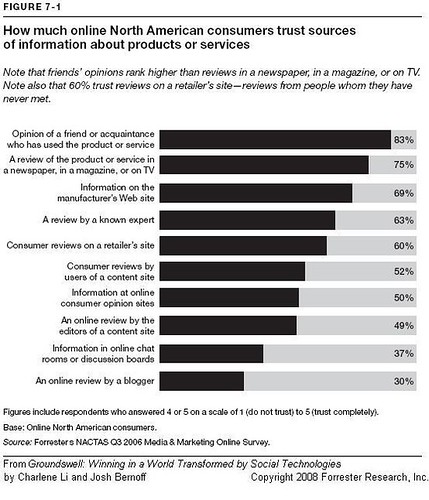
However, what both this research from Forrester and the Edelman Trust Barometer also shows, is that people don't really trust bloggers.
Jeremiah has commented on this research, but I'm also going to give my view on this.
1. These terms are not mutually exclusive
I don't know enough about how these figures are put together, but I do know that it is possible for a person to be in two categories at once. E.g.
- An expert and a participant on a consumer information site
- An aquantance who blogs about using the product
I think these categories would be better as weighting for different amounts of influence and by combining them you could get a better measure of the impact of an opinion about a product or brand.
2. There are missing assessment criteria
Whist the categorisation of the research conveys a lot, there are some information gaps, such as:
- Transparency:
Is there anything in the blog that would cause the consumer to believe it was from anyone other than who it was supposed to be? (see my previous posting on Fake blogs) - Sentiment:
Are people more likely to trust a blog that has a generally positive outlook towards the brand or company rather than one that is slating it? - Demographic information:
Are the Google generation more likely to trust a review by a blogger than the MTV generation?
Also...
I'd also be curious to know if there is any blog information on which of our friends opinion we trust the most and which particular market sector and products attract a greater trust. On top of this, I'd be interested to know if a multi-contributor blog was trusted more or less.
Subscribe to:
Posts (Atom)