Showing posts with label research. Show all posts

Monday, May 8, 2023

Time to be open about Open Data

The concept of Open Data has been around for many years (the earliest I can find is around 2000, but there may well be much earlier usage). Yet some individuals still seem to be confused by the concept.

Here is the Open Data Handbook’s definition:
"Open data is data that can be freely used, re-used and redistributed by anyone - subject only, at most, to the requirement to attribute and sharealike."
https://opendatahandbook.org/guide/en/what-is-open-data/

This clear and understood approach to data provides increased transparency, improved decision making, fosters innovation and can increase civic engagement.


But its range of use can perhaps make it difficult for people to understand what Open Data is.

Here’s some examples:

Research:
Researchers & academics can use Open Data to study impacts and changes across economies, governments and populations

Business:
Organisations can Open Data to develop new products and services, such as a map app that shows the location and availability of parking spaces

Public Sector:
Governments can use Open Data to demonstrate and improve transparency & accountability, such as by publishing data on Public Sector spending.

Individuals:
Citizens and journalists can use Open Data to hold governments & authorities accountable, such as tracking the performance of local schools.

However, in my experience some people have deliberately misunderstood the term Open Data. Why?

Open Data can lead to change, and some people may be afraid of this. They may worry that Open Data will subsequently make it more difficult for them to control information, perhaps leading to job losses. Others may have vested interests in keeping data closed. For example, businesses may not want their competitors to have access to their data, and governments may not want citizens to have access to data that could be used to hold them accountable.

Ultimately Open Data is a powerful concept. It is therefore up to all of us to ensure that we all share the same definition and push for Open Data's continued societal benefit, not just the few.

Tuesday, October 9, 2012

Has Google Plus lost the game?

In a recent piece of research, I was not surprised to see Facebook and Twitter taking up the lion's share of attention.

Using their online research tool, HighBeam (www.highbeam.com) looked into the total media attention received from the eight major social media tools / platforms in September 2012.

Although Twitter dominated with 55.84 percent of the media attention and Facebook had 40.30 percent, Google Plus received less than 1 percent of media attention. In fact it only had a meagre 0.08%, although they are keen to mention that their "Google+" search had to be performed as “Google Plus” (so results may not have contained all mentions).

However, this is yet another indication that the Google Social Network is really not getting the attention (and therefore the eyeballs) it needs, if is to compete with the big boys.

Thursday, September 23, 2010

SEO and eCommerce Merchandising

At Ideal Interface we have various clients who have eCommerce websites. Having done SEO work for them, including strategy and implementation consulting, I thought I'd post on some ways you can leverage your online trading site to benefit your company's search engine optimisation efforts.
  1. Give you products the names that people are looking for
    If you want to target search users who are looking for a "red patent shoe", then calling your product "scarlet platform brogue" isn't going to help as much.
  2. Provide decent product descriptions
    The supporting content you provide on the page will help the search engine spiders to understand your page better. Also try to include alternative words to target the long tail of search (Hint: you might want to mention "scarlet platform brogue" here, but again only if people will search for that term)
  3. Ensure your site navigation (and therefore your directory structure) includes keywords and that these are replicated in your page titles and breadcrumbs.
    E.g. footwear > shoes > smart shoes > red patent shoe
  4. Use of on-site search for keyword research
    Take a look at the terms that users type into your on-site search and you'll learn a lot about what they are looking for. Obviously these will be different to the terms that users type into the major search engines (e.g. they don't tend to search too often for your site name in on-site search, rather your brands or products) but they will be terms that real users type in expecting to find things.
    You'll also find out (if your search is clever enough) the terms that bring up no products. (Hint: this could either be highlighting a problem with the way you describe products or be an opportunity in the making).
  5. Optimise your entire site to ensure spidering and indexing by search engines
    As well as making sure every page of your site is coded to standards and that you're taking full advantage of Semantic HTML, you should use tools such as the Google Webmaster services that are freely available. 
  6. Create a dynamic sitemap.xml
    If your product catalogue is constantly changing, then I  recommend the use of a dynamic sitemap.xml file. This is a technical file that sits in the root directory of your site and tells the search engines all the indexable pages your have. A sitemap.xml file should be created each time your website product catalogue is created and will save you effort of manually updating it
Does anyone have any further suggestions?

Sunday, November 8, 2009

Online retail will be 20% of all UK sales

Despite the economy shrinking by 0.4% in the last quarter, by 5.9% overall in the last year and now with the UK officially entered its longest period of recession in 54 years, there's some good news....

According to a report from Kelkoo recently, £8.9bn will be spent online this Christmas, that's 20 pence for every £ spent!

In a report by the Centre for Retail Research on behalf of Kelkoo, online shopping is anticipated to grow by 24% on last year!

More here:
http://www.kelkoo.co.uk/co_17053-kelkoo-press-release-christmas-2009.html

Wednesday, February 11, 2009

Online retailers fail on email customer service

Figures released today from the the eDigital Research survey of 39 UK eTailers , has Play.com, Amazon and Asos claiming the top three slots this year . However many of them provide poor customer service by email.

eConsultancy goes into more detail and give specific examples of which online retailers do well (and which ones don't):
http://econsultancy.com/blog/3282-etailers-need-to-work-on-customer-service

More details are available if you download the report:
http://www.edigitalresearch.com/news/item/nid/849753604
(I'm waiting on my one right now)

Friday, January 23, 2009

Online retailers have ROI issues too

Are you a marketer who's having difficulty deciding where to spend your online budget? Or are you struggling to work out the Return on Investment for your digital campaigns?
Well, you're not alone!

‘The Eyes & Ears of Digital Marketing Survey’ done at the end of 2008 for Coremetrics examined the effectiveness of the digital marketing formulas from different European online retailers. It found that 96% of Marketers don’t Measure ROI Across All Online Marketing Activity and a third do even not know where to allocate digital marketing budget.

Despite this, a third of the respondents were expecting to add further online tactics to their marketing mix in 2009....

Thursday, October 2, 2008

The trust of strangers

Purchasing decisions are changing because of customers use of social media. As a consequence almost 40% of retailers are using social networks to reach and influence these peer-to-peer decisions.

However, lets just think about this for a second. We allow others to give us an opinion and depending upon the amount of influence they have, we trust that opinion less or more. Therefore the customers (In reality everyone, for we are all customers of some products & services) are influenced differently, but to some extent we value the input of people we don't know. It is now possible for anyone to influence anyone else.

Before you deny this, consider if you've ever read a review on Amazon before buying a product or checked on the eBay seller before bidding on their item.
On the Internet, information about past transactions may be both limited and
potentially unreliable, but it can be distributed far more systematically than
the informal gossip among friends that characterizes conventional marketplaces.
Resnick & Zeckhauser 2001

This report is interesting as it tries to explain why buyers trust unknown sellers in the "vast
electronic garage sale" known as eBay, which, although isn't a social network to the precise letter of the definition, definately creates a sense of community, feedback and trust.

So, its not suprising then that http://www.universalmccann.com/ have recently published their latest research report entitled "When did we start trusting strangers?".
Hint: Way before social media became a popular term and perhaps we may have to look back even before Mr Resnick & Mr Zeckhauser started their research.

This report identifies a trend called casual influence, showing how its incredibly easy to influence other consumers by using quick voting and recommendations. They indicate that influence and online have almost become one and the same thing, as they put it:
There are so many tools to do this that we no longer have to really think actively about influencing

Food for thought?

Thursday, September 11, 2008

Usability has a commercial impact

According to an earlier article in Internet Retailing, some three-quarters of consumers say that bad usability on a company website has put them off dealing with that orgainisation.

The principles of good website usability have been around for some while, led by people such as Jacob Neilson from his excellent site (http://www.useit.com/) and Jesse James Garrett . The simple rules are there to be followed, some of them include:
  • Try to keep you navigation options to around 7
    (There's a very good reason for this and its to do with human short-term memory capacity and other sensible stuff!)
  • Tell users what's about to happen and then make sure it happens in the way they expect
  • Build your site for the lowest common browser/device, not the latest or greatest (therefore JavaScript is there to enhance functionality, not to break the site when its not used)
I'm therefore amazed that poor website layout and design is such a problem in today's modern eCommerce world. But then I'm also suprised we still have: global poverty, no cure of the common cold and Nylon used to make shirts. As I've previously stated, you can significantly influence your users by providing a positive user experience on your website, but this is the first research I've seen in a while that says a bad User Experience negatively effects the impression that people have of that company.

Wednesday, April 30, 2008

Trust and blogs

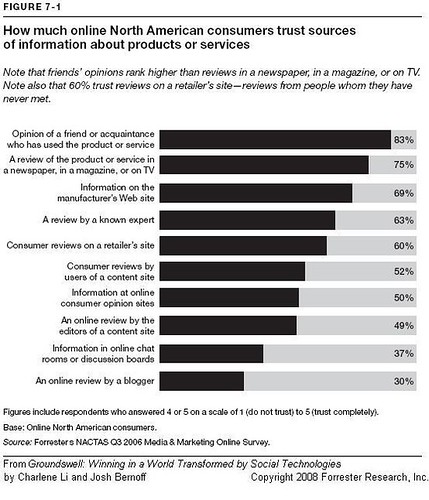
I have previously mentioned that consumers 'trust others like themselves' and the recent report from Forrester researchers Charlene Li and Josh Bernoff backs this up:


However, what both this research from Forrester and the Edelman Trust Barometer also shows, is that people don't really trust bloggers.

Jeremiah has commented on this research, but I'm also going to give my view on this.

1. These terms are not mutually exclusive

I don't know enough about how these figures are put together, but I do know that it is possible for a person to be in two categories at once. E.g.
  • An expert and a participant on a consumer information site
  • An aquantance who blogs about using the product

I think these categories would be better as weighting for different amounts of influence and by combining them you could get a better measure of the impact of an opinion about a product or brand.


2. There are missing assessment criteria
Whist the categorisation of the research conveys a lot, there are some information gaps, such as:

  • Transparency:
    Is there anything in the blog that would cause the consumer to believe it was from anyone other than who it was supposed to be? (see my previous posting on Fake blogs)
  • Sentiment:
    Are people more likely to trust a blog that has a generally positive outlook towards the brand or company rather than one that is slating it?
  • Demographic information:
    Are the Google generation more likely to trust a review by a blogger than the MTV generation?

Also...
I'd also be curious to know if there is any blog information on which of our friends opinion we trust the most and which particular market sector and products attract a greater trust. On top of this, I'd be interested to know if a multi-contributor blog was trusted more or less.