Showing posts with label trust. Show all posts

Monday, June 10, 2013

Still segmenting financial products by life stage?

Back about a decade ago I used to work for a digital agency and we had one of the UK’s largest Financial Services as our client. Life was fun and the projects were interesting, for example we developed sites for acquiring new student accounts, we created digital marketing campaigns for first-time mortgage products and we built content-rich portals for customers of added-value current accounts.

Throughout all of this, we focused on targeting prospects according to their life stage. This followed the typical life stage breakdown of:
  • Going to university (student account)
  • First job (graduate or regular current account)
  • Wedding / First house (mortgage, home insurance)
Other products, such as savings, loans and insurances were usually either seen as more opportunistic (e.g. Going on holiday? = holiday insurance or travel money) or obvious up-sells and cross-sells (e.g. Got a mortgage with us? = we think you’ll need contents insurance)

However this segmentation, aided by the banding potential customers by age (e.g. Ignore if under 17, try and grab customers aged 18 – 21, market the heck out of those who are under 50 with money) always seemed fairly rudimentary to me.

Now several years on and with more life experience under my belt, I see that these basic categories and product segments are less and less relevant. Why is this then? Well...

1. The customer is more demanding
They now require financial products based around them and not just any old thing that their existing FS company wants to tout. However most typical products offered still don’t provide the flexibility that the modern informed buyer wants (e.g. Could I find an offset mortgage when I recently went looking for one? Nope!)

2. Life has changed
Society is more diverse and multi-cultural, consumer choice has fragmented and so have the niches that went with this. Therefore the life stage someone is at is no longer as predictable an indicator of the propensity to buy a financial product as it once was. Nowadays a person of 55 and 25 could have the same requirements in cars or property (and therefore the insurances needed to cover both), just as they could also have in music, clothes and food.

3. Trust in finance by younger people has crumbled
Just in the same way as you once would have advised a smart young city-dweller to work in a bank but now wouldn’t so much (for fear of getting a slap), trust in products such as savings and pensions has been eroded... leading a lot of the millennial generation to ignore traditional financial institutions and use alternatives (from the ‘bank of mum & dad and beyond)

In short, people and their finance needs have evolved and fragmented over the last decade, with the impact that the old models used are not the new models now needed.

How they should now segment is perhaps the subject of a different post...

Wednesday, May 8, 2013

Why I want automated check ins

My wife says she trusts me. I know this because she tells me on a regular basis. She doesn't have to tell me, but it's nice to be told anyway.
However, when I asked her recently why she trusted me, I didn't get the response I expected. Instead she said "I know where you are all the time because you check in on Foursquare". After I got over the shock of her not having unmitigated faith in my activities, I began to realise what she actually meant.
You see she has now got used to seeing my digital waypoints appear at difference intervals throughout the day. Those automated announcements of my majorships appearing on Facebook are actually mini notifications that I'm out there somewhere and activity posting my whereabouts.  Or to put it another way... she has a certain amount of reassurance from knowing I'm voluntarily checking in on one of the most popular location - based online service.
However I can see a time where I'm going to stop using Foursquare.  I'm actually tiring of it a little and am not getting the rewards from using it I want. Why? Well the gamification seems to be getting poorer (for example I don't seem to get many badges for constantly visiting places) and I have such a geographical spread of friends that I'm getting notifications from as far afield as London, Sau Paulo and Somerset.
But if Foursquare automated their service, I would still keep using it. In fact, I'd turn it on, leave it on and have it poll my location on a regular basis. I'd still use it's user generated comments feature to find out useful stuff and still check to see who else is nearby. But importantly Mrs S would get more regular reassurances that I'm alive and on the go.
Or to put it more bluntly.... if I turned automatic notifications off, I could understand why she mighy trust a little less.

Thursday, March 3, 2011

How can I build trust in my ecommerce site?


In this clip I explain the ways you can build trust on your website and make customers more confident about purchasing from your ecommerce website.

In short its all about content and imagery to reassure users, plus adequate security.

Wednesday, September 1, 2010

Multi-channel dialogue - is your organisation ready?

I've already mentioned how the increased complexity caused by a number of communication channels can create disjointed or even contradictory messaging.

Nevertheless customers still want to trust companies they buy from, despite an erosion of that trust (particularly financial institutions) over the last few years. And (surprisingly) many would still like to build a lasting relationship with those companies.

But this can no longer be done just using one channel of communication (such as the phone or email), there's the need for a more innovative & creative approach to gaining customer trust and enhancing the customer experience at the same time.

A dialogue with the customer has always been a very successful method of building customer loyalty and now newer digital methods such as Social Media are available to engage customers in consistent and continuous dialogues across a number of channels.

But not all organizations are ready for this level of constant communication, despite its obvious way of creating differentiation in today’s market. Is yours?

Wednesday, April 21, 2010

Edelman Trust Barometer 2010

I have realised that I've had this video introduction to the 2010 Edelman Trust Barometer unpublished for a while and hadn't put it live:

The following have all dropped in their trust ratings as sources of credible information: radio, TV and newspapers (probably because of reduced staffing & quality, but also an increase in social media and other digital sources). However, surprisingly to me, is that trust in ‘friends like myself’ has dropped substantially as a credible source of information.

Wednesday, June 3, 2009

Media trust, why newspapers are still worthy

Something that may suprise a few of you... newspapers are still a trusted source of information

The recent eMarketer survey on media trust (http://www.emarketer.com/Article.aspx?R=1007067) found that a surprisingly high number of people trust the news. But the more suprising finding is that online news scores higher than traditional newspapers in a lot of countries including us here in the UK!
The survey found that online news is trusted in the UK by 40% of those asked, compared with 23% trusting their paper.

Is this a false trust in modern digital news or a cynical perspective of our current celebrity & scandal - filled broadsheets & tabloids?

Friday, May 1, 2009

The Customer is now Social

Hasn't you customer grown up? Haven't they learnt to ask each other for opinion and to trust each other?

Yup!

Never before have people started trusting each other and I'll once-again refer to the Universal Mccanns study on' When did we start trusting strangers?'
And as customers get more social, they need new ways of interacting with companies.
So, just like CRM, that gave companies a segmented view of their customer-base, VRM (Vendor Relationship Management) allows customers the tools for engaging with vendors.

Could companies be realising that their customers' view of them is not the same as their own? Surely not?

Tuesday, October 7, 2008

Trust in different media

When yet another survey is released that states normal people distrust what newspapers say, the same newspapers go on the defensive? Therefore its therefore hardly unsurprising that when a study shows a small variance in these pessemistic figures (e.g. a small rise back in favour of newspapers), the newspapers make a bit of a song and dance about it?
http://www.guardian.co.uk/media/greenslade/2008/sep/12/uk1

However, neither Roy Greenslade nor the report writer Claire O'Sullivan from the research company Metrica, can offer no explaination or even an hypothesis for this upward trend.

:-(

Wednesday, April 30, 2008

Trust and blogs

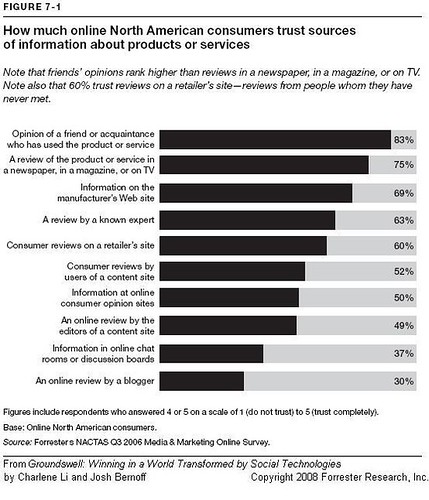
I have previously mentioned that consumers 'trust others like themselves' and the recent report from Forrester researchers Charlene Li and Josh Bernoff backs this up:


However, what both this research from Forrester and the Edelman Trust Barometer also shows, is that people don't really trust bloggers.

Jeremiah has commented on this research, but I'm also going to give my view on this.

1. These terms are not mutually exclusive

I don't know enough about how these figures are put together, but I do know that it is possible for a person to be in two categories at once. E.g.
  • An expert and a participant on a consumer information site
  • An aquantance who blogs about using the product

I think these categories would be better as weighting for different amounts of influence and by combining them you could get a better measure of the impact of an opinion about a product or brand.


2. There are missing assessment criteria
Whist the categorisation of the research conveys a lot, there are some information gaps, such as:

  • Transparency:
    Is there anything in the blog that would cause the consumer to believe it was from anyone other than who it was supposed to be? (see my previous posting on Fake blogs)
  • Sentiment:
    Are people more likely to trust a blog that has a generally positive outlook towards the brand or company rather than one that is slating it?
  • Demographic information:
    Are the Google generation more likely to trust a review by a blogger than the MTV generation?

Also...
I'd also be curious to know if there is any blog information on which of our friends opinion we trust the most and which particular market sector and products attract a greater trust. On top of this, I'd be interested to know if a multi-contributor blog was trusted more or less.

Wednesday, April 9, 2008

More on the Edelman Trust Barometer 2008

A copy of Edelman's Trust Barometer 2008 presentation has been posted online:

I agree with him that the findings are slightly confusing as to whether online sources are truly trusted or not, but that key online influencers are definately creating a growing trust.

Of particular interest are his key points:
  • Use top-down and peer-to-peer tactics in your communications strategies

  • Engage via word of mouth with influencers

  • Companies can become leaders by building their reputations and encouraging conversation.

I would also encourage companies to plan your approach beforehand, start measuring the influence of social media and then try to categorise them so that you can hopefully have a better dialogue with them.

Tuesday, April 8, 2008

Social Media, Shopping and Trust

So who do customers actually trust these days?

Well according the “Trust Barometer”* for 2008 from Edelman, the world's largest independent PR firm, consumers feel the most credible source for information about a company is a....

.... “person like themselves.”

*Is this a box with two doors, out of which comes either a little man with a stick or a lady holding a carrot?

Theoretically we should then also should assume that the trust for a company carries over into product/brand trust and hopefully sales.

Of particular interest over the last 2 years is:

In 2007 businesses were more trusted than Governments, with the UK population having the lowest trust in Government (and in media companies).

In 2008 young opinion elites have higher general levels of trust than their older counterparts. They also apparently rely on multiple sources of information to form opinions of companies.

According to Jeff Grau, Senior Analyst at eMarketer:
“While blogs and customer ratings and reviews have long been a familiar
part of the Internet commercial landscape, over the past two years social
shopping sites have emerged as another way for customers to share product
experiences and opinions.”
“The sites typically provide tools for users to download photos of
interesting products found on retail Web sites to their profile page or blog.
Users then share and discuss their findings with the community,”

His article also goes into more detail about the social aspects of shopping, particularly the users need to feel part of a community and their recognition from peers.