Following yesterday's blog posting on why new websites might intially have poor conversion rates , here's my further thoughts on why your shiny new eCommerce site might not be converting as you'd hoped...
Your site isn’t optimised for eCommerce
Yes, that’s right, your new site may have a new funky way of taking visitors through to purchase or whatever, but that doesn’t mean that it’s the optimal way. By looking at your analytics packages you’ll have to hypothesise why users are leaving the process when they should be converting. You’ll then have to change things in a systematic way to see what makes an improvement (and what has a negative effect). This is called A/B (where you swap 2 things to observe the impact) and multivariate testing (where you change a number of things) in the eCommerce industry. You may well find that the right supporting content or imagery provides the necessary reassurance to sufficiently encourage more people to do online business with you.
You’re losing visitors from search engines
Oh, did nobody inform you that having a different site structure and page naming convention could affect your search engine traffic? Well I’m sorry to inform you that all those pages of your old site that were indexed by the popular search engines aren’t going to help you if they don’t exist anymore. You’re going to have to speak with your search engine optimisation (SEO) agency before you move to the new site and make sure you’re doing all you can to minimise the impact of the new site.
Note:
They will suggest things such as ‘301 redirects’ and other such clever stuff. You really should take this advice (especially if you’ve moved to/from using ‘WWW’ at the beginning of your URL structure).
In a nutshell..
Getting a new site is just the beginning. You now have a new task ahead of you, to quickly make the most of what you have had built and to eventually surpass those conversion stats you gave the boss.
Tuesday, June 21, 2011


Monday, June 20, 2011
Why your new website doesn’t have the Conversion Rate you planned
So, you spent a small fortune getting that new transactional website designed and developed by a leading agency. You told the boss that with an improved ‘user experience’ you would have a higher number of online purchases than with the old site you currently have (perhaps even giving a new and higher percentage figure of just how many conversions you would achieve) …. and you have just launched it.
So why has the number of conversions you predicted not happened? Why, when you take a look at your analytics dashboard, have those ‘look to book’ ratios not shot up as you predicted?
Well here’s something that your web agency may not have told you, when you set out your expectations at the beginning of the project….. Conversion rates don’t usually start off as high as you planned for a new site.
But why?
Existing users now get a different experience
According to user experience best-practice you should have a site that relies far more on ’recognition’ rather than ‘recollection’…. but the fact is that for a lot of sites, a certain proportion of regular users know their way around.
For example, if you consistently use one online banking site, do you find you start to move the mouse to the part of the screen where the ‘login’ section is, even before the page has fully loaded? I do!
For these regular users, this new site will be a disconnect with what they are used to and some may even think they are on the wrong site. All this confusion makes them think and this is the opposite of what you need!
More tomorrow, as its getting late.....
Friday, June 17, 2011
An online fashion content strategy
If you're in the online world of fashion (and these days if you're not online you're not very fashionable) then you may be struggling for ideas to generate content for your website and off-site SEO & Social Media campaigns.
This handy presentation from http://twitter.com/tamarstar should give you a few pointers on where to start
This handy presentation from http://twitter.com/tamarstar should give you a few pointers on where to start
Thursday, June 16, 2011
Average conversion rates - important differentiation points
I have a new article published in the http://directorsof.com website, this time on website conversion. The article centres around the key fact that there is anything but an average conversions rate for an eCommerce site and that different traffic from different sources converts differently too.
I think its important for transactional site to understand one principle.... all traffic is not equal and there is significant differentiation between conversion rates (and average order values too) depending upon the source of the traffic and other factors, such as the keywords they type into search engines.
In the real world this is perhaps easier to spot. For example: a car dealer may realise that a smartly-dressed person, pulling up in a 3 year old vehicle of the same make is more likely to buy a replacement one than someone being dropped-off by a bus or by the way they dress... even perhaps in the words they use when initially asking for a test drive.
And the same thing applies online, you just have to know what those things are and set out your site accordingly.
Here's the article in full:
http://directorsof.com/ecommerce/experts/06/16/are-you-measuring-the-right-conversion-rate-asks-hayden-sutherland/
Please let me know what you think of it.
Tuesday, June 14, 2011
Retail website homepage weights – why are they so bloated?
I have been working on client eCommerce sites recently and noticed that some competitive ones were very slow to download. Assuming my Internet connection was the problem I looked to stop any other online services that might be running (e.g. Skype, downloads, etc.)… Only to find I didn’t have anything else downloading.
So I loaded-up Firebug (a brilliant and free debugging tool that plugs into Firefox) and checked the size of the homepages I was looking at.
Here’s what I found:
Site: http://www.johnlewis.com/
Total file size: 573k
Onload time*: 7.55s
Site: http://www.marksandspencer.com/
Total file size: 1.5Mb
Onload time*: 13.63s
Site: http://www.hsamuel.co.uk/
Total file size: 1.3Mb
Onload time*: 16.28s
Site: http://www.debenhams.com/
Total file size: 1.1Mb
Onload time*: 8.16s
Site: http://www.goldsmiths.co.uk/
Total file size: 1.1Mb
Onload time*: 7.44s
Site: http://www.bhs.co.uk/
Total file size: 720kb
Onload time*: 7.39s
Site: http://www.morrisons.co.uk/
Total file size: 1.1Mb
Onload time*: 7.22s
Site: http://asda.co.uk/
Total file size: 866k
Onload time*: 9.33s
Note: This isn’t an exactly scientific test, being conducted once on a PC with network traffic. But even as indicators of total file size and download time, they do start to paint a pretty interesting picture.
However these figures pale into mere insignificance when compared with the weight of the George Style Blog http://georgestyle.george.com/ set up to accompany their support of Graduate Fashion Week. This homepage tops the scales at a whopping 2.8Mb (or to put it another way, not just one but two entire old HD floppy drives from the past!).
You really have to ask why this sort of bloated homepage shenanigans is still going on in this age of web page optimisation…. and whether any of these UK retailers are aware that an increase in page delivery speed can significantly improve conversion.
*Onload time is approximately the time taken for the page to start to display. Other elements are still downloading and the entire page might take much longer to fully render.
Monday, June 13, 2011
Content Farms and SEO – part 2
This is a follow-up posting to my earlier one on Content Farms*
What are search engines doing about content farms?
Search engines fully understand that visitors will only use them if they can provide highly relevant search results. In fact Google has recently very publicly stated its aim to crack down on content farms (and therefore by consequence retain market share of the lucrative search advertising market). One approach has been in the releasing of a ‘plug in’ to its Chrome browser; this creates a personal ‘blocklist’ that gives users the ability to block certain sites from Google’s search results (but only for that person using their browser).
Other initiatives include a number of changes to the Google search algorithm that noticeably improves the quality of search results. The recent 'Panda' update by Google in April was one such change that was inteded to down-grade the visibility of more obvious content farm sites.
It is also my belief that the Google +1 button I covered in an earlier post is an aim to combat sites such as content farms. But rather than using the negative technique of blocking those that it thinks are less relevant to the search user, it is now encouraging users to reward the more relevant pages and sites.
Isn’t there a fine line between some content sites and content farms?
Oh yes indeed, in fact there is considerable overlap and it is becoming increasingly hard for the search engines such as Bing and Google to tell them apart. For example, news sites such as those from the popular newspapers (obviously except those behind a pay wall) are increasingly aware that they need to encourage search traffic. In fact the Washington Post earlier this year was caught with a posting on its website stating “SEO headline here”, obviously highlighting where some reporter had failed to add the keyword-focused headline to the article before it was published online.

Cases such as this show that even the big boys are trying to capture search traffic in anyway legitimate way they can… but in doing so are further blurring the line between news source and content farms.
So how do I stop my site being recognised as a content farm?
In a reversal of my earlier post on creating a content farm, the most important advice I give on this topic is to write for your visitors not for the search terms…quality content will be well read, forwarded and linked to. Search engine algorithms are increasingly able to cleverly tell which sites are official and which sites are created just for the purpose of targeting them… and in the end it is in everyone’s interest to ensure that we get quality search results.
In a nutshell, content quality is not something you should forget when writing for your website, especially if you produce a lot of it!
*this article was not written just because I was getting a lot of keyword-related traffic on this subject from search engines, honest!
Friday, June 10, 2011
Content Farms and SEO – what you need to know
What is a content farm?
A website (such as a blog) containing content that is run with the aim of appealing to search engines.
Why would someone create a content farm?
Search engines are a fast and easy way of finding information about all sorts of topics. If you can create content that people search for then you will get traffic to your site. You can then monetise this traffic in a number of ways, such as selling advertising or sending visitors to an eCommerce site for a commission (known as affiliate selling).
How do you create a content farm?
The main rule is you don’t write for your reader, you write for the terms your visitor is looking for and you ‘fill in the gaps’ with content.
I’m sure you have been to sites that read appallingly badly except they contain a lot of the search terms you type in to find the page…. You know the ones; it’s almost as if someone doesn’t actually care about what they have written except to stuff keywords into a posting. If you recognise this sort of site, its a good bet that you’ve visited a content farm..
But isn’t this what SEO people do anyway?
Well, sort of… but not really. A good Search Engine Optimisation professional will advise you to write content for your site around the topics and keywords that you want people to find in the search engines. They may get into more detail and ask you to write a list of the more popular terms you want to target…. and advise you to mention these on a regular (but not too often basis). They shouldn’t advise you to create page-upon-page of meaningless and keyword-packed content purely to target search traffic.
Thursday, June 9, 2011
The PR digital sweet spot
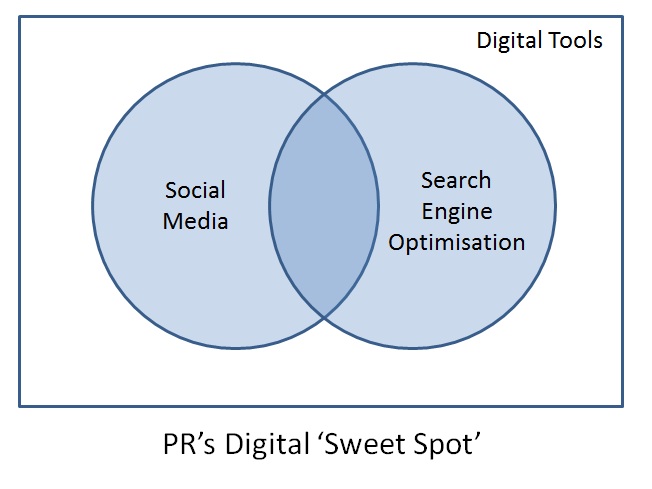
In my post recently, I blogged about the intersection of Social Media and Search Engine Optimisation. This is a place I called the "PR digital sweet spot" and it’s the place where the modern PR practitioner needs to work and think.
 As I've previously explained, there are a number of digital tools available to the modern PR agency. The more I talk with clients and prospects, more I believe that the two essential tools of the modern PR trade are
Social Media and Search Engine Optimisation.
However it is the combination of these two that creates an extremely potent mix that has a two-fold benefit...
Social Media and Search Engine Optimisation.
However it is the combination of these two that creates an extremely potent mix that has a two-fold benefit...
- Search Engines are the place where people look for instant answers, or at least for clues to to the questions they have.
- Social Media is the online place where they engage with their friends, colleagues and confidants
Tuesday, June 7, 2011
So Is Google +1 going to work? History tells us it might not
Now, I’m a fairly obvious ‘power user’ of Google (as I run a digital consultancy that has an online marketing & SEO division) and have my Google Profile all set up and current… in fact I think I have a couple…. a personal Google account and an Ideal Interface one. So I’m not really your typical user out here, e.g. the person who may not have done this and may even know what a Google Profile is. So I therefore question the usefulness of this function and actually wonder how popular the +1 feature will be.
Hopefully this foray into Social Media for Google isn't as half-hearted as their earlier attempts.
1. Google Buzz hasn't really gained traction in a market already use to Twitter (perhaps because people were upset by its stealth launch into their Google Mail account rather than being something they requested)
2. Google Wave was touted as the successor to email, but turned out to unusable by many as a collaborative place to work and produce rich documents (however, that's not to say that it will have its day eventually, perhaps when people are more used to working in that way).
Only last week the ex-CEO Eric Schmidt accepted that he’d missed out on "the friend thing"…. which is not only a complete simplification of how social networks, it also gives us some idea of just how the search great generally views social media – e.g. it’s a thing to do, rather than a way to connect and even add value to search results.
Put simply, I’m not convinced that Google still gets Social Media and sharing completely. If you want an example of just how little the Google +1 feature is integrated into the rest of the Google product set, consider how useful it would have been to have added a “+1” button into Google’s blogging platform (Blogspot) and how beneficial this would have been to the legions of bloggers who are so dependent on referrals from any source….. That’s really not something Facebook would have missed and perhaps why they lead the social media league table.
Monday, June 6, 2011
Google gets social sharing eventually
Google has now launched the +1 button, which is basically a way for your visitors to easily recommend your site within the search engine. By adding a +1 button to your site (you’ll probably need you site developer’s help in doing this) you are adding Google’s equivalent of a Facebook ‘Like’ to the page. This allows people viewing Google’s search results to see which links their friends positively rate and therefore add more relevance to the results. In other words… someone is more likely to visit a site found in Google if one of their contacts also thinks it’s a good link.
However, there are a couple of caveats to consider:
Whether this also means a +1 has an effect upon your site’s ranking in Google for everyone or just those who have linked contacts and are logged in remains to be seen.
However, there are a couple of caveats to consider:
- This functionality is currently reserved just for the main Google.com site, with other local versions due to get theirs subsequently
- You need a Google Profile set-up and be logged into Google while you browse
Whether this also means a +1 has an effect upon your site’s ranking in Google for everyone or just those who have linked contacts and are logged in remains to be seen.
Sunday, June 5, 2011
Why buttons are helping sites
You will have seen social media sharing buttons crop up all over the web recently, with sites only too keen to encourage you to click, share and show your appreciation.
This is happening more and more, but why has everyone gone button mad?
As I see it… for one key reason… Share-ability (or in other words the pull & push of social media)
Buttons are now a very useful way to encourage visitors to share their content. When once it was all about content.... “content is King” we used to cry. Content is what search engines love and these same search engines are what get you traffic & recognition.... and therefore attention & advertising space or sales.
But now it is all about content sharing, your site content is far more valuable if it is read, shared and then re-read by others. There’s still the reassuring need to make money from content… but if you can use the power of social media platforms to share this content to a wider audience (whilst still retaining your revenue from all these disparate channels) then you are clearly onto a good thing.
Your site has to work as hard a possible. By providing buttons and the means to share this content beyond your current readership, you are using social platforms & their users as a means of free syndication.
Friday, June 3, 2011
Button mania
There have been two developments in the social media sphere over the last few days you might be considering if you need to grow your site traffic or your online reputation.
Both are similar pieces of functionality launched by Google & Twitter that you embed within your site and they mean bigger things for these two giants of the web (that I will explain in a series of small subsequent posts). But let’s be honest about what they are…. Buttons.
Everywhere you go on the web now, there they are….. buttons requesting you ‘Like’ the site, ‘Tweet’ and tell your personal or business contacts how much you like something, or further buttons to post this & that to a wall, blog post or some other social network.
Yup…. The pinnacle of web savvi-ness (if there is such a concept or word) is to have a site with a bunch of different buttons that look like virtual medals adorned across it. In fact, someone I know recently said that sites with all their buttons on are beginning to look like the side of war planes with their ‘kills’ stencilled heroically on their flank. (If you don’t believe me, just take a look at sites like The Huffington Post, where each article has an entire section on the page devoted to their social trophies).
As a concept you could even ask ”So where does it end?”. Perhaps you could get to a point where there are more buttons on a page than content. In some ‘Kenny Everett’ type comedy extreme, you would end up having a site where the numerous buttons scroll off the page, like unending medals given to an over-rewarded highly-decorated soldier.
Thank heavens for features like addthis.com which aggregate social sharing bookmarks into a single button.
Tuesday, May 31, 2011
Has Google cracked mobile commerce?
Last week at a public launch Stephanie Tilenius, Google commerce and payments vice president stated
Google Wallet has been developed to work with MasterCard's PayPass network, which is already working in 124,000 PayPass-enabled stores across America. The trials of the technology have already started in New York and San Francisco, but as yet there's no word on if and when this service is to be rolled-out in the UK.
However, the technology and partners are available in the UK for Google to use when it wants.... We already have NFC phones available, such as Google's Nexus S and some versions of the Samsung Galaxy S II and BlackBerry Bold. Plus.... Orange and Barclaycard coincidentally launched their NFC payment service last week.
All indications are that this is finally the mobile payment service we've been waiting for and finally sees the convergence of an electronic payment and the one device we always keep with us.... our mobile phone.
“Today, we’ve joined with leaders in the industry to build the next generation of mobile commerce”Available to (US only) customers from this Summer is a new feature from Google and its partners (Citi, MasterCard, First Data and Sprint).... the Google Wallet, a new way of turning a smartphone into a smart way of paying for things. Wallet uses Near Field Communication (NFC) to make secure and fast payments conveniently by just tapping the phone on a terminal near to the checkout or payment area.
Google Wallet has been developed to work with MasterCard's PayPass network, which is already working in 124,000 PayPass-enabled stores across America. The trials of the technology have already started in New York and San Francisco, but as yet there's no word on if and when this service is to be rolled-out in the UK.
However, the technology and partners are available in the UK for Google to use when it wants.... We already have NFC phones available, such as Google's Nexus S and some versions of the Samsung Galaxy S II and BlackBerry Bold. Plus.... Orange and Barclaycard coincidentally launched their NFC payment service last week.
All indications are that this is finally the mobile payment service we've been waiting for and finally sees the convergence of an electronic payment and the one device we always keep with us.... our mobile phone.
Saturday, May 28, 2011
Common eCommerce questions I've been asked
The other day I quickly posted that I was mentioned as one of seven UK eCommerce consultants to know in the UK by directorsof.com .... So I took time out this evening to consider what it actually means to be an eCommerce consultant and I’ve put together a few questions and answers based on things I’ve been asked in the past:
1. It’s all about technology isn’t it?
No. Sure without the technology you wouldn’t have the platform to transact online (e.g. the web), but don’t be fooled into thinking that the IT part of it is the most critical part.
2. So what is about then?
It is all about selling to the customer and making money. The 4 P’s of retail still apply when selling online: Product, Price, Placement and Promotion…
3. Why are some retailers in the same market so good at it compared to others?
This is a more tricky one to explain, but simply put… they have the right support (management) & culture (drive, learning, etc.), plus have made some great choices in hiring the right staff and picked the best tools & techniques to use along the way.
4. What’s the biggest mistake online retailers make?
I was recently at a presentation by Paul Coby, the CIO of John Lewis. His quote of “if you outsource your brain, you outsource your wallet” really struck a chord with me. It reminded me of the times when I’ve seen clients depend too much on the advice of external consultants or agencies and not have even a decent understanding of what they are buying and implementing. This is so very relevant in the fast-changing world of eCommerce, where its incredibly easy to buy the latest and greatest in the race to stay ahead of the competition.
Tuesday, May 24, 2011
Being recognised as an eCommerce Consultant
Today I was really chuffed to be mentioned on the directorsof.com website as one of “Seven E-Commerce Consultants you need to know”.
This is a pretty big accolade to have in the UK online commerce and multi-channel retailing industry.
This is a pretty big accolade to have in the UK online commerce and multi-channel retailing industry.
Monday, May 23, 2011
Social Media and Solicitors
How much more proof does anyone need about the power of Social Media? It has an ability to fuel rebellions, topple governments and now revoke superinjunctions handed down by UK judges.
What is not a surprise is that out-of-touch Judges can try to suppress any form of media, old or new. However, what is far more of a shock is the obvious lack of insight about such matters that was displayed by specialist legal company Schillings, the company that recommend that Ryan Giggs chase after Twitter this week. They advised the philandering father to go after the Californian-based social networking site to find out the details of those who posted information about the footballer’s “off the ball” antics.
Are they not aware of the so-called Streisand effect; where those who attempt to hide or remove items online about themselves only make matters worse?
Sunday, May 22, 2011
Why PR needs to understand search and social media
Communications Convergence, a big term used by a few knowledgeable people to describe the gradual merging of the different roles done by communications professionals. As you will have seem from previous postings, I believe that the old roles of marketing and public relations are now so closely intertwined that they have become indistinguishable from each other. Awareness, interest, desire and action via digital channels are all now all part of a continuing path of online customer acquisition that defies traditional communication job roles.
Typically it has been the marketer (or marketeer, if you wish) that has been the more aggressive/assertive in online promotion areas… possibly fuelled by hard sales targets or other drivers. They were also the early adopters of social media... but as soon as consumers started asking questions back it became a problem for them.
But with existing of expertise of bringing together messages and audience (as well as being used to answering those difficult questions) PR and communications professionals are in just the right place to understand and utilise the new tools & methods of customer engagement and brand messaging…. that of online search and the social web
Ok, it is not a particularly revolutionary thing to say, but its fairly obvious that an understanding is needed of how search engines use content (notice I didn’t say “how search engines work”) and how to leverage the way that people connect with each other as well as brands & organisations. What is perhaps more challenging to those who have already got their heads around the previous two online tools, is the fact that search and social aren’t actually distinct functions, but two sides of the same arch that meet over the head of the PR pro sat underneath.
In my view the intersection of where Social Media and Search Engine Optimisation meet is the PR digital sweet spot. It’s this point that’s the true online communication convergence point. It is here that news meets searcher and where potential customer meets a shared audience with the same voice. It is therefore this point that the PR person must understand, adopt and learn to wield with all the effort and rigour that they have previously applied to their traditional role.
Friday, May 20, 2011
Integrating Facebook into my blog (correctly)
The keen-eyed amongst you (who read this blog via the original website, not one of the syndicated places or on an RSS reader) will see that I have an updated "Tell your Facebook friends" area on the right side of each page.
Previously for about a year this held a very similar function that let you "like" my content (but to be honest, most of you won't have noticed the difference). The main aim was that when you clicked on the thumb icon it would link to your Facebook account, with the secondary aim that this blog could eventually build up more than 25 followers... so I could claim a 'Facebook vanity URL'.
Why? Well, because this was the first time I had done something like this, integrating my public self with my private self in the popular social network that I share with my friends. It was more a "let's try it and see", rather than "let's try it and build followers".
However, there was one rather large problem. It didn't work.
Yup, for some reason when users clicked on the old link, it instantly told them they "liked" this blog, but that was it. It didn't register them as a follower within the Facebook page I had set up and it most definitely didn't display any blog postings into the page.
But that has now been corrected. I have not-only changed the code behind this button to correctly register any interest from my loyal or passing readers....but also any posting that I submit to this blog now automatically gets fed into the Facebook of those who expressed their interest (So if you do want to show your appreciation of the regular content I put here, please be aware that you will also get it piped into your Facebook account as well!).
The downside is that I have not retained the goodwill of those who previously liked this blog... so I now have to build up these numbers again from scratch.
Tuesday, May 17, 2011
Website traffic decline, the Facebook effect?
Webtrends (now calling itself a 'Social analytics company', so perhaps it is trying to measure all the social media "gurus" out there) has released a fascinating study which reveals that an astounding 68% of Fortune 100 companies are experiencing a significant decline in their website traffic.
Yup, that's right.... at a time when the web has evolved to become the communication, transactional and engagement medium we all hoped it would be, visitors are now less interested in checking out corporate websites than they have been.
Over the same period Facebook sign-ups and traffic has increased (in the UK it grew from 24milion to 30 million users from July 2010 to the beginning of 2011). A coincidence? Unlikely. Especilly when brands are now using their Facebook vanity URL's more, rather than use their own website adresses.
Monday, May 16, 2011
Advanced SEO : Using canonical references
What is Canonicalization?
The process of picking a single site URL to be indexed by the search engines from a range of URL’s. This happens when there are duplicate versions of the same/similar content on one site. Think of it as a way of suggesting the ‘true’ URL for your page(s) to the search engines
Why would I have multiple versions of the same content?
This usually occurs when you have dynamic content delivered from a database or there is more than one URL for a single page (typically the homepage, but not necessarily).
An example of this is an ecommerce site that enables users to get the same or very similar results from different actions.
E.g. If you have the URL of a product catalogue listing page built up from a series queries or filters.
The search engines understand this stuff?
Yes, they more than understand it they use it as a signal for search engine optimization. Since early 2009 Google, Yahoo and Microsoft have all stated they support this way for website owners to say “hey search engines, all these pages may have different URL’s but they are actually the same”.
What is the issue with duplicate content?
Search engines think that everyone is trying to game them and submit duplicate content to push themselves up the organic rankings. Without this, when a search engine finds duplicate content, it won’t now if you have done this accidentally or on. This means that they may well display the URL you don’t want to display, miss pages you want to get index or even worse downgrade the value of the page(s) they find… affecting the rankings and potentially the entire optimization of your site.
So how do I do this on my site?
If you read articles about this on the web, you would think that it is as simple as embedding a link in the header of your HTML pages (See: http://en.wikipedia.org/wiki/Canonical_meta_tag )
In theory this tells search engines the preferred location of the page to index (the “canonical” location) instead of the one it has found.
In practice it is more complex to create and maintain a working Canonical structure within an eCommerce site, especially one that has an evolving product catalogue.
Subscribe to:
Posts (Atom)