Let’s imagine a situation that is becoming a pretty regular occurrence these days…
You have been given the go-ahead for developing (or re-developing) your company’s online store or multi-channel retail proposition. As the ‘business stakeholder’ you are far too busy running day-to-day operations (or fighting fires) and do not have the bandwidth to deliver this work yourself. You have a ‘sizeable’ budget to implement the right solution without cutting any major corners, but you have to have it live within pretty tight deadlines and it must be ‘right first time’
(Question: Does anyone get told “oh, its ok if you screw it up this time around, you’ll have plenty more chances to get it right in the future except politicians?”).
There are a number of things you can initially do to get things on their way, but here’s why I suggest you look at getting an eCommerce Project Manager in first.
1. Market knowledge
Unless you have recent prior experience of the eCommerce landscape (e.g. the vendors, products, prices and all their associated short-comings) then you are stepping into a virtual swamp, where three letter acronyms (TLA’s) abound and the initially-offered price of some web services could be overpriced from anything between 20% and 300% … or beyond.
Someone who has managed a project similar to the solution you are looking for should have some idea of the available services and be able to hold your hand through the early stages of the project.
2. You don’t always have the right person internally
It is an obvious statement to make, but to stand the best chance of having a well-managed project you need a project manager with the relevant experience. If you do not already have someone within your organisation that can correctly fill the eCommerce PM’s role then you really need to look outside. I’ve seen all sorts of people in the past drafted into the role who were clearly not able to run the online project. Examples include: a graphic designer who was friends with the chief executive’s wife, an IT manager who clearly had other important things on her mind (like running the IT department) and a member of the ecommerce team who “didn’t have anything else to do”. In each case project either failed to deliver completely or had to be rescued by stakeholders and/or external assistance.
3. If you don’t…. it will be you that gets asked to deliver it…
In essence….. If you really want an eCommerce project run well and do not want to be given the run-around by the project, then you need the right person to manage it.
Wednesday, August 17, 2011


Friday, August 12, 2011
10 things to consider when building a new website
We often get asked to provide best-practice advice to clients about their websites and I felt it was best to put this information in the public domain.
- Before you start – Take time to understand the purpose of your site and who your users are
- Build on good foundations – Get the site map and user journey right and the structure and navigation will become apparent
- Content Is King - What is the message and is it conveyed correctly? Without engaging content people will leave and not return
- Present the content in a coherent way – Web pages are often structured to be a familiar UI to the user, allowing them to instinctively know how to use and navigate to the content they want to find. Presentation and navigation needs to be clear engaging and guiding in a way that represents brand values correctly online.
- A site is for life - Content is key to engagement but be sure there are people and processes in-place to keep it up to date
- Compatibility – There is a growing number of browsers and devices in the market today, so check your site has cross-platform compatibility from desktop to mobile.
- Don't Exclude – Ensure every visitor can use the site. Accessibility is increasingly more important with new legislation being written and passed all the time.
- Standards should be followed. Wherever possible:
a. Use text and not images (able to be read by screen readers). This also helps with SEO as search engines can search all the text on the page.
b. Use web-safe fonts (or approved webfont rendering techniques)
c. Make navigation and links accessed via the keyboard
d. Make images and headings are appropriate to the content and use correct alternative text.
e. Test, test and test again. - Less is more – A simple interface can say a thousand words, by minimising visual clutter a message and key points can be strengthened. Good use of whitespace to ensure the areas of the page are clearly set out and uncluttered.
- Engagement – The web is becoming a more social arena having the ability to contribute, share and interact with the site will help to develop a community and a reason for return visits.
Note: Special thanks to Ben Kilby for initially putting this list together
Wednesday, August 10, 2011
Don't blame social media for unrest
I live in Ealing in West London, where some of the riots took place the other night. I spent a lot of time listening to police sirens & helicopters overhead and throughout the disturbances I followed the news online (via the BBC) and on Twitter & Facebook.
In the last few days a lot of things have been cited as the cause of these riots, however one constant theme mentioned by Newspapers, TV & Radio channels is that "Social Media is allowing people to riot".
Quite frankly, this topic is a pathetic attempt to create headlines that are nonsense. Riots have existed before social media, and before TV and other channels. Note: I've yet to check if there was 'technically' a riot before the invention of the printing press... but you get my drift.
Social Media, just like the telephone and every other method of communication we have is not the cause of social unrest.... it is merely a facilitator, the channel via which people now interact with each other. Blaming it is like blaming the air for transmitting an influenza virus.
And just like air, Social Media has become just another thing we now take for granted in our modern lives. However there have been calls by some political leaders to shut down various social media (most popularly Blackberry Messenger / BBM because it is far less traceable). But as several overthrown rulers of several North African countries will testify.... trying to shut these sources down really didn't help matters....
In the last few days a lot of things have been cited as the cause of these riots, however one constant theme mentioned by Newspapers, TV & Radio channels is that "Social Media is allowing people to riot".
Quite frankly, this topic is a pathetic attempt to create headlines that are nonsense. Riots have existed before social media, and before TV and other channels. Note: I've yet to check if there was 'technically' a riot before the invention of the printing press... but you get my drift.
Social Media, just like the telephone and every other method of communication we have is not the cause of social unrest.... it is merely a facilitator, the channel via which people now interact with each other. Blaming it is like blaming the air for transmitting an influenza virus.
And just like air, Social Media has become just another thing we now take for granted in our modern lives. However there have been calls by some political leaders to shut down various social media (most popularly Blackberry Messenger / BBM because it is far less traceable). But as several overthrown rulers of several North African countries will testify.... trying to shut these sources down really didn't help matters....
Monday, August 8, 2011
Mallify : Facebook Commerce made easy
John Smith is Sales Director for Mallify, a social commerce application that enables businesses to have a store in Facebook. He’s taken the time to answer a few questions on his product.
a) How would you describe your product to a non-technical audience?
Mallify allows you to set-up a store with the Facebook website. It therefore makes use of the social shopping experience that can happen between users, encourages viral activity, lets them like and recommend & products and this way spread them to each-other. However the most important thing about Mallify is that enables them to buy your products directly with Facebook, so you don't lose customers by navigating them away to another website.
You get an F-Commerce store that is easy to set-up and easy to administrate. You therefore save time, use your own e-commerce processes behind the scenes and you don't even have to learn, trust or use a new online sales system. It’s a really flexible solution, where you can add and sell your products in your own way, get the customer data you wish and also use the payment gate/method you wish instead of being forces to use someone else's choice.
b) What are the key benefits:
Mallify has a number of benefits, but the main three are:
1) Most simple
It is really easy to start, understand and use Mallify, thus getting you trading online quickly and having an immediate short-term benefit
2) Most flexible
From a mid-term perspective you can customize your store and your products to fit, therefore running your online business how you want to.
3) Most social
By launching your store on Facebook, you not only joint the World’s fastest growing marketplace, you do it in an environment that encourages social sharing and group activity, thus helping to boost interactivity, engagement and therefore sales conversions in the longer-term.
c) Do I need to install any specific software?
No specific software is needed, only Facebook in any modern browser. Mallify is simply a Facebook app (approved) that you can easily add to your Facebook Page within a minute, this makes it easy to set up.
d) How do I get my products, prices and inventory into it?
The simplest way is to add the products manually into our system. For doing this we have a
special interface, the same one used to maintain your inventory (change prices, update the info, etc).
After you have created you Facebook Page you simply add the Mallify Store app to it. When this is done you will get a Mallify Store icon on your personal Facebook page - click on it and you will end up in the administration area where you can add, edit and delete company information and products.
As an administrator of the Facebook Page you can directly see statistic and sales, you can also add pictures and text to your store without leaving the Facebook Page.
If you're using a common e-commerce system, you can connect it to Mallify via the "Integration plugin". Just send us an e-mail and we will give you access to our API.
In our "Enterprise” price plan we even can build an API integration to your chosen system.
e) What payment service providers can I use?
The current supported Payment Service Providers (PSP’s) are DIBS and PayPal. However we are planning to quickly add more to our list as we have clients requesting them.
f) Is it secure?
Our system (the one that is storing your products, personal information, etc.) is well-secured using an SSL certificate .The payment process is further secured by the Payment Service Provider.
g) What is the cost of your service?
We have 3 plans and each plan has a set up fee which covers the implementation and API integration. The price plans are on our Facebook page - and at www.mallify.se
Here is a quick summary:
Basic: £50 per month
Pro: £170 per month
Enterprise: £425 per month
h) Do you provide me with any help to set up my online shop?
It’s easy enough (and have a free 30days trial) to start by yourself. However should you need help there’s a support team available and further assistance is provided in higher
price plans. We can even do all the launch work for you - it's in the "Enterprise" plan
i) What UK/European clients do you currently have?
Hammarby Fotboll
https://www.facebook.com/pages/Hammarby-Fotboll/165865959828
Live Loud
https://www.facebook.com/liveloudbyzabina
Gynna P
https://www.facebook.com/pages/Gynna/109626499119307
Childrens Gift ideas (launching v. Soon!)
https://www.facebook.com/childrensgifts
plus many other in a free trial phase right now.
a) How would you describe your product to a non-technical audience?
Mallify allows you to set-up a store with the Facebook website. It therefore makes use of the social shopping experience that can happen between users, encourages viral activity, lets them like and recommend & products and this way spread them to each-other. However the most important thing about Mallify is that enables them to buy your products directly with Facebook, so you don't lose customers by navigating them away to another website.
You get an F-Commerce store that is easy to set-up and easy to administrate. You therefore save time, use your own e-commerce processes behind the scenes and you don't even have to learn, trust or use a new online sales system. It’s a really flexible solution, where you can add and sell your products in your own way, get the customer data you wish and also use the payment gate/method you wish instead of being forces to use someone else's choice.
b) What are the key benefits:
Mallify has a number of benefits, but the main three are:
1) Most simple
It is really easy to start, understand and use Mallify, thus getting you trading online quickly and having an immediate short-term benefit
2) Most flexible
From a mid-term perspective you can customize your store and your products to fit, therefore running your online business how you want to.
3) Most social
By launching your store on Facebook, you not only joint the World’s fastest growing marketplace, you do it in an environment that encourages social sharing and group activity, thus helping to boost interactivity, engagement and therefore sales conversions in the longer-term.
c) Do I need to install any specific software?
No specific software is needed, only Facebook in any modern browser. Mallify is simply a Facebook app (approved) that you can easily add to your Facebook Page within a minute, this makes it easy to set up.
d) How do I get my products, prices and inventory into it?
The simplest way is to add the products manually into our system. For doing this we have a
special interface, the same one used to maintain your inventory (change prices, update the info, etc).
After you have created you Facebook Page you simply add the Mallify Store app to it. When this is done you will get a Mallify Store icon on your personal Facebook page - click on it and you will end up in the administration area where you can add, edit and delete company information and products.
As an administrator of the Facebook Page you can directly see statistic and sales, you can also add pictures and text to your store without leaving the Facebook Page.
If you're using a common e-commerce system, you can connect it to Mallify via the "Integration plugin". Just send us an e-mail and we will give you access to our API.
In our "Enterprise” price plan we even can build an API integration to your chosen system.
e) What payment service providers can I use?
The current supported Payment Service Providers (PSP’s) are DIBS and PayPal. However we are planning to quickly add more to our list as we have clients requesting them.
f) Is it secure?
Our system (the one that is storing your products, personal information, etc.) is well-secured using an SSL certificate .The payment process is further secured by the Payment Service Provider.
g) What is the cost of your service?
We have 3 plans and each plan has a set up fee which covers the implementation and API integration. The price plans are on our Facebook page - and at www.mallify.se
Here is a quick summary:
Basic: £50 per month
Pro: £170 per month
Enterprise: £425 per month
h) Do you provide me with any help to set up my online shop?
It’s easy enough (and have a free 30days trial) to start by yourself. However should you need help there’s a support team available and further assistance is provided in higher
price plans. We can even do all the launch work for you - it's in the "Enterprise" plan
i) What UK/European clients do you currently have?
Hammarby Fotboll
https://www.facebook.com/pages/Hammarby-Fotboll/165865959828
Live Loud
https://www.facebook.com/liveloudbyzabina
Gynna P
https://www.facebook.com/pages/Gynna/109626499119307
Childrens Gift ideas (launching v. Soon!)
https://www.facebook.com/childrensgifts
plus many other in a free trial phase right now.
Thursday, August 4, 2011
Screen scraping: not dead, just renamed
A few years back I blogged about the act of screen scraping and why it was wrong to do this.
Since that time I've seen clients (primarily eCommerce ones) develop feeds for:
Since that time I've seen clients (primarily eCommerce ones) develop feeds for:
- Affiliates
- Google product search
- 3rd party applications (e.g. Mobile apps)
- and other such things
This however means that a decent website may quickly end up developing a number of different feeds that all do different things. It can therefore create a mesh of XML files & API's that can become quite complex to maintain and manage.
One approach is to create a single feed that is then used for everything, perhaps going via a marketing agency, who can then reformat it for different purposes. However this can turn out to be a pretty bulky file (e.g. if you have a large catalogue, this can quickly become several megabytes in size) or can contain details that you might not wish all parties to have (e.g. links to your hi-res images from your Content Delivery Network that you may be paying by the megabyte for).
So I was reasonably interested in this article from eConsultancy that seemed to address this very issue. Had they really found a decent solution to this problem? One that I think will only get worse over time as the needs of eCommerce sites grow.....
Well the answer lies in this part of the posting:
Next-generation data feed solutions allow feeds to be generated and deployed
quickly and at low cost by extracting the ‘front end’ product-related HTML code
from the website, with no requirement for any ‘back end’ data – or expertise on
the part of the merchant. By harvesting elements such as pricing, availability
and product attributes directly from the merchant’s website, it is possible to
ensure that the extracted data feed is comprehensive and accurate
So let me get that straight. This 'next generation' method doesn't use an actual data feed from the site owner. It works by 'harvesting elements' from the HTML of the merchant's site without their actual involvement.
And that's not screen-scraping how exactly?
Wednesday, July 27, 2011
US to see continued growth in online commerce
Today's post from eMarketer shows a slow but healthy grown in the both the number of online users (penetration) and the percentage that will purchase goods or services.
 So whilst over 7 out of 10 of American internet users are now utilising eCommerce sites to make their purchases, this ratio is continuing to increase over at least the next 4 years.
This means that almost 30 million extra US consumers will transact online. Which can only be good news for the country's precarious economy right now.
Also, with half of American retailers planning to sell overseas in the next one to two years, UK retailers now need to look to protect their market share and also develop their international online sales ability.
 So whilst over 7 out of 10 of American internet users are now utilising eCommerce sites to make their purchases, this ratio is continuing to increase over at least the next 4 years.
This means that almost 30 million extra US consumers will transact online. Which can only be good news for the country's precarious economy right now.
Also, with half of American retailers planning to sell overseas in the next one to two years, UK retailers now need to look to protect their market share and also develop their international online sales ability.
Monday, July 25, 2011
Share and enjoy
OK, perhaps I was a bit critical in my recent post about oversharing on Twitter and obviously not everyone who positions himself as an online curator is as bad as I pointed out. In fact, isn't everyone who retweets interesting stuff and posts links carrying out some form of curation?
(In that case, that makes nearly everyone on Twitter an online curator of content in some way).
The altruism of online sharing is a concept I'm looking to further explore as I try to understand more about its impact and viral nature. To me it is still a mystery why are certain things far more "sharable" than others and the idea that there is a magical viral formula that brands can tap into this to try to reach their influencers and customers is not something that rests easily with me.
I sometimes find sharing hard work. It is not all the time that I remember to pass-on what I find... perhaps because I'm too busy trying to absorb what I have learnt.
However, when I do share things and this gets passed around the Internet... there is a certain amount of pleasure I get from knowing that I have also helped someone on their knowledge journey.
Perhaps its this joy we need to preserve and increase (and perhaps its why the top online curators seem to enjoy what they do so much).
(In that case, that makes nearly everyone on Twitter an online curator of content in some way).
The altruism of online sharing is a concept I'm looking to further explore as I try to understand more about its impact and viral nature. To me it is still a mystery why are certain things far more "sharable" than others and the idea that there is a magical viral formula that brands can tap into this to try to reach their influencers and customers is not something that rests easily with me.
I sometimes find sharing hard work. It is not all the time that I remember to pass-on what I find... perhaps because I'm too busy trying to absorb what I have learnt.
However, when I do share things and this gets passed around the Internet... there is a certain amount of pleasure I get from knowing that I have also helped someone on their knowledge journey.
Perhaps its this joy we need to preserve and increase (and perhaps its why the top online curators seem to enjoy what they do so much).
Friday, July 22, 2011
SEO - justifying the time & effort
Yesterday an article I contributed to was published. You can read it here: http://directorsof.com/network/advice/07/21/is-my-digital-marketing-agency-taking-me-for-a-ride
For this article I was asked for advice on a hypothetical dilemma, where a website is getting no Search Engine Optimisation benefit after five months of an agency working for them. And whilst this was a fictional problem, it does highlight the real issue a lot of companies have with SEO services...... "how do I know they are giving me value for money?".
As I highlighted in the posting, there are some things it is possible for an organisation and its search agency to influence, whilst there are others (e.g. the work done by competitors and their SEO agencies, plus the workings for the search engines themselves) that are beyond their control. And as the popular phrase states: "Only worry about those things you can change and don't worry about those you can't".
But that's easier said than done, especially for a client who may not know which is which and therefore makes unrealistic demands upon their agency. It is really only by having a collaborative approach to SEO, with both the company and SEO agency understanding and working together to optimise things (such as their site and in-bound links) to get the most benefit.
Failing to do this may well mean the client underestimates the time and effort gone into the optimisation efforts and raises questions such as the one raised.
For this article I was asked for advice on a hypothetical dilemma, where a website is getting no Search Engine Optimisation benefit after five months of an agency working for them. And whilst this was a fictional problem, it does highlight the real issue a lot of companies have with SEO services...... "how do I know they are giving me value for money?".
As I highlighted in the posting, there are some things it is possible for an organisation and its search agency to influence, whilst there are others (e.g. the work done by competitors and their SEO agencies, plus the workings for the search engines themselves) that are beyond their control. And as the popular phrase states: "Only worry about those things you can change and don't worry about those you can't".
But that's easier said than done, especially for a client who may not know which is which and therefore makes unrealistic demands upon their agency. It is really only by having a collaborative approach to SEO, with both the company and SEO agency understanding and working together to optimise things (such as their site and in-bound links) to get the most benefit.
Failing to do this may well mean the client underestimates the time and effort gone into the optimisation efforts and raises questions such as the one raised.
Thursday, July 21, 2011
Embracing digital isn’t always easy – but it can be worth it!
Stop thinking of digital as an addition to your organisation and make it part of your day-to-day work, culture and business drivers.
Amazingly I still hear prospects and contacts saying how they are “adopting digital” or “embracing social media” within their company, when in fact what they really mean is…
OK.... yes some do go part of the way and try to bolt-on digital ways of working to their standard practices. For example you see this when a company pilots something like an enterprise collaboration tool as a replacement for their Intranet, when they only have internal network access for their staff (or take on a Social Media marketing person, but then block access to the sites need because of ‘firewall’ policies).
However the truly evolved organisation is one that does actually take digital to the core of what it does and use it in the most relevant and productive way. This is typified when an organisation automatically writes normal press releases that are optimised for the keywords they are targeting as part of their SEO efforts. Or when it considers the mix of products it sells across different channels before it buys or manufacturers them (rather than selling the same stuff on its website as it sells in its stores).
This adoption doesn’t just result in a more connected company that can hopefully take advantage of more opportunities and learn to discard the negative ones quicker… but somewhere that hires & retains the most innovative & forward-thinking staff… plus one that can hopefully react to market pressures quicker.
Amazingly I still hear prospects and contacts saying how they are “adopting digital” or “embracing social media” within their company, when in fact what they really mean is…
Does this sound familiar?“We’re going to continue to do what we’ve always done, but mention the occasional online buzzword when it suits us or when we think the boss is looking”
OK.... yes some do go part of the way and try to bolt-on digital ways of working to their standard practices. For example you see this when a company pilots something like an enterprise collaboration tool as a replacement for their Intranet, when they only have internal network access for their staff (or take on a Social Media marketing person, but then block access to the sites need because of ‘firewall’ policies).
However the truly evolved organisation is one that does actually take digital to the core of what it does and use it in the most relevant and productive way. This is typified when an organisation automatically writes normal press releases that are optimised for the keywords they are targeting as part of their SEO efforts. Or when it considers the mix of products it sells across different channels before it buys or manufacturers them (rather than selling the same stuff on its website as it sells in its stores).
This adoption doesn’t just result in a more connected company that can hopefully take advantage of more opportunities and learn to discard the negative ones quicker… but somewhere that hires & retains the most innovative & forward-thinking staff… plus one that can hopefully react to market pressures quicker.
Can you over-share on Twitter?
Being a content curator on Twitter is a great gig….. You get to Tweet about everything you like and hopefully build a reputation as a content sharer the process.
The less-than-generous may say that these self-indulgent personal brand builders merely pump out regurgitated opinions and provide shortcut links inks to a multitude of sites that their followers mindlessly click on and consume.
Whilst this opinion might be a little harsh on most Twitter users, there are a few points that some online content curators don’t want you to know.
They over-share….
In other words:
So do you know an over-sharer and isn’t it about time to call the serial offenders out?
The less-than-generous may say that these self-indulgent personal brand builders merely pump out regurgitated opinions and provide shortcut links inks to a multitude of sites that their followers mindlessly click on and consume.
Whilst this opinion might be a little harsh on most Twitter users, there are a few points that some online content curators don’t want you to know.
They over-share….
In other words:
- They don’t actually read all those links they add into their Twitter posts
- They copy tweets (and pass them off as their original finds) rather than retweeting
- They work out how often to tweet the same thing to get maximum exposure
So do you know an over-sharer and isn’t it about time to call the serial offenders out?
Wednesday, July 20, 2011
The benefit of foresight
As a director of a digital consultancy and web agency, I get asked to pitch for work quite a bit these days. Often these requests are of the “we know what we want, how cheap can we get it?” sort… However these projects invariable end up with the client changing their mind once we have engaged with them and shown them what is now possible with the latest tools & technologies, an improvement on the user interface they thought they needed or more manageable in the longer-term.
However we always prefer to be part of any web project before this stage and to be involved in the pre-project planning (and sometimes ONLY involved in this stage if that is what is needed)/
The pre-project work means that we can:
- Understand & document the business proposition and processes (multi-channel delivery, content management work-flow, etc.)
- Define the overall scope and help detail the business requirements
- Map typical customer profiles (e.g. CRM personas) to user journeys
- Understand the non-functional requirements such as volume (how many) and performance (how fast) criteria
- Provide best practice on product/vendor and service suppliers
- Work with the different internal departments (e.g marketing, eCommerce, distribution, customer services) to prepare them for the
project
We have found that helping clients at this early stage can not only help them start and deliver a project that is right-first-time, but one that is better suited to their needs going forward. Only then would we look to help them with: project/programme management, user experience, website design, development, testing, launch and subsequent online marketing skills.
It is perhaps a shame that this doesn’t happen as often as we would like.
Tuesday, July 19, 2011
Social Media Bullshit Bingo – some suggestions
I’ve had a bit of feedback on my earlier post about Social Media Bullshit Bingo and a few people have asked me for suggestions of words they can use to play this game. So here is a list I have put together from my own experiences (plus a few from some Twitter buddies who I asked back a few weeks ago when this whole idea initially took shape).
Facebook
Twitter
Social Graph
Google+
Crowdsourcing
Transparency
Influence
Authenticity
and finally Amazeballs (thanks to http://twitter.com/bobblebardsley)
Note: This is not an exhaustive list, as I am sure you will have your own and terms will evolve as new products and services emerge or grow in prominence (for example, Google + would not have been on the list just 3 weeks ago).
However, if you think there are any blindingly obvious ones that I have missed and that other game players could benefit from them, then please feel free to add them in the comments section below
Social Graph
Google+
Crowdsourcing
Transparency
Influence
Authenticity
and finally Amazeballs (thanks to http://twitter.com/bobblebardsley)
Note: This is not an exhaustive list, as I am sure you will have your own and terms will evolve as new products and services emerge or grow in prominence (for example, Google + would not have been on the list just 3 weeks ago).
However, if you think there are any blindingly obvious ones that I have missed and that other game players could benefit from them, then please feel free to add them in the comments section below
Monday, July 18, 2011
Social Media Bullshit Bingo
You’re probably already familiar with the office game called ‘bullshit bingo’ where you sit in a presentation given by a consultant, middle manager or other person full of their own self-importance. If you’re not, then I will quickly explain… you each have a set of ‘meaningless’ words that could be uttered and the first person to hear a given number or all of them has to shout “bingo”.
By ’meaningless’ terms, I’m referring to those buzz words that you typically heard in meetings, but in reality: have no real function), are nonsensical or are just plain bullshit. “Synergy”, “proactive” and “ballpark” were used all the time and most people had no idea (or cared about) what they meant. Consequently the bullshit game grew in usage during the heady 1980’s when people thought that being a ‘Yuppie’ was the best thing ever… kinda like Social Media is now.
To be honest I’ve not heard “bingo” shouted at the back of a presentation in quite a while. Now eleven years into the new millennium, you'd think people would have learnt that using this hyperbole is pretty pointless and only succeeds in separating the presenter from the audience . But perhaps not…. Because I think there’s now a new game to be played.
Social Media Bullshit Bingo
So how do you play it?
Well, in a very similar way to the original game actually. Each person has a list of the popular terms used in Social Media circles and brings them along to a presentation given by a consultant (or self-professed social media expert, guru, etc.) Then, as the presentation starts, you listen carefully for your chosen words and terms. A prize of your collective choosing then goes to the person first to shout out “Bingo” at the top of their voice.
Have fun playing the game and let me know how you get on!
By ’meaningless’ terms, I’m referring to those buzz words that you typically heard in meetings, but in reality: have no real function), are nonsensical or are just plain bullshit. “Synergy”, “proactive” and “ballpark” were used all the time and most people had no idea (or cared about) what they meant. Consequently the bullshit game grew in usage during the heady 1980’s when people thought that being a ‘Yuppie’ was the best thing ever… kinda like Social Media is now.
To be honest I’ve not heard “bingo” shouted at the back of a presentation in quite a while. Now eleven years into the new millennium, you'd think people would have learnt that using this hyperbole is pretty pointless and only succeeds in separating the presenter from the audience . But perhaps not…. Because I think there’s now a new game to be played.
Social Media Bullshit Bingo
So how do you play it?
Well, in a very similar way to the original game actually. Each person has a list of the popular terms used in Social Media circles and brings them along to a presentation given by a consultant (or self-professed social media expert, guru, etc.) Then, as the presentation starts, you listen carefully for your chosen words and terms. A prize of your collective choosing then goes to the person first to shout out “Bingo” at the top of their voice.
Have fun playing the game and let me know how you get on!
Friday, July 15, 2011
Smart phones need smart power
I’ve been off on holiday recently and for most of the time I didn’t use the voice dialling or Internet capabilities of my mobile. The HTC Desire that I exchanged for my 3G iPhone last Summer stayed indoors most of the time, while I mainly spent my days with the family &friends out in the sunshine.
Note: The main reasons for this were that we couldn’t get a signal where we are plus Mrs Sutherland had made it expressly clear that I needed to stop checking the thing all the time (or nasty & painful things would have happened to me). However, there were times when I needed to take my smartphone with me, to use as a compass, GPS, camera, map or (heavens above) for calling someone should an emergency occur… such as when I went mountain biking.
But after only a few hours of light use, my phone would run out of power and I was typically left with a useless oblong weight in my pocket or backpack. Put quite plainly, my smart phone’s battery is the device’s worst feature and probably the key reason why I will change it as soon as I can. Yes, I am aware that I have significantly contributed to its now incredibly short battery life and can either buy a replacement or even another one as backup… but that’s not really the point. The fully-featured and far more powerful laptop I am currently using to type up this blog posting is older than the HTC, it would cost about the same amount to buy (if I had bought the HTC off the shelf and considering it has paid-for Windows Vista installed, compared with the free Google Android OS on the phone, makes the laptop a bargain!), gets daily use and is powered via the mains intermittently and wherever possible. Yet, it is the mobile phone that is now plugged into the only available power socket….
Surely if available battery technology is not sufficient to power the modern smartphone for longer than a typical business day…. then manufacturers really need to look at the ways they can optimise the power usage of the device or be more honest about the longer-term battery life that users can expect.
In short, I really think that these days smart phones now really need smart power ….
Note: The main reasons for this were that we couldn’t get a signal where we are plus Mrs Sutherland had made it expressly clear that I needed to stop checking the thing all the time (or nasty & painful things would have happened to me). However, there were times when I needed to take my smartphone with me, to use as a compass, GPS, camera, map or (heavens above) for calling someone should an emergency occur… such as when I went mountain biking.
But after only a few hours of light use, my phone would run out of power and I was typically left with a useless oblong weight in my pocket or backpack. Put quite plainly, my smart phone’s battery is the device’s worst feature and probably the key reason why I will change it as soon as I can. Yes, I am aware that I have significantly contributed to its now incredibly short battery life and can either buy a replacement or even another one as backup… but that’s not really the point. The fully-featured and far more powerful laptop I am currently using to type up this blog posting is older than the HTC, it would cost about the same amount to buy (if I had bought the HTC off the shelf and considering it has paid-for Windows Vista installed, compared with the free Google Android OS on the phone, makes the laptop a bargain!), gets daily use and is powered via the mains intermittently and wherever possible. Yet, it is the mobile phone that is now plugged into the only available power socket….
Surely if available battery technology is not sufficient to power the modern smartphone for longer than a typical business day…. then manufacturers really need to look at the ways they can optimise the power usage of the device or be more honest about the longer-term battery life that users can expect.
In short, I really think that these days smart phones now really need smart power ….
Thursday, July 7, 2011
Did Twitter Bring Down a Newspaper?
Oh my… a week is a long time in politics and a day is even longer in media, regardless of whether its online, TV or in print!
Yesterday I asked if a new media outcry could hurt the News of the World? And today in a surprise announcement we learn that this Sunday’s edition will be the last, as News International tries to urgent fix a huge hole in the bottom of its boat by sinking the entire ship and not making the then-editor walk the gang plank.
Social Media has gone into overdrive this afternoon, heralding a moral win for online (and in particular Twitter) in bringing down a 168 year old newspaper.
But hang on… was Twitter really solely responsible for the demise of a newspaper by attacking its advertising source in a torrent of Tweets to brand owners and industry figures?
In a word…. No!
Certainly Twitter played a part in getting the upset across but other things in my opinion had a far greater hand, including: Rupert & James Murdoch, traditional & competing media sources and Hugh Grant (yes…. the actor who was exposed by News of the World employee Paul McMullan, but then subsequently turned investigative journalist himself, bugged McMullan and in April publish his findings in The New Statesman).
But in my mind it wasn’t really any of these that finally brought about the end of a Sunday tabloid that was untimately known far more for its star-snooping ‘exclusives’ than for real journalism….. it was the paper itself with its now-exposed immoral and illegal activities.
Good riddance I say……
Yesterday I asked if a new media outcry could hurt the News of the World? And today in a surprise announcement we learn that this Sunday’s edition will be the last, as News International tries to urgent fix a huge hole in the bottom of its boat by sinking the entire ship and not making the then-editor walk the gang plank.
Social Media has gone into overdrive this afternoon, heralding a moral win for online (and in particular Twitter) in bringing down a 168 year old newspaper.
But hang on… was Twitter really solely responsible for the demise of a newspaper by attacking its advertising source in a torrent of Tweets to brand owners and industry figures?
In a word…. No!
Certainly Twitter played a part in getting the upset across but other things in my opinion had a far greater hand, including: Rupert & James Murdoch, traditional & competing media sources and Hugh Grant (yes…. the actor who was exposed by News of the World employee Paul McMullan, but then subsequently turned investigative journalist himself, bugged McMullan and in April publish his findings in The New Statesman).
But in my mind it wasn’t really any of these that finally brought about the end of a Sunday tabloid that was untimately known far more for its star-snooping ‘exclusives’ than for real journalism….. it was the paper itself with its now-exposed immoral and illegal activities.
Good riddance I say……
Wednesday, July 6, 2011
Could a new media outcry hurt the News Of The World?
Unless you’ve been living under a stone the last few day, or only read the front pages of certain News International newspapers, then you will no doubt know that there’s been a complete outcry at the activities of the sleazy UK Sunday newspaper the News Of The World. The moral outrage has taken place between people in true ‘word of mouth’ (e.g. over the breakfast table) style as well as in the traditional media (TV, Radio and non-New International papers).
However, new media has definitely played its part in communicating just how horrified normal people are at the underhand activities of a weekend tabloid (that seems to have more snooping resources than Mossad or MI6).
Today a sustained online campaign brought Twitter to life in a way I haven’t seen since the Royal Wedding back in April . However this action didn’t target the newspaper itself (for it seems to be in some turmoil as a consequence of an outwardly-facing PR melt-down and an internal & parliamentary witch-hunt for the head of the ex-editor and now Chief Exec of News International, Rebekah Brooks ), no this Twitter campaign went for the life-blood of the newspaper… it advertising revenue, by asking the brands that advertise in the paper to reconsider their budgets in the wake of the recent scandal.
Only time will tell if this action has any effect
However, new media has definitely played its part in communicating just how horrified normal people are at the underhand activities of a weekend tabloid (that seems to have more snooping resources than Mossad or MI6).
Today a sustained online campaign brought Twitter to life in a way I haven’t seen since the Royal Wedding back in April . However this action didn’t target the newspaper itself (for it seems to be in some turmoil as a consequence of an outwardly-facing PR melt-down and an internal & parliamentary witch-hunt for the head of the ex-editor and now Chief Exec of News International, Rebekah Brooks ), no this Twitter campaign went for the life-blood of the newspaper… it advertising revenue, by asking the brands that advertise in the paper to reconsider their budgets in the wake of the recent scandal.
Only time will tell if this action has any effect
Monday, July 4, 2011
The decline of Facebook?
“All good things must come to an end” goes the phrase, but is the beginning of the end up for Facebook?
I’ve currently no hard statistics to back up my claim, but I suspect we are now seeing the peak in Facebook’s: domination, user numbers and therefore its hugely-overated potential market valuation.
Why do I say this? Well, for two reasons:
1. Twitter
What started off as an also-run to Facebook as a way of connecting everyone is now turning out to be an increasingly-popular communication tool. For me it has replaced SMS for a lot of my messaging needs and now is the first social media platform I check before I get out of bed in the mornings (and indeed the only one I consume until the car radio goes on as I drive off to client offices).
2. Google Plus
Let’s face it, it took a while for Google to get there and indeed a lot of people (including me) still don’t have access to it… as it is still in ‘limited field trial’. However, if the Demo (http://www.google.com/+/demo/) is some indication, then further attention will be quickly drawn away from Facebook to Google Plus.
And where will this leave Facebook… well only time will tell and I wouldn’t start drawing any comparisons with MySpace just yet (at least not until everyone who requested access has tried and complained about Google Plus).
I’ve currently no hard statistics to back up my claim, but I suspect we are now seeing the peak in Facebook’s: domination, user numbers and therefore its hugely-overated potential market valuation.
Why do I say this? Well, for two reasons:
1. Twitter
What started off as an also-run to Facebook as a way of connecting everyone is now turning out to be an increasingly-popular communication tool. For me it has replaced SMS for a lot of my messaging needs and now is the first social media platform I check before I get out of bed in the mornings (and indeed the only one I consume until the car radio goes on as I drive off to client offices).
2. Google Plus
Let’s face it, it took a while for Google to get there and indeed a lot of people (including me) still don’t have access to it… as it is still in ‘limited field trial’. However, if the Demo (http://www.google.com/+/demo/) is some indication, then further attention will be quickly drawn away from Facebook to Google Plus.
And where will this leave Facebook… well only time will tell and I wouldn’t start drawing any comparisons with MySpace just yet (at least not until everyone who requested access has tried and complained about Google Plus).
Sunday, July 3, 2011
How Google Plus can gain ubiquity
Following on from my earlier posting on Google’s introduction of Google Plus, I was taking along a further understanding of its potential thanks to the comments by my old friend Boudewijn.
His comment below really struck a chord with me:
If they'd make something that has the wow-factor of wave, would focus on cellphone users, and that would enable commerce without pushing it in the face of the casual user... then we'd have a winner.
Without that ubiquity, Google Plus could just be another social media also-ran.
Thursday, June 30, 2011
The battle for the web continues
My post last month declared that the battle for the web has begun, with the rivalry between Google and Facebook escalating to the point where a Global PR agency was hired by Facebook to tarnish the reputation of one of Google's products.
And now the battle over the eyeballs & attention, browsing behaviour and therefore the wallets of the majority of Internet users has taken another step forward with Google's announcement of Google Plus ... its own social networking site that lets users post photographs and videos as well as comments and messages. In addition it claims to allow users have "real world interactions" and "real life sharing" (whatever that is, but my guess its somewhere between a Facebook status update and a Twitter post).
This latest dive into the social space by the mighty G has already built up a healthy cynicism for the digital elite, who claim that Google's previous attempts at social networking have been less-than ideal and I also have my already-documented reservations about their ability to understand and develop social functionality.
However, let's not forget that Google already has a working and popular social networking platform... http://www.orkut.com/ . Now it may not be that popular in Europe or the United States, but Orkut has over 100 million global active users... with a high proportion of them in Brazil and India.
So before we all dismiss Google Plus as a venture as flawed as Buzz and Wave (which I still think will make a magical and evolved appearance when the world is ready for it), consider that Orkut is in the top 100 of all sites according to Alexa. And furthermore, ask yourself what would happen if it decided to merge this community with its newly-created Plus service?
The battle continues....
And now the battle over the eyeballs & attention, browsing behaviour and therefore the wallets of the majority of Internet users has taken another step forward with Google's announcement of Google Plus ... its own social networking site that lets users post photographs and videos as well as comments and messages. In addition it claims to allow users have "real world interactions" and "real life sharing" (whatever that is, but my guess its somewhere between a Facebook status update and a Twitter post).
This latest dive into the social space by the mighty G has already built up a healthy cynicism for the digital elite, who claim that Google's previous attempts at social networking have been less-than ideal and I also have my already-documented reservations about their ability to understand and develop social functionality.
However, let's not forget that Google already has a working and popular social networking platform... http://www.orkut.com/ . Now it may not be that popular in Europe or the United States, but Orkut has over 100 million global active users... with a high proportion of them in Brazil and India.
So before we all dismiss Google Plus as a venture as flawed as Buzz and Wave (which I still think will make a magical and evolved appearance when the world is ready for it), consider that Orkut is in the top 100 of all sites according to Alexa. And furthermore, ask yourself what would happen if it decided to merge this community with its newly-created Plus service?
The battle continues....
Monday, June 27, 2011
Social Media Maturity
Companies of all shapes and sizes have been venturing into Social Media for a few years now and the case studies from their agencies are coming thick & fast. The leaders in each of their respective markets have been continually breaking new ground online and laying the path for others to follow. In fact, you would be hard-pressed to not see Social Media on the communication and/or technology agenda of most decent sized companies, with some displaying a fair degree of advanced implementation and feedback.
But as I've posted about before, Social Media maturity isn't equal in all companies and I even developed the social media maturity matrix last year as a way of benchmarking a company's evoloution and adoption.
So it was good to see Forrester research releasing this post earlier this month as asking "Where is your company on the social maturity scale?"
http://forrester.typepad.com/groundswell/2011/06/where-is-your-company-on-the-social-maturity-scale.html
This piece, a mere taster of the huge research that Josh Bernoff and Ted Schadler have done as part of their analysis into the social media maturity of organizations also forms an additional chapter to the incredibly popular Groundswell book.
![]()
The diagram they have provided shows a four point scale progressing from early adopters through to laggards and describes the various stages along the way of:
I guess I'd also like to see how my model of social media maturity stacks up against theirs.
But as I've posted about before, Social Media maturity isn't equal in all companies and I even developed the social media maturity matrix last year as a way of benchmarking a company's evoloution and adoption.
So it was good to see Forrester research releasing this post earlier this month as asking "Where is your company on the social maturity scale?"
http://forrester.typepad.com/groundswell/2011/06/where-is-your-company-on-the-social-maturity-scale.html
This piece, a mere taster of the huge research that Josh Bernoff and Ted Schadler have done as part of their analysis into the social media maturity of organizations also forms an additional chapter to the incredibly popular Groundswell book.
The diagram they have provided shows a four point scale progressing from early adopters through to laggards and describes the various stages along the way of:
- Dormant stage (laggards)
- Testing (late majority).
- Coordinating (early majority).
- Scaling and Optimizing (early adopters).
I guess I'd also like to see how my model of social media maturity stacks up against theirs.
Friday, June 24, 2011
Dear PR person: the basics of blogger outreach
I’m not going to name-names (yet), but I have recently been sent several online pitches “For Immediate Release” that almost defied belief. Clumsy, unprofessional and badly-written emails are being sent all the time to blog writers in an attempt to get them to write stuff and get the word out in the blogosphere.
I know I’ve previously covered some of this topic before, but here are some further examples of what really hacks me off about bad blogger outreach:
1. Stop trying to be my buddy
Whilst most bloggers like to be treated as humans, we’re not daft enough to fall for your ploy that you’re our best friend divulging a secret, when you’re just touting a new product or service. Using a very informal tone and being sycophantic is less likely to endear us to you. “Hey there, I thought you’d like to be the first know about ….” just doesn't cut it.
2. Stop writing huge amounts of content
If you have to take over a hundred words to describe your client’s new offering, then either you can’t write succinctly or your client is doomed to failure with an overtly-complex product. Better still, write a clear summary of the features and make sure the link to more information on your website is obvious and works. If reading your press release is hard work…. There’s less chance I will continue read it.
3. Provide a link to more information
How am I supposed to learn more or even provide a link to your client’s site if you don’t include it? Yes, there are online press releases sent out that still don’t include a link to the client’s website or other online resources that could be of interest (e.g. Flickr product gallery, independent reviews, etc.). Links in blogs help your client SEO efforts.... and this is something you should even be advising them about.
4. Don’t send attachments – ever!
Not everyone is on a broadband or company Internet connection; some of us are on our mobile devices. This also includes any imbedded images or even your agency logo which we have no interest in downloading.
Rant over
I know I’ve previously covered some of this topic before, but here are some further examples of what really hacks me off about bad blogger outreach:
1. Stop trying to be my buddy
Whilst most bloggers like to be treated as humans, we’re not daft enough to fall for your ploy that you’re our best friend divulging a secret, when you’re just touting a new product or service. Using a very informal tone and being sycophantic is less likely to endear us to you. “Hey there, I thought you’d like to be the first know about ….” just doesn't cut it.
2. Stop writing huge amounts of content
If you have to take over a hundred words to describe your client’s new offering, then either you can’t write succinctly or your client is doomed to failure with an overtly-complex product. Better still, write a clear summary of the features and make sure the link to more information on your website is obvious and works. If reading your press release is hard work…. There’s less chance I will continue read it.
3. Provide a link to more information
How am I supposed to learn more or even provide a link to your client’s site if you don’t include it? Yes, there are online press releases sent out that still don’t include a link to the client’s website or other online resources that could be of interest (e.g. Flickr product gallery, independent reviews, etc.). Links in blogs help your client SEO efforts.... and this is something you should even be advising them about.
4. Don’t send attachments – ever!
Not everyone is on a broadband or company Internet connection; some of us are on our mobile devices. This also includes any imbedded images or even your agency logo which we have no interest in downloading.
Rant over
Thursday, June 23, 2011
Brace Yourself for the return of the Ealing Tweetup
As many readers of this blog will know, I now run the Ealing Tweetup. This is West London's best social media event and has been a huge hit with local Twitter users (and some from further afield). It has previously included: live music, video interviews and even sponsorship from Ealing-based businesses.
In April we had a great event with about 25 people turning up to enjoy themselves and meet their fellow Tweeters, some of which had only ever met each other online and not in the real world before then.
Now the Ealing Tweetup returns to its spiritual home of the Rose and Crown pub in South Ealing:
http://www.fullers.co.uk/rte.asp?id=243&itemid=252&task=View
Church Place, St. Mary's Road, Ealing, London, W5 4HN [map]
If you would like to come along and be part of the fun, then feel free to come along unannounced. However to give us some idea of the numbers (and to help future sponsorship opportunities), we'd really like people to confirm here: twtvite.com/ealingtu9
This time we have some sponsorship for the event and to qualify for your free drink all you have to do is sign-up for the Ealing Today newsletter . In addition we also have local band Brace Yourself playing throughout the night and here they are in action (not Acton)
In April we had a great event with about 25 people turning up to enjoy themselves and meet their fellow Tweeters, some of which had only ever met each other online and not in the real world before then.
Now the Ealing Tweetup returns to its spiritual home of the Rose and Crown pub in South Ealing:
http://www.fullers.co.uk/rte.asp?id=243&itemid=252&task=View
Church Place, St. Mary's Road, Ealing, London, W5 4HN [map]
If you would like to come along and be part of the fun, then feel free to come along unannounced. However to give us some idea of the numbers (and to help future sponsorship opportunities), we'd really like people to confirm here: twtvite.com/ealingtu9
This time we have some sponsorship for the event and to qualify for your free drink all you have to do is sign-up for the Ealing Today newsletter . In addition we also have local band Brace Yourself playing throughout the night and here they are in action (not Acton)
Dilbert gets SEO - shame about his boss
Today's Dilbert comic strip highlights the regular problem where clients (internal as well as external) misunderstand the benefits that 'black hat' SEO can have.
![]()
http://dilbert.com/strips/comic/2011-06-23/
Unfortunately this sort of situation can happen in real life as well as in comic strips. It can even take longer to explain why black hat activities are not appropriate as it can to explain why your search engine optimisation services are of benefit.

http://dilbert.com/strips/comic/2011-06-23/
Unfortunately this sort of situation can happen in real life as well as in comic strips. It can even take longer to explain why black hat activities are not appropriate as it can to explain why your search engine optimisation services are of benefit.
Tuesday, June 21, 2011
Poor Conversion Rate? Why a new website STILL doesn’t convert as planned
Following yesterday's blog posting on why new websites might intially have poor conversion rates , here's my further thoughts on why your shiny new eCommerce site might not be converting as you'd hoped...
Your site isn’t optimised for eCommerce
Yes, that’s right, your new site may have a new funky way of taking visitors through to purchase or whatever, but that doesn’t mean that it’s the optimal way. By looking at your analytics packages you’ll have to hypothesise why users are leaving the process when they should be converting. You’ll then have to change things in a systematic way to see what makes an improvement (and what has a negative effect). This is called A/B (where you swap 2 things to observe the impact) and multivariate testing (where you change a number of things) in the eCommerce industry. You may well find that the right supporting content or imagery provides the necessary reassurance to sufficiently encourage more people to do online business with you.
You’re losing visitors from search engines
Oh, did nobody inform you that having a different site structure and page naming convention could affect your search engine traffic? Well I’m sorry to inform you that all those pages of your old site that were indexed by the popular search engines aren’t going to help you if they don’t exist anymore. You’re going to have to speak with your search engine optimisation (SEO) agency before you move to the new site and make sure you’re doing all you can to minimise the impact of the new site.
Note:
They will suggest things such as ‘301 redirects’ and other such clever stuff. You really should take this advice (especially if you’ve moved to/from using ‘WWW’ at the beginning of your URL structure).
In a nutshell..
Getting a new site is just the beginning. You now have a new task ahead of you, to quickly make the most of what you have had built and to eventually surpass those conversion stats you gave the boss.
Your site isn’t optimised for eCommerce
Yes, that’s right, your new site may have a new funky way of taking visitors through to purchase or whatever, but that doesn’t mean that it’s the optimal way. By looking at your analytics packages you’ll have to hypothesise why users are leaving the process when they should be converting. You’ll then have to change things in a systematic way to see what makes an improvement (and what has a negative effect). This is called A/B (where you swap 2 things to observe the impact) and multivariate testing (where you change a number of things) in the eCommerce industry. You may well find that the right supporting content or imagery provides the necessary reassurance to sufficiently encourage more people to do online business with you.
You’re losing visitors from search engines
Oh, did nobody inform you that having a different site structure and page naming convention could affect your search engine traffic? Well I’m sorry to inform you that all those pages of your old site that were indexed by the popular search engines aren’t going to help you if they don’t exist anymore. You’re going to have to speak with your search engine optimisation (SEO) agency before you move to the new site and make sure you’re doing all you can to minimise the impact of the new site.
Note:
They will suggest things such as ‘301 redirects’ and other such clever stuff. You really should take this advice (especially if you’ve moved to/from using ‘WWW’ at the beginning of your URL structure).
In a nutshell..
Getting a new site is just the beginning. You now have a new task ahead of you, to quickly make the most of what you have had built and to eventually surpass those conversion stats you gave the boss.
Monday, June 20, 2011
Why your new website doesn’t have the Conversion Rate you planned
So, you spent a small fortune getting that new transactional website designed and developed by a leading agency. You told the boss that with an improved ‘user experience’ you would have a higher number of online purchases than with the old site you currently have (perhaps even giving a new and higher percentage figure of just how many conversions you would achieve) …. and you have just launched it.
So why has the number of conversions you predicted not happened? Why, when you take a look at your analytics dashboard, have those ‘look to book’ ratios not shot up as you predicted?
Well here’s something that your web agency may not have told you, when you set out your expectations at the beginning of the project….. Conversion rates don’t usually start off as high as you planned for a new site.
But why?
Existing users now get a different experience
According to user experience best-practice you should have a site that relies far more on ’recognition’ rather than ‘recollection’…. but the fact is that for a lot of sites, a certain proportion of regular users know their way around.
For example, if you consistently use one online banking site, do you find you start to move the mouse to the part of the screen where the ‘login’ section is, even before the page has fully loaded? I do!
For these regular users, this new site will be a disconnect with what they are used to and some may even think they are on the wrong site. All this confusion makes them think and this is the opposite of what you need!
More tomorrow, as its getting late.....
So why has the number of conversions you predicted not happened? Why, when you take a look at your analytics dashboard, have those ‘look to book’ ratios not shot up as you predicted?
Well here’s something that your web agency may not have told you, when you set out your expectations at the beginning of the project….. Conversion rates don’t usually start off as high as you planned for a new site.
But why?
Existing users now get a different experience
According to user experience best-practice you should have a site that relies far more on ’recognition’ rather than ‘recollection’…. but the fact is that for a lot of sites, a certain proportion of regular users know their way around.
For example, if you consistently use one online banking site, do you find you start to move the mouse to the part of the screen where the ‘login’ section is, even before the page has fully loaded? I do!
For these regular users, this new site will be a disconnect with what they are used to and some may even think they are on the wrong site. All this confusion makes them think and this is the opposite of what you need!
More tomorrow, as its getting late.....
Friday, June 17, 2011
An online fashion content strategy
If you're in the online world of fashion (and these days if you're not online you're not very fashionable) then you may be struggling for ideas to generate content for your website and off-site SEO & Social Media campaigns.
This handy presentation from http://twitter.com/tamarstar should give you a few pointers on where to start
This handy presentation from http://twitter.com/tamarstar should give you a few pointers on where to start
Thursday, June 16, 2011
Average conversion rates - important differentiation points
I have a new article published in the http://directorsof.com website, this time on website conversion. The article centres around the key fact that there is anything but an average conversions rate for an eCommerce site and that different traffic from different sources converts differently too.
I think its important for transactional site to understand one principle.... all traffic is not equal and there is significant differentiation between conversion rates (and average order values too) depending upon the source of the traffic and other factors, such as the keywords they type into search engines.
In the real world this is perhaps easier to spot. For example: a car dealer may realise that a smartly-dressed person, pulling up in a 3 year old vehicle of the same make is more likely to buy a replacement one than someone being dropped-off by a bus or by the way they dress... even perhaps in the words they use when initially asking for a test drive.
And the same thing applies online, you just have to know what those things are and set out your site accordingly.
Here's the article in full:
http://directorsof.com/ecommerce/experts/06/16/are-you-measuring-the-right-conversion-rate-asks-hayden-sutherland/
Please let me know what you think of it.
I think its important for transactional site to understand one principle.... all traffic is not equal and there is significant differentiation between conversion rates (and average order values too) depending upon the source of the traffic and other factors, such as the keywords they type into search engines.
In the real world this is perhaps easier to spot. For example: a car dealer may realise that a smartly-dressed person, pulling up in a 3 year old vehicle of the same make is more likely to buy a replacement one than someone being dropped-off by a bus or by the way they dress... even perhaps in the words they use when initially asking for a test drive.
And the same thing applies online, you just have to know what those things are and set out your site accordingly.
Here's the article in full:
http://directorsof.com/ecommerce/experts/06/16/are-you-measuring-the-right-conversion-rate-asks-hayden-sutherland/
Please let me know what you think of it.
Tuesday, June 14, 2011
Retail website homepage weights – why are they so bloated?
I have been working on client eCommerce sites recently and noticed that some competitive ones were very slow to download. Assuming my Internet connection was the problem I looked to stop any other online services that might be running (e.g. Skype, downloads, etc.)… Only to find I didn’t have anything else downloading.
So I loaded-up Firebug (a brilliant and free debugging tool that plugs into Firefox) and checked the size of the homepages I was looking at.
Here’s what I found:
Site: http://www.johnlewis.com/
Total file size: 573k
Onload time*: 7.55s
Site: http://www.marksandspencer.com/
Total file size: 1.5Mb
Onload time*: 13.63s
Site: http://www.hsamuel.co.uk/
Total file size: 1.3Mb
Onload time*: 16.28s
Site: http://www.debenhams.com/
Total file size: 1.1Mb
Onload time*: 8.16s
Site: http://www.goldsmiths.co.uk/
Total file size: 1.1Mb
Onload time*: 7.44s
Site: http://www.bhs.co.uk/
Total file size: 720kb
Onload time*: 7.39s
Site: http://www.morrisons.co.uk/
Total file size: 1.1Mb
Onload time*: 7.22s
Site: http://asda.co.uk/
Total file size: 866k
Onload time*: 9.33s
Note: This isn’t an exactly scientific test, being conducted once on a PC with network traffic. But even as indicators of total file size and download time, they do start to paint a pretty interesting picture.
However these figures pale into mere insignificance when compared with the weight of the George Style Blog http://georgestyle.george.com/ set up to accompany their support of Graduate Fashion Week. This homepage tops the scales at a whopping 2.8Mb (or to put it another way, not just one but two entire old HD floppy drives from the past!).
You really have to ask why this sort of bloated homepage shenanigans is still going on in this age of web page optimisation…. and whether any of these UK retailers are aware that an increase in page delivery speed can significantly improve conversion.
*Onload time is approximately the time taken for the page to start to display. Other elements are still downloading and the entire page might take much longer to fully render.
So I loaded-up Firebug (a brilliant and free debugging tool that plugs into Firefox) and checked the size of the homepages I was looking at.
Here’s what I found:
Site: http://www.johnlewis.com/
Total file size: 573k
Onload time*: 7.55s
Site: http://www.marksandspencer.com/
Total file size: 1.5Mb
Onload time*: 13.63s
Site: http://www.hsamuel.co.uk/
Total file size: 1.3Mb
Onload time*: 16.28s
Site: http://www.debenhams.com/
Total file size: 1.1Mb
Onload time*: 8.16s
Site: http://www.goldsmiths.co.uk/
Total file size: 1.1Mb
Onload time*: 7.44s
Site: http://www.bhs.co.uk/
Total file size: 720kb
Onload time*: 7.39s
Site: http://www.morrisons.co.uk/
Total file size: 1.1Mb
Onload time*: 7.22s
Site: http://asda.co.uk/
Total file size: 866k
Onload time*: 9.33s
Note: This isn’t an exactly scientific test, being conducted once on a PC with network traffic. But even as indicators of total file size and download time, they do start to paint a pretty interesting picture.
However these figures pale into mere insignificance when compared with the weight of the George Style Blog http://georgestyle.george.com/ set up to accompany their support of Graduate Fashion Week. This homepage tops the scales at a whopping 2.8Mb (or to put it another way, not just one but two entire old HD floppy drives from the past!).
You really have to ask why this sort of bloated homepage shenanigans is still going on in this age of web page optimisation…. and whether any of these UK retailers are aware that an increase in page delivery speed can significantly improve conversion.
*Onload time is approximately the time taken for the page to start to display. Other elements are still downloading and the entire page might take much longer to fully render.
Monday, June 13, 2011
Content Farms and SEO – part 2
This is a follow-up posting to my earlier one on Content Farms*
What are search engines doing about content farms?
Search engines fully understand that visitors will only use them if they can provide highly relevant search results. In fact Google has recently very publicly stated its aim to crack down on content farms (and therefore by consequence retain market share of the lucrative search advertising market). One approach has been in the releasing of a ‘plug in’ to its Chrome browser; this creates a personal ‘blocklist’ that gives users the ability to block certain sites from Google’s search results (but only for that person using their browser).
Other initiatives include a number of changes to the Google search algorithm that noticeably improves the quality of search results. The recent 'Panda' update by Google in April was one such change that was inteded to down-grade the visibility of more obvious content farm sites.
It is also my belief that the Google +1 button I covered in an earlier post is an aim to combat sites such as content farms. But rather than using the negative technique of blocking those that it thinks are less relevant to the search user, it is now encouraging users to reward the more relevant pages and sites.
Isn’t there a fine line between some content sites and content farms?
Oh yes indeed, in fact there is considerable overlap and it is becoming increasingly hard for the search engines such as Bing and Google to tell them apart. For example, news sites such as those from the popular newspapers (obviously except those behind a pay wall) are increasingly aware that they need to encourage search traffic. In fact the Washington Post earlier this year was caught with a posting on its website stating “SEO headline here”, obviously highlighting where some reporter had failed to add the keyword-focused headline to the article before it was published online.

Cases such as this show that even the big boys are trying to capture search traffic in anyway legitimate way they can… but in doing so are further blurring the line between news source and content farms.
So how do I stop my site being recognised as a content farm?
In a reversal of my earlier post on creating a content farm, the most important advice I give on this topic is to write for your visitors not for the search terms…quality content will be well read, forwarded and linked to. Search engine algorithms are increasingly able to cleverly tell which sites are official and which sites are created just for the purpose of targeting them… and in the end it is in everyone’s interest to ensure that we get quality search results.
In a nutshell, content quality is not something you should forget when writing for your website, especially if you produce a lot of it!
*this article was not written just because I was getting a lot of keyword-related traffic on this subject from search engines, honest!
What are search engines doing about content farms?
Search engines fully understand that visitors will only use them if they can provide highly relevant search results. In fact Google has recently very publicly stated its aim to crack down on content farms (and therefore by consequence retain market share of the lucrative search advertising market). One approach has been in the releasing of a ‘plug in’ to its Chrome browser; this creates a personal ‘blocklist’ that gives users the ability to block certain sites from Google’s search results (but only for that person using their browser).
Other initiatives include a number of changes to the Google search algorithm that noticeably improves the quality of search results. The recent 'Panda' update by Google in April was one such change that was inteded to down-grade the visibility of more obvious content farm sites.
It is also my belief that the Google +1 button I covered in an earlier post is an aim to combat sites such as content farms. But rather than using the negative technique of blocking those that it thinks are less relevant to the search user, it is now encouraging users to reward the more relevant pages and sites.
Isn’t there a fine line between some content sites and content farms?
Oh yes indeed, in fact there is considerable overlap and it is becoming increasingly hard for the search engines such as Bing and Google to tell them apart. For example, news sites such as those from the popular newspapers (obviously except those behind a pay wall) are increasingly aware that they need to encourage search traffic. In fact the Washington Post earlier this year was caught with a posting on its website stating “SEO headline here”, obviously highlighting where some reporter had failed to add the keyword-focused headline to the article before it was published online.

Cases such as this show that even the big boys are trying to capture search traffic in anyway legitimate way they can… but in doing so are further blurring the line between news source and content farms.
So how do I stop my site being recognised as a content farm?
In a reversal of my earlier post on creating a content farm, the most important advice I give on this topic is to write for your visitors not for the search terms…quality content will be well read, forwarded and linked to. Search engine algorithms are increasingly able to cleverly tell which sites are official and which sites are created just for the purpose of targeting them… and in the end it is in everyone’s interest to ensure that we get quality search results.
In a nutshell, content quality is not something you should forget when writing for your website, especially if you produce a lot of it!
*this article was not written just because I was getting a lot of keyword-related traffic on this subject from search engines, honest!
Friday, June 10, 2011
Content Farms and SEO – what you need to know
What is a content farm?
A website (such as a blog) containing content that is run with the aim of appealing to search engines.
Why would someone create a content farm?
Search engines are a fast and easy way of finding information about all sorts of topics. If you can create content that people search for then you will get traffic to your site. You can then monetise this traffic in a number of ways, such as selling advertising or sending visitors to an eCommerce site for a commission (known as affiliate selling).
How do you create a content farm?
The main rule is you don’t write for your reader, you write for the terms your visitor is looking for and you ‘fill in the gaps’ with content.
I’m sure you have been to sites that read appallingly badly except they contain a lot of the search terms you type in to find the page…. You know the ones; it’s almost as if someone doesn’t actually care about what they have written except to stuff keywords into a posting. If you recognise this sort of site, its a good bet that you’ve visited a content farm..
But isn’t this what SEO people do anyway?
Well, sort of… but not really. A good Search Engine Optimisation professional will advise you to write content for your site around the topics and keywords that you want people to find in the search engines. They may get into more detail and ask you to write a list of the more popular terms you want to target…. and advise you to mention these on a regular (but not too often basis). They shouldn’t advise you to create page-upon-page of meaningless and keyword-packed content purely to target search traffic.
A website (such as a blog) containing content that is run with the aim of appealing to search engines.
Why would someone create a content farm?
Search engines are a fast and easy way of finding information about all sorts of topics. If you can create content that people search for then you will get traffic to your site. You can then monetise this traffic in a number of ways, such as selling advertising or sending visitors to an eCommerce site for a commission (known as affiliate selling).
How do you create a content farm?
The main rule is you don’t write for your reader, you write for the terms your visitor is looking for and you ‘fill in the gaps’ with content.
I’m sure you have been to sites that read appallingly badly except they contain a lot of the search terms you type in to find the page…. You know the ones; it’s almost as if someone doesn’t actually care about what they have written except to stuff keywords into a posting. If you recognise this sort of site, its a good bet that you’ve visited a content farm..
But isn’t this what SEO people do anyway?
Well, sort of… but not really. A good Search Engine Optimisation professional will advise you to write content for your site around the topics and keywords that you want people to find in the search engines. They may get into more detail and ask you to write a list of the more popular terms you want to target…. and advise you to mention these on a regular (but not too often basis). They shouldn’t advise you to create page-upon-page of meaningless and keyword-packed content purely to target search traffic.
Thursday, June 9, 2011
The PR digital sweet spot
In my post recently, I blogged about the intersection of Social Media and Search Engine Optimisation. This is a place I called the "PR digital sweet spot" and it’s the place where the modern PR practitioner needs to work and think.
 As I've previously explained, there are a number of digital tools available to the modern PR agency. The more I talk with clients and prospects, more I believe that the two essential tools of the modern PR trade are
Social Media and Search Engine Optimisation.
However it is the combination of these two that creates an extremely potent mix that has a two-fold benefit...
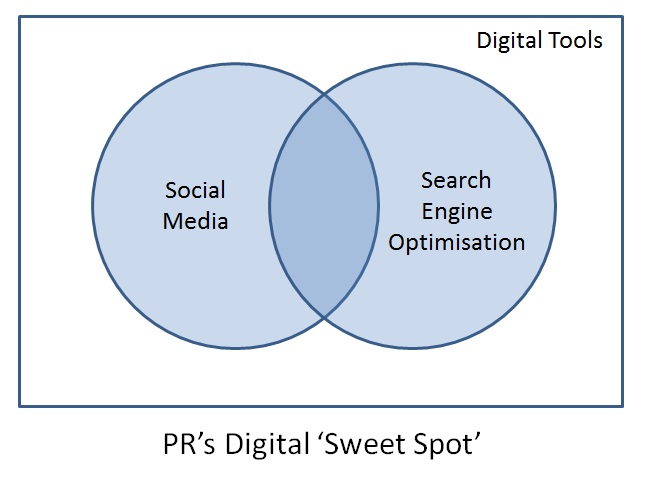
Social Media and Search Engine Optimisation.
However it is the combination of these two that creates an extremely potent mix that has a two-fold benefit...
- Search Engines are the place where people look for instant answers, or at least for clues to to the questions they have.
- Social Media is the online place where they engage with their friends, colleagues and confidants
Tuesday, June 7, 2011
So Is Google +1 going to work? History tells us it might not
Now, I’m a fairly obvious ‘power user’ of Google (as I run a digital consultancy that has an online marketing & SEO division) and have my Google Profile all set up and current… in fact I think I have a couple…. a personal Google account and an Ideal Interface one. So I’m not really your typical user out here, e.g. the person who may not have done this and may even know what a Google Profile is. So I therefore question the usefulness of this function and actually wonder how popular the +1 feature will be.
Hopefully this foray into Social Media for Google isn't as half-hearted as their earlier attempts.
1. Google Buzz hasn't really gained traction in a market already use to Twitter (perhaps because people were upset by its stealth launch into their Google Mail account rather than being something they requested)
2. Google Wave was touted as the successor to email, but turned out to unusable by many as a collaborative place to work and produce rich documents (however, that's not to say that it will have its day eventually, perhaps when people are more used to working in that way).
Only last week the ex-CEO Eric Schmidt accepted that he’d missed out on "the friend thing"…. which is not only a complete simplification of how social networks, it also gives us some idea of just how the search great generally views social media – e.g. it’s a thing to do, rather than a way to connect and even add value to search results.
Put simply, I’m not convinced that Google still gets Social Media and sharing completely. If you want an example of just how little the Google +1 feature is integrated into the rest of the Google product set, consider how useful it would have been to have added a “+1” button into Google’s blogging platform (Blogspot) and how beneficial this would have been to the legions of bloggers who are so dependent on referrals from any source….. That’s really not something Facebook would have missed and perhaps why they lead the social media league table.
Hopefully this foray into Social Media for Google isn't as half-hearted as their earlier attempts.
1. Google Buzz hasn't really gained traction in a market already use to Twitter (perhaps because people were upset by its stealth launch into their Google Mail account rather than being something they requested)
2. Google Wave was touted as the successor to email, but turned out to unusable by many as a collaborative place to work and produce rich documents (however, that's not to say that it will have its day eventually, perhaps when people are more used to working in that way).
Only last week the ex-CEO Eric Schmidt accepted that he’d missed out on "the friend thing"…. which is not only a complete simplification of how social networks, it also gives us some idea of just how the search great generally views social media – e.g. it’s a thing to do, rather than a way to connect and even add value to search results.
Put simply, I’m not convinced that Google still gets Social Media and sharing completely. If you want an example of just how little the Google +1 feature is integrated into the rest of the Google product set, consider how useful it would have been to have added a “+1” button into Google’s blogging platform (Blogspot) and how beneficial this would have been to the legions of bloggers who are so dependent on referrals from any source….. That’s really not something Facebook would have missed and perhaps why they lead the social media league table.
Monday, June 6, 2011
Google gets social sharing eventually
Google has now launched the +1 button, which is basically a way for your visitors to easily recommend your site within the search engine. By adding a +1 button to your site (you’ll probably need you site developer’s help in doing this) you are adding Google’s equivalent of a Facebook ‘Like’ to the page. This allows people viewing Google’s search results to see which links their friends positively rate and therefore add more relevance to the results. In other words… someone is more likely to visit a site found in Google if one of their contacts also thinks it’s a good link.
However, there are a couple of caveats to consider:
Whether this also means a +1 has an effect upon your site’s ranking in Google for everyone or just those who have linked contacts and are logged in remains to be seen.
However, there are a couple of caveats to consider:
- This functionality is currently reserved just for the main Google.com site, with other local versions due to get theirs subsequently
- You need a Google Profile set-up and be logged into Google while you browse
Whether this also means a +1 has an effect upon your site’s ranking in Google for everyone or just those who have linked contacts and are logged in remains to be seen.
Sunday, June 5, 2011
Why buttons are helping sites
You will have seen social media sharing buttons crop up all over the web recently, with sites only too keen to encourage you to click, share and show your appreciation.
This is happening more and more, but why has everyone gone button mad?
As I see it… for one key reason… Share-ability (or in other words the pull & push of social media)
Buttons are now a very useful way to encourage visitors to share their content. When once it was all about content.... “content is King” we used to cry. Content is what search engines love and these same search engines are what get you traffic & recognition.... and therefore attention & advertising space or sales.
But now it is all about content sharing, your site content is far more valuable if it is read, shared and then re-read by others. There’s still the reassuring need to make money from content… but if you can use the power of social media platforms to share this content to a wider audience (whilst still retaining your revenue from all these disparate channels) then you are clearly onto a good thing.
Your site has to work as hard a possible. By providing buttons and the means to share this content beyond your current readership, you are using social platforms & their users as a means of free syndication.
This is happening more and more, but why has everyone gone button mad?
As I see it… for one key reason… Share-ability (or in other words the pull & push of social media)
Buttons are now a very useful way to encourage visitors to share their content. When once it was all about content.... “content is King” we used to cry. Content is what search engines love and these same search engines are what get you traffic & recognition.... and therefore attention & advertising space or sales.
But now it is all about content sharing, your site content is far more valuable if it is read, shared and then re-read by others. There’s still the reassuring need to make money from content… but if you can use the power of social media platforms to share this content to a wider audience (whilst still retaining your revenue from all these disparate channels) then you are clearly onto a good thing.
Your site has to work as hard a possible. By providing buttons and the means to share this content beyond your current readership, you are using social platforms & their users as a means of free syndication.
Friday, June 3, 2011
Button mania
There have been two developments in the social media sphere over the last few days you might be considering if you need to grow your site traffic or your online reputation.
Both are similar pieces of functionality launched by Google & Twitter that you embed within your site and they mean bigger things for these two giants of the web (that I will explain in a series of small subsequent posts). But let’s be honest about what they are…. Buttons.
Everywhere you go on the web now, there they are….. buttons requesting you ‘Like’ the site, ‘Tweet’ and tell your personal or business contacts how much you like something, or further buttons to post this & that to a wall, blog post or some other social network.
Yup…. The pinnacle of web savvi-ness (if there is such a concept or word) is to have a site with a bunch of different buttons that look like virtual medals adorned across it. In fact, someone I know recently said that sites with all their buttons on are beginning to look like the side of war planes with their ‘kills’ stencilled heroically on their flank. (If you don’t believe me, just take a look at sites like The Huffington Post, where each article has an entire section on the page devoted to their social trophies).
As a concept you could even ask ”So where does it end?”. Perhaps you could get to a point where there are more buttons on a page than content. In some ‘Kenny Everett’ type comedy extreme, you would end up having a site where the numerous buttons scroll off the page, like unending medals given to an over-rewarded highly-decorated soldier.
Thank heavens for features like addthis.com which aggregate social sharing bookmarks into a single button.
Both are similar pieces of functionality launched by Google & Twitter that you embed within your site and they mean bigger things for these two giants of the web (that I will explain in a series of small subsequent posts). But let’s be honest about what they are…. Buttons.
Everywhere you go on the web now, there they are….. buttons requesting you ‘Like’ the site, ‘Tweet’ and tell your personal or business contacts how much you like something, or further buttons to post this & that to a wall, blog post or some other social network.
Yup…. The pinnacle of web savvi-ness (if there is such a concept or word) is to have a site with a bunch of different buttons that look like virtual medals adorned across it. In fact, someone I know recently said that sites with all their buttons on are beginning to look like the side of war planes with their ‘kills’ stencilled heroically on their flank. (If you don’t believe me, just take a look at sites like The Huffington Post, where each article has an entire section on the page devoted to their social trophies).
As a concept you could even ask ”So where does it end?”. Perhaps you could get to a point where there are more buttons on a page than content. In some ‘Kenny Everett’ type comedy extreme, you would end up having a site where the numerous buttons scroll off the page, like unending medals given to an over-rewarded highly-decorated soldier.
Thank heavens for features like addthis.com which aggregate social sharing bookmarks into a single button.
Tuesday, May 31, 2011
Has Google cracked mobile commerce?
Last week at a public launch Stephanie Tilenius, Google commerce and payments vice president stated
Google Wallet has been developed to work with MasterCard's PayPass network, which is already working in 124,000 PayPass-enabled stores across America. The trials of the technology have already started in New York and San Francisco, but as yet there's no word on if and when this service is to be rolled-out in the UK.
However, the technology and partners are available in the UK for Google to use when it wants.... We already have NFC phones available, such as Google's Nexus S and some versions of the Samsung Galaxy S II and BlackBerry Bold. Plus.... Orange and Barclaycard coincidentally launched their NFC payment service last week.
All indications are that this is finally the mobile payment service we've been waiting for and finally sees the convergence of an electronic payment and the one device we always keep with us.... our mobile phone.
“Today, we’ve joined with leaders in the industry to build the next generation of mobile commerce”Available to (US only) customers from this Summer is a new feature from Google and its partners (Citi, MasterCard, First Data and Sprint).... the Google Wallet, a new way of turning a smartphone into a smart way of paying for things. Wallet uses Near Field Communication (NFC) to make secure and fast payments conveniently by just tapping the phone on a terminal near to the checkout or payment area.
Google Wallet has been developed to work with MasterCard's PayPass network, which is already working in 124,000 PayPass-enabled stores across America. The trials of the technology have already started in New York and San Francisco, but as yet there's no word on if and when this service is to be rolled-out in the UK.
However, the technology and partners are available in the UK for Google to use when it wants.... We already have NFC phones available, such as Google's Nexus S and some versions of the Samsung Galaxy S II and BlackBerry Bold. Plus.... Orange and Barclaycard coincidentally launched their NFC payment service last week.
All indications are that this is finally the mobile payment service we've been waiting for and finally sees the convergence of an electronic payment and the one device we always keep with us.... our mobile phone.
Saturday, May 28, 2011
Common eCommerce questions I've been asked
The other day I quickly posted that I was mentioned as one of seven UK eCommerce consultants to know in the UK by directorsof.com .... So I took time out this evening to consider what it actually means to be an eCommerce consultant and I’ve put together a few questions and answers based on things I’ve been asked in the past:
1. It’s all about technology isn’t it?
No. Sure without the technology you wouldn’t have the platform to transact online (e.g. the web), but don’t be fooled into thinking that the IT part of it is the most critical part.
2. So what is about then?
It is all about selling to the customer and making money. The 4 P’s of retail still apply when selling online: Product, Price, Placement and Promotion…
3. Why are some retailers in the same market so good at it compared to others?
This is a more tricky one to explain, but simply put… they have the right support (management) & culture (drive, learning, etc.), plus have made some great choices in hiring the right staff and picked the best tools & techniques to use along the way.
4. What’s the biggest mistake online retailers make?
I was recently at a presentation by Paul Coby, the CIO of John Lewis. His quote of “if you outsource your brain, you outsource your wallet” really struck a chord with me. It reminded me of the times when I’ve seen clients depend too much on the advice of external consultants or agencies and not have even a decent understanding of what they are buying and implementing. This is so very relevant in the fast-changing world of eCommerce, where its incredibly easy to buy the latest and greatest in the race to stay ahead of the competition.
1. It’s all about technology isn’t it?
No. Sure without the technology you wouldn’t have the platform to transact online (e.g. the web), but don’t be fooled into thinking that the IT part of it is the most critical part.
2. So what is about then?
It is all about selling to the customer and making money. The 4 P’s of retail still apply when selling online: Product, Price, Placement and Promotion…
3. Why are some retailers in the same market so good at it compared to others?
This is a more tricky one to explain, but simply put… they have the right support (management) & culture (drive, learning, etc.), plus have made some great choices in hiring the right staff and picked the best tools & techniques to use along the way.
4. What’s the biggest mistake online retailers make?
I was recently at a presentation by Paul Coby, the CIO of John Lewis. His quote of “if you outsource your brain, you outsource your wallet” really struck a chord with me. It reminded me of the times when I’ve seen clients depend too much on the advice of external consultants or agencies and not have even a decent understanding of what they are buying and implementing. This is so very relevant in the fast-changing world of eCommerce, where its incredibly easy to buy the latest and greatest in the race to stay ahead of the competition.
Tuesday, May 24, 2011
Being recognised as an eCommerce Consultant
Today I was really chuffed to be mentioned on the directorsof.com website as one of “Seven E-Commerce Consultants you need to know”.
This is a pretty big accolade to have in the UK online commerce and multi-channel retailing industry.
This is a pretty big accolade to have in the UK online commerce and multi-channel retailing industry.
Monday, May 23, 2011
Social Media and Solicitors
How much more proof does anyone need about the power of Social Media? It has an ability to fuel rebellions, topple governments and now revoke superinjunctions handed down by UK judges.
What is not a surprise is that out-of-touch Judges can try to suppress any form of media, old or new. However, what is far more of a shock is the obvious lack of insight about such matters that was displayed by specialist legal company Schillings, the company that recommend that Ryan Giggs chase after Twitter this week. They advised the philandering father to go after the Californian-based social networking site to find out the details of those who posted information about the footballer’s “off the ball” antics.
Are they not aware of the so-called Streisand effect; where those who attempt to hide or remove items online about themselves only make matters worse?
What is not a surprise is that out-of-touch Judges can try to suppress any form of media, old or new. However, what is far more of a shock is the obvious lack of insight about such matters that was displayed by specialist legal company Schillings, the company that recommend that Ryan Giggs chase after Twitter this week. They advised the philandering father to go after the Californian-based social networking site to find out the details of those who posted information about the footballer’s “off the ball” antics.
Are they not aware of the so-called Streisand effect; where those who attempt to hide or remove items online about themselves only make matters worse?
Sunday, May 22, 2011
Why PR needs to understand search and social media
Communications Convergence, a big term used by a few knowledgeable people to describe the gradual merging of the different roles done by communications professionals. As you will have seem from previous postings, I believe that the old roles of marketing and public relations are now so closely intertwined that they have become indistinguishable from each other. Awareness, interest, desire and action via digital channels are all now all part of a continuing path of online customer acquisition that defies traditional communication job roles.
Typically it has been the marketer (or marketeer, if you wish) that has been the more aggressive/assertive in online promotion areas… possibly fuelled by hard sales targets or other drivers. They were also the early adopters of social media... but as soon as consumers started asking questions back it became a problem for them.
But with existing of expertise of bringing together messages and audience (as well as being used to answering those difficult questions) PR and communications professionals are in just the right place to understand and utilise the new tools & methods of customer engagement and brand messaging…. that of online search and the social web
Ok, it is not a particularly revolutionary thing to say, but its fairly obvious that an understanding is needed of how search engines use content (notice I didn’t say “how search engines work”) and how to leverage the way that people connect with each other as well as brands & organisations. What is perhaps more challenging to those who have already got their heads around the previous two online tools, is the fact that search and social aren’t actually distinct functions, but two sides of the same arch that meet over the head of the PR pro sat underneath.
In my view the intersection of where Social Media and Search Engine Optimisation meet is the PR digital sweet spot. It’s this point that’s the true online communication convergence point. It is here that news meets searcher and where potential customer meets a shared audience with the same voice. It is therefore this point that the PR person must understand, adopt and learn to wield with all the effort and rigour that they have previously applied to their traditional role.
Typically it has been the marketer (or marketeer, if you wish) that has been the more aggressive/assertive in online promotion areas… possibly fuelled by hard sales targets or other drivers. They were also the early adopters of social media... but as soon as consumers started asking questions back it became a problem for them.
But with existing of expertise of bringing together messages and audience (as well as being used to answering those difficult questions) PR and communications professionals are in just the right place to understand and utilise the new tools & methods of customer engagement and brand messaging…. that of online search and the social web
Ok, it is not a particularly revolutionary thing to say, but its fairly obvious that an understanding is needed of how search engines use content (notice I didn’t say “how search engines work”) and how to leverage the way that people connect with each other as well as brands & organisations. What is perhaps more challenging to those who have already got their heads around the previous two online tools, is the fact that search and social aren’t actually distinct functions, but two sides of the same arch that meet over the head of the PR pro sat underneath.
In my view the intersection of where Social Media and Search Engine Optimisation meet is the PR digital sweet spot. It’s this point that’s the true online communication convergence point. It is here that news meets searcher and where potential customer meets a shared audience with the same voice. It is therefore this point that the PR person must understand, adopt and learn to wield with all the effort and rigour that they have previously applied to their traditional role.
Friday, May 20, 2011
Integrating Facebook into my blog (correctly)
The keen-eyed amongst you (who read this blog via the original website, not one of the syndicated places or on an RSS reader) will see that I have an updated "Tell your Facebook friends" area on the right side of each page.
Previously for about a year this held a very similar function that let you "like" my content (but to be honest, most of you won't have noticed the difference). The main aim was that when you clicked on the thumb icon it would link to your Facebook account, with the secondary aim that this blog could eventually build up more than 25 followers... so I could claim a 'Facebook vanity URL'.
Why? Well, because this was the first time I had done something like this, integrating my public self with my private self in the popular social network that I share with my friends. It was more a "let's try it and see", rather than "let's try it and build followers".
However, there was one rather large problem. It didn't work.
Yup, for some reason when users clicked on the old link, it instantly told them they "liked" this blog, but that was it. It didn't register them as a follower within the Facebook page I had set up and it most definitely didn't display any blog postings into the page.
But that has now been corrected. I have not-only changed the code behind this button to correctly register any interest from my loyal or passing readers....but also any posting that I submit to this blog now automatically gets fed into the Facebook of those who expressed their interest (So if you do want to show your appreciation of the regular content I put here, please be aware that you will also get it piped into your Facebook account as well!).
The downside is that I have not retained the goodwill of those who previously liked this blog... so I now have to build up these numbers again from scratch.
Previously for about a year this held a very similar function that let you "like" my content (but to be honest, most of you won't have noticed the difference). The main aim was that when you clicked on the thumb icon it would link to your Facebook account, with the secondary aim that this blog could eventually build up more than 25 followers... so I could claim a 'Facebook vanity URL'.
Why? Well, because this was the first time I had done something like this, integrating my public self with my private self in the popular social network that I share with my friends. It was more a "let's try it and see", rather than "let's try it and build followers".
However, there was one rather large problem. It didn't work.
Yup, for some reason when users clicked on the old link, it instantly told them they "liked" this blog, but that was it. It didn't register them as a follower within the Facebook page I had set up and it most definitely didn't display any blog postings into the page.
But that has now been corrected. I have not-only changed the code behind this button to correctly register any interest from my loyal or passing readers....but also any posting that I submit to this blog now automatically gets fed into the Facebook of those who expressed their interest (So if you do want to show your appreciation of the regular content I put here, please be aware that you will also get it piped into your Facebook account as well!).
The downside is that I have not retained the goodwill of those who previously liked this blog... so I now have to build up these numbers again from scratch.
Tuesday, May 17, 2011
Website traffic decline, the Facebook effect?
Webtrends (now calling itself a 'Social analytics company', so perhaps it is trying to measure all the social media "gurus" out there) has released a fascinating study which reveals that an astounding 68% of Fortune 100 companies are experiencing a significant decline in their website traffic.
Yup, that's right.... at a time when the web has evolved to become the communication, transactional and engagement medium we all hoped it would be, visitors are now less interested in checking out corporate websites than they have been.
Over the same period Facebook sign-ups and traffic has increased (in the UK it grew from 24milion to 30 million users from July 2010 to the beginning of 2011). A coincidence? Unlikely. Especilly when brands are now using their Facebook vanity URL's more, rather than use their own website adresses.
Yup, that's right.... at a time when the web has evolved to become the communication, transactional and engagement medium we all hoped it would be, visitors are now less interested in checking out corporate websites than they have been.
Over the same period Facebook sign-ups and traffic has increased (in the UK it grew from 24milion to 30 million users from July 2010 to the beginning of 2011). A coincidence? Unlikely. Especilly when brands are now using their Facebook vanity URL's more, rather than use their own website adresses.
Monday, May 16, 2011
Advanced SEO : Using canonical references
What is Canonicalization?
The process of picking a single site URL to be indexed by the search engines from a range of URL’s. This happens when there are duplicate versions of the same/similar content on one site. Think of it as a way of suggesting the ‘true’ URL for your page(s) to the search engines
Why would I have multiple versions of the same content?
This usually occurs when you have dynamic content delivered from a database or there is more than one URL for a single page (typically the homepage, but not necessarily).
An example of this is an ecommerce site that enables users to get the same or very similar results from different actions.
E.g. If you have the URL of a product catalogue listing page built up from a series queries or filters.
The search engines understand this stuff?
Yes, they more than understand it they use it as a signal for search engine optimization. Since early 2009 Google, Yahoo and Microsoft have all stated they support this way for website owners to say “hey search engines, all these pages may have different URL’s but they are actually the same”.
What is the issue with duplicate content?
Search engines think that everyone is trying to game them and submit duplicate content to push themselves up the organic rankings. Without this, when a search engine finds duplicate content, it won’t now if you have done this accidentally or on. This means that they may well display the URL you don’t want to display, miss pages you want to get index or even worse downgrade the value of the page(s) they find… affecting the rankings and potentially the entire optimization of your site.
So how do I do this on my site?
If you read articles about this on the web, you would think that it is as simple as embedding a link in the header of your HTML pages (See: http://en.wikipedia.org/wiki/Canonical_meta_tag )
In theory this tells search engines the preferred location of the page to index (the “canonical” location) instead of the one it has found.
In practice it is more complex to create and maintain a working Canonical structure within an eCommerce site, especially one that has an evolving product catalogue.
The process of picking a single site URL to be indexed by the search engines from a range of URL’s. This happens when there are duplicate versions of the same/similar content on one site. Think of it as a way of suggesting the ‘true’ URL for your page(s) to the search engines
Why would I have multiple versions of the same content?
This usually occurs when you have dynamic content delivered from a database or there is more than one URL for a single page (typically the homepage, but not necessarily).
An example of this is an ecommerce site that enables users to get the same or very similar results from different actions.
E.g. If you have the URL of a product catalogue listing page built up from a series queries or filters.
The search engines understand this stuff?
Yes, they more than understand it they use it as a signal for search engine optimization. Since early 2009 Google, Yahoo and Microsoft have all stated they support this way for website owners to say “hey search engines, all these pages may have different URL’s but they are actually the same”.
What is the issue with duplicate content?
Search engines think that everyone is trying to game them and submit duplicate content to push themselves up the organic rankings. Without this, when a search engine finds duplicate content, it won’t now if you have done this accidentally or on. This means that they may well display the URL you don’t want to display, miss pages you want to get index or even worse downgrade the value of the page(s) they find… affecting the rankings and potentially the entire optimization of your site.
So how do I do this on my site?
If you read articles about this on the web, you would think that it is as simple as embedding a link in the header of your HTML pages (See: http://en.wikipedia.org/wiki/Canonical_meta_tag )
In theory this tells search engines the preferred location of the page to index (the “canonical” location) instead of the one it has found.
In practice it is more complex to create and maintain a working Canonical structure within an eCommerce site, especially one that has an evolving product catalogue.
Sunday, May 15, 2011
Content curation sucks
There’s been a load of chatter in the Social Media echo chamber about the increasing role of content curation rather than content creation.
The theory goes that more people will abandon blogging and other ways of producing content in favour of becoming virtual guides to these sources. Twitter even encourages this sort of behaviour by only providing you 140 characters to provide just a sentence or a link & comment.
Well, quite frankly, this sucks! (there I said it!)
Hopefully there is still a place for blogging and the publication of original, thought-provoking content that develops ideas and challenges existing perspectives.
The theory goes that more people will abandon blogging and other ways of producing content in favour of becoming virtual guides to these sources. Twitter even encourages this sort of behaviour by only providing you 140 characters to provide just a sentence or a link & comment.
Well, quite frankly, this sucks! (there I said it!)
- Has nobody ever heard the phrase “too many chiefs and not enough Indians”?
- Why is pointing at content better than producing it?
- Have we really reached an online pinnacle where everyone now needs to go from becoming a journalist to an editor?
- Does the world really need a plethora of people saying “check this out”, rather than “I think this”?
- Is this really the evolution of social media, where the citizen blogger transitions to the citizen news signpost?
Hopefully there is still a place for blogging and the publication of original, thought-provoking content that develops ideas and challenges existing perspectives.
Friday, May 13, 2011
The battle for The Web has begun
The Internet has been around for about 27 years now and the World Wide Web has now existed for two decades. It is part of the daily life for more & more of us, with a growing number of people living, loving and working online.
However, unless you’re very young or old, a member of a profession that doesn’t allow you to contribute or you’ve recently unsubscribed from one… you’re probably a member of a social network. And for most countries in the Western world, this means you’re signed-up to Facebook.
Here in the UK Facebook is used by about 30 million people, having grown its numbers by 4 million in 9 months ….which means that it can count over 50% of the UK population as members!
Facebook is now the site we use to catch-up with friends and family members, engage with brands (who are increasingly seeing the value of being part of the online conversation), play games and manage their everyday lives. On top of this, if you haven’t already, you will soon be: shopping online and sharing your purchases with your network of acquaintances. It’s even managed to pull-off a partnership with Microsoft, who 3 years ago took a small ($240m) share in the company at an important time in its growth, which then meant Facebook was instantly worth $15bn! (Its now worth close to $50bn)
But… that’s not enough for Facebook, it wants more…..it wants to own your entire online experience.
Unfortunately for them there’s one fly in the digital ointment. Another company is in the way…. One who already have around 60% of the global search engine market, one of the most popular email services and provide the only real (and free) competition for Microsoft’s Office suite and Apple’s iPhone operating system…. Google.
This rivalry (or jealousy) has never really been as open as it has been in the last day or so, with the recent expose that Facebook was the ‘mysterious client’ behind Global PR agency Burson-Marsteller’s attempted smearing of one of Google’s Gmail services called Social Circle (who up until 48 hours ago, very little people had even heard of)
So now the entire Internet industry’s attention has focused in on the competition between these two giants of online as they compete for the attention, thought processes and wallets of World’s entire Internet population. Those 30 million UK users suddenly look a drop in the ocean when compared with 2 billion….
However, unless you’re very young or old, a member of a profession that doesn’t allow you to contribute or you’ve recently unsubscribed from one… you’re probably a member of a social network. And for most countries in the Western world, this means you’re signed-up to Facebook.
Here in the UK Facebook is used by about 30 million people, having grown its numbers by 4 million in 9 months ….which means that it can count over 50% of the UK population as members!
Facebook is now the site we use to catch-up with friends and family members, engage with brands (who are increasingly seeing the value of being part of the online conversation), play games and manage their everyday lives. On top of this, if you haven’t already, you will soon be: shopping online and sharing your purchases with your network of acquaintances. It’s even managed to pull-off a partnership with Microsoft, who 3 years ago took a small ($240m) share in the company at an important time in its growth, which then meant Facebook was instantly worth $15bn! (Its now worth close to $50bn)
But… that’s not enough for Facebook, it wants more…..it wants to own your entire online experience.
Unfortunately for them there’s one fly in the digital ointment. Another company is in the way…. One who already have around 60% of the global search engine market, one of the most popular email services and provide the only real (and free) competition for Microsoft’s Office suite and Apple’s iPhone operating system…. Google.
This rivalry (or jealousy) has never really been as open as it has been in the last day or so, with the recent expose that Facebook was the ‘mysterious client’ behind Global PR agency Burson-Marsteller’s attempted smearing of one of Google’s Gmail services called Social Circle (who up until 48 hours ago, very little people had even heard of)
So now the entire Internet industry’s attention has focused in on the competition between these two giants of online as they compete for the attention, thought processes and wallets of World’s entire Internet population. Those 30 million UK users suddenly look a drop in the ocean when compared with 2 billion….
Monday, May 9, 2011
UK FCommerce: from Goldrush to Maturity
Having just received the latest Social Media Benchmark results from the eDigitalResearch survey that looked at 73 of the UK's leading retail brands, it makes for interesting reading.
Retailers are continuing to grow their legions of followers, with the top ones still attracting tens of thousands of new ones each month across the different social networks. However the main platform for engagement is most definitely Facebook, with UK market leaders such as ASOS adding the most. TopShop is still the only UK retailer over a million followers (although River Island is closing in) and fashion retailers as a whole are the obvious trail-blazers, due to their target demographic being so prevalent in Facebook usage.
However a growing trend that I’m particularly interested in is the continued introduction of Fcommerce, with nine of the top twenty retailers in the study already offering their followers the ability to shop from their Facebook pages. Its fair to say that the retailers who established a social media presence early one are now the ones who are reaping the benefits…. and its therefore my belief that those who do the same over the next few months with Facebook Social Commerce will grow their sales as well as their social footprint the most.
Retailers are continuing to grow their legions of followers, with the top ones still attracting tens of thousands of new ones each month across the different social networks. However the main platform for engagement is most definitely Facebook, with UK market leaders such as ASOS adding the most. TopShop is still the only UK retailer over a million followers (although River Island is closing in) and fashion retailers as a whole are the obvious trail-blazers, due to their target demographic being so prevalent in Facebook usage.
However a growing trend that I’m particularly interested in is the continued introduction of Fcommerce, with nine of the top twenty retailers in the study already offering their followers the ability to shop from their Facebook pages. Its fair to say that the retailers who established a social media presence early one are now the ones who are reaping the benefits…. and its therefore my belief that those who do the same over the next few months with Facebook Social Commerce will grow their sales as well as their social footprint the most.
Thursday, May 5, 2011
The evolution of digital, gently does it.
How customers & consumers interact with a brand has certainly changed in the last few years thanks to online communication technologies. There are now blogs, web forums and user-generated content (UGC) websites for every possible niche service or product out there and at every emotional point between brand fanatic and disgruntled ex-customer (and beyond).
The Internet (and in particular social media) has given everyone with an online connection the ability to find those with similar feelings or experiences – no matter how specific – and to come together to discuss, refine, support, encourage, complain or plot.
So while it seems quite strange – at least to those of us who use, and work in and around, online social space – that some organisations still choose not to venture into this area, we must also remember that we are (including our clients) all at different points along a digital adoption path, with many still relatively new to understanding it, let alone harnessing the power of, this new communication phenomenon.
The Internet (and in particular social media) has given everyone with an online connection the ability to find those with similar feelings or experiences – no matter how specific – and to come together to discuss, refine, support, encourage, complain or plot.
So while it seems quite strange – at least to those of us who use, and work in and around, online social space – that some organisations still choose not to venture into this area, we must also remember that we are (including our clients) all at different points along a digital adoption path, with many still relatively new to understanding it, let alone harnessing the power of, this new communication phenomenon.
Tuesday, May 3, 2011
Is your website driving away customers?
Yes, that's right.... your website could be harming your business rather than helping it. How?
Well, did you know that 57% of visitors will abandon a site if it doesn't load in 3 seconds?
Yup! Although internet speeds have increased significantly over the last few years (my ISP is currently offering broadband at between 8mbps to 40mbps)..... modern websites tend to be full of complex code and large images. And to make matters worse... Internet users now expect websites to download faster than ever before.
So all that bloated script, photos and video (in a lot of cases), means those key pages that you're trying to drive users to take a long time to fully render in their browser. And all the time the user is waiting for this to happen.....they are only a click away from selecting another site.
Potentially your competition's.
Well, did you know that 57% of visitors will abandon a site if it doesn't load in 3 seconds?
Yup! Although internet speeds have increased significantly over the last few years (my ISP is currently offering broadband at between 8mbps to 40mbps)..... modern websites tend to be full of complex code and large images. And to make matters worse... Internet users now expect websites to download faster than ever before.
So all that bloated script, photos and video (in a lot of cases), means those key pages that you're trying to drive users to take a long time to fully render in their browser. And all the time the user is waiting for this to happen.....they are only a click away from selecting another site.
Potentially your competition's.
Ignore it and it will go away... right?
A friend of mine works in a place where the understanding by big organisations and brands of social media and digital communications are not as developed as those of say the USA and Western Europe. He’s facing the problem where his potential clients simply don’t see the benefit of communicating with digital audiences, especially on negative issues.
This is something that I thought had bee addressed on a global scale a few years back. So I was a little surprised to hear that the large organisations he is talking to still have an “ignore it and it will go away” attitude.
So what should he say to those he is pitching to who believe they can ignore negative sentiment and that online comments cannot affect a brand?
1. Ignoring negative sentiment
For a really good example of this from several years back (but that is still relevant today) check out the case about "Dell Hell" that I have blogged about a few years back:
http://www.guardian.co.uk/technology/2005/aug/29/mondaymediasection.blogging
http://www.customerthink.com/article/you_can_learn_dell_hell_dell_did
For example:
http://www.bulletproofblog.com/2008/11/19/motrin-moms-show-their-social-media-savvy/
http://www.bulletproofblog.com/2009/07/28/youtube-video-targeted-at-united-airlines-strikes-a-chord/
http://www.directorship.com/dominos-discovers-social-media/
Sure, you can spend your way out of trouble each time to try and bury/block/buy strategies. But that can be both expensive and reactionary, neither of which are approaches that the shareholders of large companies appreciate.
Taking the 20th century view that these issue will just go away over time is no longer the way to communicate, engage and grown your business.
This is something that I thought had bee addressed on a global scale a few years back. So I was a little surprised to hear that the large organisations he is talking to still have an “ignore it and it will go away” attitude.
So what should he say to those he is pitching to who believe they can ignore negative sentiment and that online comments cannot affect a brand?
So let's take each part separately:
1. Ignoring negative sentiment
- Remember that any comment (negative or positive) stays on the Internet for as long as it is hosted. This means that content posted to popular blogs and social platforms could stay there indefinitely. You can no longer bury bad news on the web!
- Search engines love popular, relevant & regularly-updated content, therefore its possible that a popular negative article or blog posting could affect a brand’s organic rankings (meaning they could even get deposed from the top of Google for their own brand terms or more realistically that more SEO budget is needed to keep them there).
- Those people who post negative comments don't go away, they pop up at any time and continue their comments (especially if there is new activity around the subject)
As an example of this, I once had a prospect who had the same negative TV clips uploaded to YouTube about them. They wanted to send a lawyers letter, I wanted them to film a response. (They eventually did what they wanted and the same clip then appeared in several other places online).
These have been called Badvocates (Bad advocates), the opposite of brand ambassadors, and I even blogged about this in 2009:
http://press20.blogspot.com/2009/10/are-you-brand-bashing-badvocate.html
So you should expect the same sort of passion that your most prized followers and fans have... but in reverse.
Ha ha ha.... that's both arrogant and ignorant in this modern world
For a really good example of this from several years back (but that is still relevant today) check out the case about "Dell Hell" that I have blogged about a few years back:
http://www.guardian.co.uk/technology/2005/aug/29/mondaymediasection.blogging
http://www.customerthink.com/article/you_can_learn_dell_hell_dell_did
In short, Jeff Jarvis wrote about bad service from the PC manufacturer and it snowballed into a huge customer service & reputation issue for Dell. In the end Dell decided to address this and eventually set up a focused social media team to monitor, address and grow engagement across the web.
Now why would Dell do this? Because it was creating a negative effect on its brand and its revenues.....
A few years on from Dell Hell there are now loads of examples about how brands have had to spend lots of money to counter negative publicity that either started or grew online.For example:
http://www.bulletproofblog.com/2008/11/19/motrin-moms-show-their-social-media-savvy/
http://www.bulletproofblog.com/2009/07/28/youtube-video-targeted-at-united-airlines-strikes-a-chord/
http://www.directorship.com/dominos-discovers-social-media/
Sure, you can spend your way out of trouble each time to try and bury/block/buy strategies. But that can be both expensive and reactionary, neither of which are approaches that the shareholders of large companies appreciate.
Taking the 20th century view that these issue will just go away over time is no longer the way to communicate, engage and grown your business.
Sunday, May 1, 2011
PR and Marketing – the race to Social Media Maturity
In the old days… if you were in advertising you made commercials (or told people you did, when really you made posters for bus shelters or newspaper adverts), if you were in marketing you bought TV slots (or space in shelters and the press) and if you were in PR you spoke to journalists or created events (hopefully not in bus shelters).
Basically, everyone knew what they were doing and everyone had their own budgets and; responsibilities to worry about. Yes sure, occasionally the client would want a fancy ‘integrated’ approach, which generally meant every respective agency would rock up at the client’s offices at the same time and try to pretend they both understood and wanted to get along with each other.
Note: As we all know, in an integrated campaign everyone tried to steal each other budgets, but only the clever ones managed this (usually by merging with another agency).
But now those rules have changed.
As you may have seen from my posts, the roles of PR and Marketing have now blurred so much that both agencies and clients cannot differentiate between them. Digital communications in the shape of: search engine marketing, social media listening & engagement and their like are now part of the digital toolbox that can be used by all disciplines. What was once a pure marketing campaign is now typicsally also a part PR one and also has a direct input on the client's online business (e.g. conversion on an ecommerce website).
PR has also grown up to embrace the digital techniques that were once the domain of the geek. Perhaps because the technology has become easier, but also because the agencies and clients have both become more acceptable of digital methods… as they invariably consumers of it as well. PR has now evolved from a producer of one way information (e.g. press releases) to become far more about developing a two-way dialogue in the larger market and about building relationships with a complex range of stakeholders and influencers.
What is clear is that both disciplines have now learnt, to a lesser or greater extent, to understand and use the wide range of tools available, especially Social Media… as this is where the collective client mind and budgets are right now.
So if you work for an agency that is offering Social Media skills or are a client looking to hire someone to look after this complex area... consider the background of these individuals (e.g. are they from a decent marketing and or PR background) and understand just how mature are they in this market.
Basically, everyone knew what they were doing and everyone had their own budgets and; responsibilities to worry about. Yes sure, occasionally the client would want a fancy ‘integrated’ approach, which generally meant every respective agency would rock up at the client’s offices at the same time and try to pretend they both understood and wanted to get along with each other.
Note: As we all know, in an integrated campaign everyone tried to steal each other budgets, but only the clever ones managed this (usually by merging with another agency).
But now those rules have changed.
As you may have seen from my posts, the roles of PR and Marketing have now blurred so much that both agencies and clients cannot differentiate between them. Digital communications in the shape of: search engine marketing, social media listening & engagement and their like are now part of the digital toolbox that can be used by all disciplines. What was once a pure marketing campaign is now typicsally also a part PR one and also has a direct input on the client's online business (e.g. conversion on an ecommerce website).
PR has also grown up to embrace the digital techniques that were once the domain of the geek. Perhaps because the technology has become easier, but also because the agencies and clients have both become more acceptable of digital methods… as they invariably consumers of it as well. PR has now evolved from a producer of one way information (e.g. press releases) to become far more about developing a two-way dialogue in the larger market and about building relationships with a complex range of stakeholders and influencers.
What is clear is that both disciplines have now learnt, to a lesser or greater extent, to understand and use the wide range of tools available, especially Social Media… as this is where the collective client mind and budgets are right now.
- Both are now competing in the same arena.
- Both are now in the same space race to build a better Social Media offering as quickly as they can.
- Both are prone to calling themselves experts or guru’s as way of trying to prove that their growing knowledge is better than anyone else.
- Both are trying to show their level of maturity in an immature market
So if you work for an agency that is offering Social Media skills or are a client looking to hire someone to look after this complex area... consider the background of these individuals (e.g. are they from a decent marketing and or PR background) and understand just how mature are they in this market.
Subscribe to:
Posts (Atom)