What is a content farm?
A website (such as a blog) containing content that is run with the aim of appealing to search engines.
Why would someone create a content farm?
Search engines are a fast and easy way of finding information about all sorts of topics. If you can create content that people search for then you will get traffic to your site. You can then monetise this traffic in a number of ways, such as selling advertising or sending visitors to an eCommerce site for a commission (known as affiliate selling).
How do you create a content farm?
The main rule is you don’t write for your reader, you write for the terms your visitor is looking for and you ‘fill in the gaps’ with content.
I’m sure you have been to sites that read appallingly badly except they contain a lot of the search terms you type in to find the page…. You know the ones; it’s almost as if someone doesn’t actually care about what they have written except to stuff keywords into a posting. If you recognise this sort of site, its a good bet that you’ve visited a content farm..
But isn’t this what SEO people do anyway?
Well, sort of… but not really. A good Search Engine Optimisation professional will advise you to write content for your site around the topics and keywords that you want people to find in the search engines. They may get into more detail and ask you to write a list of the more popular terms you want to target…. and advise you to mention these on a regular (but not too often basis). They shouldn’t advise you to create page-upon-page of meaningless and keyword-packed content purely to target search traffic.
Friday, June 10, 2011
Thursday, June 9, 2011
The PR digital sweet spot
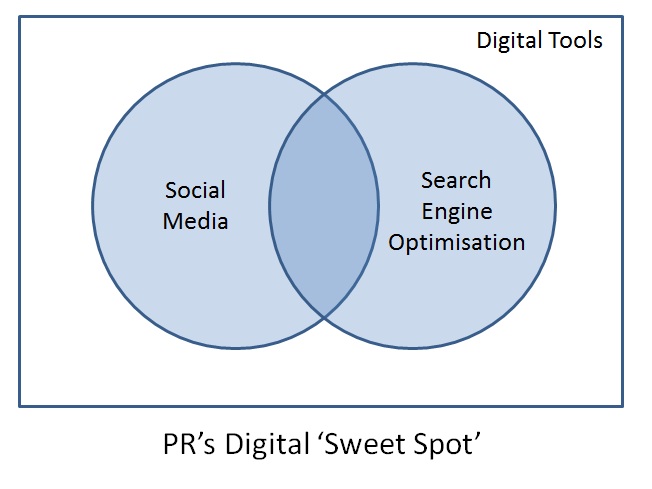
In my post recently, I blogged about the intersection of Social Media and Search Engine Optimisation. This is a place I called the "PR digital sweet spot" and it’s the place where the modern PR practitioner needs to work and think.
 As I've previously explained, there are a number of digital tools available to the modern PR agency. The more I talk with clients and prospects, more I believe that the two essential tools of the modern PR trade are
Social Media and Search Engine Optimisation.
However it is the combination of these two that creates an extremely potent mix that has a two-fold benefit...
Social Media and Search Engine Optimisation.
However it is the combination of these two that creates an extremely potent mix that has a two-fold benefit...
- Search Engines are the place where people look for instant answers, or at least for clues to to the questions they have.
- Social Media is the online place where they engage with their friends, colleagues and confidants
Tuesday, June 7, 2011
So Is Google +1 going to work? History tells us it might not
Now, I’m a fairly obvious ‘power user’ of Google (as I run a digital consultancy that has an online marketing & SEO division) and have my Google Profile all set up and current… in fact I think I have a couple…. a personal Google account and an Ideal Interface one. So I’m not really your typical user out here, e.g. the person who may not have done this and may even know what a Google Profile is. So I therefore question the usefulness of this function and actually wonder how popular the +1 feature will be.
Hopefully this foray into Social Media for Google isn't as half-hearted as their earlier attempts.
1. Google Buzz hasn't really gained traction in a market already use to Twitter (perhaps because people were upset by its stealth launch into their Google Mail account rather than being something they requested)
2. Google Wave was touted as the successor to email, but turned out to unusable by many as a collaborative place to work and produce rich documents (however, that's not to say that it will have its day eventually, perhaps when people are more used to working in that way).
Only last week the ex-CEO Eric Schmidt accepted that he’d missed out on "the friend thing"…. which is not only a complete simplification of how social networks, it also gives us some idea of just how the search great generally views social media – e.g. it’s a thing to do, rather than a way to connect and even add value to search results.
Put simply, I’m not convinced that Google still gets Social Media and sharing completely. If you want an example of just how little the Google +1 feature is integrated into the rest of the Google product set, consider how useful it would have been to have added a “+1” button into Google’s blogging platform (Blogspot) and how beneficial this would have been to the legions of bloggers who are so dependent on referrals from any source….. That’s really not something Facebook would have missed and perhaps why they lead the social media league table.
Monday, June 6, 2011
Google gets social sharing eventually
Google has now launched the +1 button, which is basically a way for your visitors to easily recommend your site within the search engine. By adding a +1 button to your site (you’ll probably need you site developer’s help in doing this) you are adding Google’s equivalent of a Facebook ‘Like’ to the page. This allows people viewing Google’s search results to see which links their friends positively rate and therefore add more relevance to the results. In other words… someone is more likely to visit a site found in Google if one of their contacts also thinks it’s a good link.
However, there are a couple of caveats to consider:
Whether this also means a +1 has an effect upon your site’s ranking in Google for everyone or just those who have linked contacts and are logged in remains to be seen.
However, there are a couple of caveats to consider:
- This functionality is currently reserved just for the main Google.com site, with other local versions due to get theirs subsequently
- You need a Google Profile set-up and be logged into Google while you browse
Whether this also means a +1 has an effect upon your site’s ranking in Google for everyone or just those who have linked contacts and are logged in remains to be seen.
Sunday, June 5, 2011
Why buttons are helping sites
You will have seen social media sharing buttons crop up all over the web recently, with sites only too keen to encourage you to click, share and show your appreciation.
This is happening more and more, but why has everyone gone button mad?
As I see it… for one key reason… Share-ability (or in other words the pull & push of social media)
Buttons are now a very useful way to encourage visitors to share their content. When once it was all about content.... “content is King” we used to cry. Content is what search engines love and these same search engines are what get you traffic & recognition.... and therefore attention & advertising space or sales.
But now it is all about content sharing, your site content is far more valuable if it is read, shared and then re-read by others. There’s still the reassuring need to make money from content… but if you can use the power of social media platforms to share this content to a wider audience (whilst still retaining your revenue from all these disparate channels) then you are clearly onto a good thing.
Your site has to work as hard a possible. By providing buttons and the means to share this content beyond your current readership, you are using social platforms & their users as a means of free syndication.
Friday, June 3, 2011
Button mania
There have been two developments in the social media sphere over the last few days you might be considering if you need to grow your site traffic or your online reputation.
Both are similar pieces of functionality launched by Google & Twitter that you embed within your site and they mean bigger things for these two giants of the web (that I will explain in a series of small subsequent posts). But let’s be honest about what they are…. Buttons.
Everywhere you go on the web now, there they are….. buttons requesting you ‘Like’ the site, ‘Tweet’ and tell your personal or business contacts how much you like something, or further buttons to post this & that to a wall, blog post or some other social network.
Yup…. The pinnacle of web savvi-ness (if there is such a concept or word) is to have a site with a bunch of different buttons that look like virtual medals adorned across it. In fact, someone I know recently said that sites with all their buttons on are beginning to look like the side of war planes with their ‘kills’ stencilled heroically on their flank. (If you don’t believe me, just take a look at sites like The Huffington Post, where each article has an entire section on the page devoted to their social trophies).
As a concept you could even ask ”So where does it end?”. Perhaps you could get to a point where there are more buttons on a page than content. In some ‘Kenny Everett’ type comedy extreme, you would end up having a site where the numerous buttons scroll off the page, like unending medals given to an over-rewarded highly-decorated soldier.
Thank heavens for features like addthis.com which aggregate social sharing bookmarks into a single button.
Tuesday, May 31, 2011
Has Google cracked mobile commerce?
Last week at a public launch Stephanie Tilenius, Google commerce and payments vice president stated
Google Wallet has been developed to work with MasterCard's PayPass network, which is already working in 124,000 PayPass-enabled stores across America. The trials of the technology have already started in New York and San Francisco, but as yet there's no word on if and when this service is to be rolled-out in the UK.
However, the technology and partners are available in the UK for Google to use when it wants.... We already have NFC phones available, such as Google's Nexus S and some versions of the Samsung Galaxy S II and BlackBerry Bold. Plus.... Orange and Barclaycard coincidentally launched their NFC payment service last week.
All indications are that this is finally the mobile payment service we've been waiting for and finally sees the convergence of an electronic payment and the one device we always keep with us.... our mobile phone.
“Today, we’ve joined with leaders in the industry to build the next generation of mobile commerce”Available to (US only) customers from this Summer is a new feature from Google and its partners (Citi, MasterCard, First Data and Sprint).... the Google Wallet, a new way of turning a smartphone into a smart way of paying for things. Wallet uses Near Field Communication (NFC) to make secure and fast payments conveniently by just tapping the phone on a terminal near to the checkout or payment area.
Google Wallet has been developed to work with MasterCard's PayPass network, which is already working in 124,000 PayPass-enabled stores across America. The trials of the technology have already started in New York and San Francisco, but as yet there's no word on if and when this service is to be rolled-out in the UK.
However, the technology and partners are available in the UK for Google to use when it wants.... We already have NFC phones available, such as Google's Nexus S and some versions of the Samsung Galaxy S II and BlackBerry Bold. Plus.... Orange and Barclaycard coincidentally launched their NFC payment service last week.
All indications are that this is finally the mobile payment service we've been waiting for and finally sees the convergence of an electronic payment and the one device we always keep with us.... our mobile phone.
Saturday, May 28, 2011
Common eCommerce questions I've been asked
The other day I quickly posted that I was mentioned as one of seven UK eCommerce consultants to know in the UK by directorsof.com .... So I took time out this evening to consider what it actually means to be an eCommerce consultant and I’ve put together a few questions and answers based on things I’ve been asked in the past:
1. It’s all about technology isn’t it?
No. Sure without the technology you wouldn’t have the platform to transact online (e.g. the web), but don’t be fooled into thinking that the IT part of it is the most critical part.
2. So what is about then?
It is all about selling to the customer and making money. The 4 P’s of retail still apply when selling online: Product, Price, Placement and Promotion…
3. Why are some retailers in the same market so good at it compared to others?
This is a more tricky one to explain, but simply put… they have the right support (management) & culture (drive, learning, etc.), plus have made some great choices in hiring the right staff and picked the best tools & techniques to use along the way.
4. What’s the biggest mistake online retailers make?
I was recently at a presentation by Paul Coby, the CIO of John Lewis. His quote of “if you outsource your brain, you outsource your wallet” really struck a chord with me. It reminded me of the times when I’ve seen clients depend too much on the advice of external consultants or agencies and not have even a decent understanding of what they are buying and implementing. This is so very relevant in the fast-changing world of eCommerce, where its incredibly easy to buy the latest and greatest in the race to stay ahead of the competition.
Tuesday, May 24, 2011
Being recognised as an eCommerce Consultant
Today I was really chuffed to be mentioned on the directorsof.com website as one of “Seven E-Commerce Consultants you need to know”.
This is a pretty big accolade to have in the UK online commerce and multi-channel retailing industry.
This is a pretty big accolade to have in the UK online commerce and multi-channel retailing industry.
Monday, May 23, 2011
Social Media and Solicitors
How much more proof does anyone need about the power of Social Media? It has an ability to fuel rebellions, topple governments and now revoke superinjunctions handed down by UK judges.
What is not a surprise is that out-of-touch Judges can try to suppress any form of media, old or new. However, what is far more of a shock is the obvious lack of insight about such matters that was displayed by specialist legal company Schillings, the company that recommend that Ryan Giggs chase after Twitter this week. They advised the philandering father to go after the Californian-based social networking site to find out the details of those who posted information about the footballer’s “off the ball” antics.
Are they not aware of the so-called Streisand effect; where those who attempt to hide or remove items online about themselves only make matters worse?
Sunday, May 22, 2011
Why PR needs to understand search and social media
Communications Convergence, a big term used by a few knowledgeable people to describe the gradual merging of the different roles done by communications professionals. As you will have seem from previous postings, I believe that the old roles of marketing and public relations are now so closely intertwined that they have become indistinguishable from each other. Awareness, interest, desire and action via digital channels are all now all part of a continuing path of online customer acquisition that defies traditional communication job roles.
Typically it has been the marketer (or marketeer, if you wish) that has been the more aggressive/assertive in online promotion areas… possibly fuelled by hard sales targets or other drivers. They were also the early adopters of social media... but as soon as consumers started asking questions back it became a problem for them.
But with existing of expertise of bringing together messages and audience (as well as being used to answering those difficult questions) PR and communications professionals are in just the right place to understand and utilise the new tools & methods of customer engagement and brand messaging…. that of online search and the social web
Ok, it is not a particularly revolutionary thing to say, but its fairly obvious that an understanding is needed of how search engines use content (notice I didn’t say “how search engines work”) and how to leverage the way that people connect with each other as well as brands & organisations. What is perhaps more challenging to those who have already got their heads around the previous two online tools, is the fact that search and social aren’t actually distinct functions, but two sides of the same arch that meet over the head of the PR pro sat underneath.
In my view the intersection of where Social Media and Search Engine Optimisation meet is the PR digital sweet spot. It’s this point that’s the true online communication convergence point. It is here that news meets searcher and where potential customer meets a shared audience with the same voice. It is therefore this point that the PR person must understand, adopt and learn to wield with all the effort and rigour that they have previously applied to their traditional role.
Friday, May 20, 2011
Integrating Facebook into my blog (correctly)
The keen-eyed amongst you (who read this blog via the original website, not one of the syndicated places or on an RSS reader) will see that I have an updated "Tell your Facebook friends" area on the right side of each page.
Previously for about a year this held a very similar function that let you "like" my content (but to be honest, most of you won't have noticed the difference). The main aim was that when you clicked on the thumb icon it would link to your Facebook account, with the secondary aim that this blog could eventually build up more than 25 followers... so I could claim a 'Facebook vanity URL'.
Why? Well, because this was the first time I had done something like this, integrating my public self with my private self in the popular social network that I share with my friends. It was more a "let's try it and see", rather than "let's try it and build followers".
However, there was one rather large problem. It didn't work.
Yup, for some reason when users clicked on the old link, it instantly told them they "liked" this blog, but that was it. It didn't register them as a follower within the Facebook page I had set up and it most definitely didn't display any blog postings into the page.
But that has now been corrected. I have not-only changed the code behind this button to correctly register any interest from my loyal or passing readers....but also any posting that I submit to this blog now automatically gets fed into the Facebook of those who expressed their interest (So if you do want to show your appreciation of the regular content I put here, please be aware that you will also get it piped into your Facebook account as well!).
The downside is that I have not retained the goodwill of those who previously liked this blog... so I now have to build up these numbers again from scratch.
Tuesday, May 17, 2011
Website traffic decline, the Facebook effect?
Webtrends (now calling itself a 'Social analytics company', so perhaps it is trying to measure all the social media "gurus" out there) has released a fascinating study which reveals that an astounding 68% of Fortune 100 companies are experiencing a significant decline in their website traffic.
Yup, that's right.... at a time when the web has evolved to become the communication, transactional and engagement medium we all hoped it would be, visitors are now less interested in checking out corporate websites than they have been.
Over the same period Facebook sign-ups and traffic has increased (in the UK it grew from 24milion to 30 million users from July 2010 to the beginning of 2011). A coincidence? Unlikely. Especilly when brands are now using their Facebook vanity URL's more, rather than use their own website adresses.
Monday, May 16, 2011
Advanced SEO : Using canonical references
What is Canonicalization?
The process of picking a single site URL to be indexed by the search engines from a range of URL’s. This happens when there are duplicate versions of the same/similar content on one site. Think of it as a way of suggesting the ‘true’ URL for your page(s) to the search engines
Why would I have multiple versions of the same content?
This usually occurs when you have dynamic content delivered from a database or there is more than one URL for a single page (typically the homepage, but not necessarily).
An example of this is an ecommerce site that enables users to get the same or very similar results from different actions.
E.g. If you have the URL of a product catalogue listing page built up from a series queries or filters.
The search engines understand this stuff?
Yes, they more than understand it they use it as a signal for search engine optimization. Since early 2009 Google, Yahoo and Microsoft have all stated they support this way for website owners to say “hey search engines, all these pages may have different URL’s but they are actually the same”.
What is the issue with duplicate content?
Search engines think that everyone is trying to game them and submit duplicate content to push themselves up the organic rankings. Without this, when a search engine finds duplicate content, it won’t now if you have done this accidentally or on. This means that they may well display the URL you don’t want to display, miss pages you want to get index or even worse downgrade the value of the page(s) they find… affecting the rankings and potentially the entire optimization of your site.
So how do I do this on my site?
If you read articles about this on the web, you would think that it is as simple as embedding a link in the header of your HTML pages (See: http://en.wikipedia.org/wiki/Canonical_meta_tag )
In theory this tells search engines the preferred location of the page to index (the “canonical” location) instead of the one it has found.
In practice it is more complex to create and maintain a working Canonical structure within an eCommerce site, especially one that has an evolving product catalogue.
Sunday, May 15, 2011
Content curation sucks
There’s been a load of chatter in the Social Media echo chamber about the increasing role of content curation rather than content creation.
The theory goes that more people will abandon blogging and other ways of producing content in favour of becoming virtual guides to these sources. Twitter even encourages this sort of behaviour by only providing you 140 characters to provide just a sentence or a link & comment.
Well, quite frankly, this sucks! (there I said it!)
Hopefully there is still a place for blogging and the publication of original, thought-provoking content that develops ideas and challenges existing perspectives.
The theory goes that more people will abandon blogging and other ways of producing content in favour of becoming virtual guides to these sources. Twitter even encourages this sort of behaviour by only providing you 140 characters to provide just a sentence or a link & comment.
Well, quite frankly, this sucks! (there I said it!)
- Has nobody ever heard the phrase “too many chiefs and not enough Indians”?
- Why is pointing at content better than producing it?
- Have we really reached an online pinnacle where everyone now needs to go from becoming a journalist to an editor?
- Does the world really need a plethora of people saying “check this out”, rather than “I think this”?
- Is this really the evolution of social media, where the citizen blogger transitions to the citizen news signpost?
Hopefully there is still a place for blogging and the publication of original, thought-provoking content that develops ideas and challenges existing perspectives.
Friday, May 13, 2011
The battle for The Web has begun
The Internet has been around for about 27 years now and the World Wide Web has now existed for two decades. It is part of the daily life for more & more of us, with a growing number of people living, loving and working online.
However, unless you’re very young or old, a member of a profession that doesn’t allow you to contribute or you’ve recently unsubscribed from one… you’re probably a member of a social network. And for most countries in the Western world, this means you’re signed-up to Facebook.
Here in the UK Facebook is used by about 30 million people, having grown its numbers by 4 million in 9 months ….which means that it can count over 50% of the UK population as members!
Facebook is now the site we use to catch-up with friends and family members, engage with brands (who are increasingly seeing the value of being part of the online conversation), play games and manage their everyday lives. On top of this, if you haven’t already, you will soon be: shopping online and sharing your purchases with your network of acquaintances. It’s even managed to pull-off a partnership with Microsoft, who 3 years ago took a small ($240m) share in the company at an important time in its growth, which then meant Facebook was instantly worth $15bn! (Its now worth close to $50bn)
But… that’s not enough for Facebook, it wants more…..it wants to own your entire online experience.
Unfortunately for them there’s one fly in the digital ointment. Another company is in the way…. One who already have around 60% of the global search engine market, one of the most popular email services and provide the only real (and free) competition for Microsoft’s Office suite and Apple’s iPhone operating system…. Google.
This rivalry (or jealousy) has never really been as open as it has been in the last day or so, with the recent expose that Facebook was the ‘mysterious client’ behind Global PR agency Burson-Marsteller’s attempted smearing of one of Google’s Gmail services called Social Circle (who up until 48 hours ago, very little people had even heard of)
So now the entire Internet industry’s attention has focused in on the competition between these two giants of online as they compete for the attention, thought processes and wallets of World’s entire Internet population. Those 30 million UK users suddenly look a drop in the ocean when compared with 2 billion….
Monday, May 9, 2011
UK FCommerce: from Goldrush to Maturity
Having just received the latest Social Media Benchmark results from the eDigitalResearch survey that looked at 73 of the UK's leading retail brands, it makes for interesting reading.
Retailers are continuing to grow their legions of followers, with the top ones still attracting tens of thousands of new ones each month across the different social networks. However the main platform for engagement is most definitely Facebook, with UK market leaders such as ASOS adding the most. TopShop is still the only UK retailer over a million followers (although River Island is closing in) and fashion retailers as a whole are the obvious trail-blazers, due to their target demographic being so prevalent in Facebook usage.
However a growing trend that I’m particularly interested in is the continued introduction of Fcommerce, with nine of the top twenty retailers in the study already offering their followers the ability to shop from their Facebook pages. Its fair to say that the retailers who established a social media presence early one are now the ones who are reaping the benefits…. and its therefore my belief that those who do the same over the next few months with Facebook Social Commerce will grow their sales as well as their social footprint the most.
Thursday, May 5, 2011
The evolution of digital, gently does it.
How customers & consumers interact with a brand has certainly changed in the last few years thanks to online communication technologies. There are now blogs, web forums and user-generated content (UGC) websites for every possible niche service or product out there and at every emotional point between brand fanatic and disgruntled ex-customer (and beyond).
The Internet (and in particular social media) has given everyone with an online connection the ability to find those with similar feelings or experiences – no matter how specific – and to come together to discuss, refine, support, encourage, complain or plot.
So while it seems quite strange – at least to those of us who use, and work in and around, online social space – that some organisations still choose not to venture into this area, we must also remember that we are (including our clients) all at different points along a digital adoption path, with many still relatively new to understanding it, let alone harnessing the power of, this new communication phenomenon.
Tuesday, May 3, 2011
Is your website driving away customers?
Yes, that's right.... your website could be harming your business rather than helping it. How?
Well, did you know that 57% of visitors will abandon a site if it doesn't load in 3 seconds?
Yup! Although internet speeds have increased significantly over the last few years (my ISP is currently offering broadband at between 8mbps to 40mbps)..... modern websites tend to be full of complex code and large images. And to make matters worse... Internet users now expect websites to download faster than ever before.
So all that bloated script, photos and video (in a lot of cases), means those key pages that you're trying to drive users to take a long time to fully render in their browser. And all the time the user is waiting for this to happen.....they are only a click away from selecting another site.
Potentially your competition's.
Ignore it and it will go away... right?
A friend of mine works in a place where the understanding by big organisations and brands of social media and digital communications are not as developed as those of say the USA and Western Europe. He’s facing the problem where his potential clients simply don’t see the benefit of communicating with digital audiences, especially on negative issues.
This is something that I thought had bee addressed on a global scale a few years back. So I was a little surprised to hear that the large organisations he is talking to still have an “ignore it and it will go away” attitude.
So what should he say to those he is pitching to who believe they can ignore negative sentiment and that online comments cannot affect a brand?
1. Ignoring negative sentiment
For a really good example of this from several years back (but that is still relevant today) check out the case about "Dell Hell" that I have blogged about a few years back:
http://www.guardian.co.uk/technology/2005/aug/29/mondaymediasection.blogging
http://www.customerthink.com/article/you_can_learn_dell_hell_dell_did
For example:
http://www.bulletproofblog.com/2008/11/19/motrin-moms-show-their-social-media-savvy/
http://www.bulletproofblog.com/2009/07/28/youtube-video-targeted-at-united-airlines-strikes-a-chord/
http://www.directorship.com/dominos-discovers-social-media/
Sure, you can spend your way out of trouble each time to try and bury/block/buy strategies. But that can be both expensive and reactionary, neither of which are approaches that the shareholders of large companies appreciate.
Taking the 20th century view that these issue will just go away over time is no longer the way to communicate, engage and grown your business.
This is something that I thought had bee addressed on a global scale a few years back. So I was a little surprised to hear that the large organisations he is talking to still have an “ignore it and it will go away” attitude.
So what should he say to those he is pitching to who believe they can ignore negative sentiment and that online comments cannot affect a brand?
So let's take each part separately:
1. Ignoring negative sentiment
- Remember that any comment (negative or positive) stays on the Internet for as long as it is hosted. This means that content posted to popular blogs and social platforms could stay there indefinitely. You can no longer bury bad news on the web!
- Search engines love popular, relevant & regularly-updated content, therefore its possible that a popular negative article or blog posting could affect a brand’s organic rankings (meaning they could even get deposed from the top of Google for their own brand terms or more realistically that more SEO budget is needed to keep them there).
- Those people who post negative comments don't go away, they pop up at any time and continue their comments (especially if there is new activity around the subject)
As an example of this, I once had a prospect who had the same negative TV clips uploaded to YouTube about them. They wanted to send a lawyers letter, I wanted them to film a response. (They eventually did what they wanted and the same clip then appeared in several other places online).
These have been called Badvocates (Bad advocates), the opposite of brand ambassadors, and I even blogged about this in 2009:
http://press20.blogspot.com/2009/10/are-you-brand-bashing-badvocate.html
So you should expect the same sort of passion that your most prized followers and fans have... but in reverse.
Ha ha ha.... that's both arrogant and ignorant in this modern world
For a really good example of this from several years back (but that is still relevant today) check out the case about "Dell Hell" that I have blogged about a few years back:
http://www.guardian.co.uk/technology/2005/aug/29/mondaymediasection.blogging
http://www.customerthink.com/article/you_can_learn_dell_hell_dell_did
In short, Jeff Jarvis wrote about bad service from the PC manufacturer and it snowballed into a huge customer service & reputation issue for Dell. In the end Dell decided to address this and eventually set up a focused social media team to monitor, address and grow engagement across the web.
Now why would Dell do this? Because it was creating a negative effect on its brand and its revenues.....
A few years on from Dell Hell there are now loads of examples about how brands have had to spend lots of money to counter negative publicity that either started or grew online.For example:
http://www.bulletproofblog.com/2008/11/19/motrin-moms-show-their-social-media-savvy/
http://www.bulletproofblog.com/2009/07/28/youtube-video-targeted-at-united-airlines-strikes-a-chord/
http://www.directorship.com/dominos-discovers-social-media/
Sure, you can spend your way out of trouble each time to try and bury/block/buy strategies. But that can be both expensive and reactionary, neither of which are approaches that the shareholders of large companies appreciate.
Taking the 20th century view that these issue will just go away over time is no longer the way to communicate, engage and grown your business.
Sunday, May 1, 2011
PR and Marketing – the race to Social Media Maturity
In the old days… if you were in advertising you made commercials (or told people you did, when really you made posters for bus shelters or newspaper adverts), if you were in marketing you bought TV slots (or space in shelters and the press) and if you were in PR you spoke to journalists or created events (hopefully not in bus shelters).
Basically, everyone knew what they were doing and everyone had their own budgets and; responsibilities to worry about. Yes sure, occasionally the client would want a fancy ‘integrated’ approach, which generally meant every respective agency would rock up at the client’s offices at the same time and try to pretend they both understood and wanted to get along with each other.
Note: As we all know, in an integrated campaign everyone tried to steal each other budgets, but only the clever ones managed this (usually by merging with another agency).
But now those rules have changed.
As you may have seen from my posts, the roles of PR and Marketing have now blurred so much that both agencies and clients cannot differentiate between them. Digital communications in the shape of: search engine marketing, social media listening & engagement and their like are now part of the digital toolbox that can be used by all disciplines. What was once a pure marketing campaign is now typicsally also a part PR one and also has a direct input on the client's online business (e.g. conversion on an ecommerce website).
PR has also grown up to embrace the digital techniques that were once the domain of the geek. Perhaps because the technology has become easier, but also because the agencies and clients have both become more acceptable of digital methods… as they invariably consumers of it as well. PR has now evolved from a producer of one way information (e.g. press releases) to become far more about developing a two-way dialogue in the larger market and about building relationships with a complex range of stakeholders and influencers.
What is clear is that both disciplines have now learnt, to a lesser or greater extent, to understand and use the wide range of tools available, especially Social Media… as this is where the collective client mind and budgets are right now.
So if you work for an agency that is offering Social Media skills or are a client looking to hire someone to look after this complex area... consider the background of these individuals (e.g. are they from a decent marketing and or PR background) and understand just how mature are they in this market.
Basically, everyone knew what they were doing and everyone had their own budgets and; responsibilities to worry about. Yes sure, occasionally the client would want a fancy ‘integrated’ approach, which generally meant every respective agency would rock up at the client’s offices at the same time and try to pretend they both understood and wanted to get along with each other.
Note: As we all know, in an integrated campaign everyone tried to steal each other budgets, but only the clever ones managed this (usually by merging with another agency).
But now those rules have changed.
As you may have seen from my posts, the roles of PR and Marketing have now blurred so much that both agencies and clients cannot differentiate between them. Digital communications in the shape of: search engine marketing, social media listening & engagement and their like are now part of the digital toolbox that can be used by all disciplines. What was once a pure marketing campaign is now typicsally also a part PR one and also has a direct input on the client's online business (e.g. conversion on an ecommerce website).
PR has also grown up to embrace the digital techniques that were once the domain of the geek. Perhaps because the technology has become easier, but also because the agencies and clients have both become more acceptable of digital methods… as they invariably consumers of it as well. PR has now evolved from a producer of one way information (e.g. press releases) to become far more about developing a two-way dialogue in the larger market and about building relationships with a complex range of stakeholders and influencers.
What is clear is that both disciplines have now learnt, to a lesser or greater extent, to understand and use the wide range of tools available, especially Social Media… as this is where the collective client mind and budgets are right now.
- Both are now competing in the same arena.
- Both are now in the same space race to build a better Social Media offering as quickly as they can.
- Both are prone to calling themselves experts or guru’s as way of trying to prove that their growing knowledge is better than anyone else.
- Both are trying to show their level of maturity in an immature market
So if you work for an agency that is offering Social Media skills or are a client looking to hire someone to look after this complex area... consider the background of these individuals (e.g. are they from a decent marketing and or PR background) and understand just how mature are they in this market.
Friday, April 29, 2011
Managing a Tweetup in Ealing
Last week the Ealing Tweetup took place at the Rose and Crown pub (http://twitter.com/#!/roseandcrowneal)in South Ealing. This was the first one organised by myself, helpfully assisted by several other Ealing Twitter users (thanks guys and girls).
Everyone is welcome to these events, even non Twitter users, and the night is a light-hearted meeting of local people all connected by their use of Twitter.
Here's a video that was kindly made of the event.
Everyone is welcome to these events, even non Twitter users, and the night is a light-hearted meeting of local people all connected by their use of Twitter.
Here's a video that was kindly made of the event.
Thursday, April 28, 2011
Using social media at conferences
My friend Mark Hillary yesterday wrote an article for Computer Weekly that raised an interesting point about the measurement of social media and in particular how not to use it at an event (e.g. by running a competition based purely on the number of times a particular hashtag was used by the same person).
http://www.computerweekly.com/blogs/social-business/2011/04/how-do-you-measure-social-media-value.html
I've often mentioned that quantity is not the same a quality when Social Media & platforms are concerned and to measure your activity purely in this quantitative way is like
http://www.computerweekly.com/blogs/social-business/2011/04/how-do-you-measure-social-media-value.html
I've often mentioned that quantity is not the same a quality when Social Media & platforms are concerned and to measure your activity purely in this quantitative way is like
judging the best driver of a car race by how loud their engine is.But there are other ways of using modern communication technologies at events that can make a difference. These include:
- Monitoring mentions of the hashtag to give instant feedback to vendors & participants
- Creating a dialogue with attendees who do tweet at the event (either during or afterward for feedback)
- Sending out digital vouchers to those who ‘check-in’ whilst at the venue This may be to encourage them to participate in an activity or engage in a specific way (e.g. come to this stand / presentation for the latest information on...)
Tuesday, April 26, 2011
Twitter and eCommerce - tread carefully
The worlds of Social Media and eCommerce are moving closer and closer all the time. The combination of these two into Social Commerce, as it is now known, is the next ‘big thing’ to happen to both.
eCommerce is all about selling your products and services online. Social Media, via platforms such as Facebook and Twitter, allows companies to engage with an online audience to create a dialogue (which builds an attachment to brands, hopefully creating more loyal customers). You can therefore see that combining these two could have a positive effect.... but just how?
Twitter, the 140 character micro-blogging platform is now well known as a mini broadcast & listening channel. It has seen terrific growth in the last few years, boosted in its adoption by PR & Marketing types for business-to-consumer (B2C) as well as business to business (B2B) communications. I think it can legitimately claim to be a mainstream comms channel as 65% of the largest international companies now have active Twitter accounts.
If your organisation hasn’t already set up an account, then you should do this immediately (at least to protect yourself from Social Media Brandjacking). And if you have not started to issue your news and press releases to your online followers, then you are still way behind the adoption curve on this one. Twitter in now also used by more and more companies as a platform for: customer service, research & development (crowdsourcing), recruitment and many other things.
However let me be clear…. most companies should never set-up a Twitter account thinking it will directly increase sales revenue. And if you are building a Social Media Return-on-investment (ROI) model purely on this premise, then you need all the luck you can get!
Monday, April 25, 2011
Do you still need both a website and a Facebook page?
A friend of mine has a great little comedy club website on which he sells tickets for each of his shows (www.lonestargroup.co.uk) –yes, we did build it for him!. He also has a Facebook presence where he uploads the same contentl as the site (without the transactional capability). We’ve been discussing over the last few months whether it is right to move his eCommerce website to just a Facebook page that has the same functionality. This potential move would save on the management of two online properties by recreating the ability to sell tickets via PayPal and then redirecting the current domain to the Facebook URL.
The discussions we’ve had really hinges around whether a Facebook page/site would provide the same comprehensive offer to all customers that the website would. And here’s the important point… whilst Facebook has now become a huge platform for brands to interact and engage with their followers, it doesn’t have every Internet user as a member…
So while Facebook is becoming (or has become, depending upon your view) the biggest relationship marketing tool for brand, you must consider your entire audience and not just the majority. So if you have only a small percentage of your target audience (e.g. 10%) not using Facebook, then you’ve not only got to keep your social media platform presence going, but also your website.
But consider the future. What happens when not just 90% of your target audience is on Facebook, but 99%, or even 99.9%? Doesn’t that make it a more compelling argument to only use just one online presence?
Tuesday, April 19, 2011
How is Google helping Google Analytics users with site speed?
Back onto the subject I blogged about yesterday of webpage performance speed, here's Matt Cutts of Google explaining that "site speed is not a huge factor in Google rankings" but that there are a number of tools to help website owners to improve their positions in the popular search engine.
One of the most useful suggestions here is to use Google's Asynchronous analytics code to track usage on your site.
Monday, April 18, 2011
Website Performance – Are you doing enough?
If you’ve read my earlier postings on the beneficial effects that webpage performance improvements can have on SEO (and this recent video where I also give a basic explanation of the eCommerce implications), then you will know I’m pretty keen on the subject of website performance optimisation. This perspective is all part of my overall view that a company’s website needs to work as hard as possible and at all times.
In my opinion, minimising the time that content takes to appear on the average user’s browser (or range of browsers) should have the same sort of priority as reducing call waiting times in a customer services centre or ensuring diners are quickly seated at a restaurant. In all three of these cases, a faster time to deliver the service is what matters.
Speed counts… and in the case of a site that transacts, speed can have a real impact on the bottom line.
So what’s a fast page response time and what’s a slow one? The complex answer to this question is “its complex”, but luckily the simple answer is “it’s simple, there are several online sources to help you”. Including: http://pagespeed.googlelabs.com/ This is the first place I would visit to measure the speed of your website pages. The performance from Google is scored and suggestions given to improve your page speed in: high, medium & low priority (as well as other best practice recommendations). For example the homepage of http://www.idealinterface.co.uk/ gets a score of 85/100 http://pagespeed.googlelabs.com/#url=http_3A_2F_2Fwww.idealinterface.co.uk&mobile=false Note: You can currently only use this site to measure one page at a time. It is not possible (as far as I am aware) to record a series of actions.... such as a user’s typical transaction process through your eCommerce site.
So don't dismiss the subject of website performance. You may find it could mean the difference between a good website and great one.
Thursday, April 14, 2011
Looking for a CEO for a start-up, interested?
So here’s the situation….
A friend and I have come up with a great idea for a new online business. We’ve worked out how we’re going to develop and market it to grow customers. We’ve planned the site mechanic, the domain & brand and have initial agreements with key suppliers.
Basically, we are confident it’s a winner – but don’t have the time to deliver it!
It’s not the first site to deliver this functionality (someone has just launched a similar idea recently) , but given our contacts and expertise, we think we can leap over the only competition and create something of considerable value.
We are therefore looking for a CEO to help deliver the site, as we don’t want the opportunity to go to waste or watch someone play in this market which we know we could dominate.
So here’s the challenge…
- Are you an experienced & commercial person with the ability to set-up and run a business-to-business online proposition?
- Are you free for the next 3 months to help deliver the solution (with obvious assistance from the two founders)
- Would you be happy (and able) to take lieu of payment in return for a generous share of the business?
Interested?
Wednesday, April 13, 2011
The future is already here
The future of anything we predict will be wrong, as there will always be further intricacies and differences over time that nobody will have foreseen (or else we'd all be driving around in hover cars several years ago and other such stuff). However, that doesn't stop: fiction writers, astrologists, weathermen and bloggers from forecasting what they believe will happen in the future. If you've attended a recent presentation given by me, you will see I regularly use a quote from the popular Science Fiction writer William Gibson, author of the classic novel Neuromancer that first used the term 'cyberspace'. Although he's great at painting a rich vision of the future, my favourite quote of his is:
The future is here. It's just not widely distributed yet. [source http://www.quotationspage.com/quote/25815.html]The rapid rate of change in both society and technology (perhaps these two go hand-in?) now means that the future isn’t the far-off sci-fi future we had in 60’s, 70’s and even 1980’s TV programmes…. Technological change means the future is only one step away. And perhaps any notion of cyberspace (AKA the Internet) as a separate place to go to, rather than something that now overlays our reality and connects 2 billion of the World’s citizens, is now outdated. Any future we now predict should really be based on the always-informed inter-connected world of today and an acceptance that the next quantum leap is only a few years, days or even weeks away. But to give equal weight to the second part of Mr Gibson’s quote, the adoption of technology (and indeed social change) is not equal across the globe. Internet access may be almost a basic human right for those of us living in the First World, but we should consider ourselves lucky each time we flick on the switch to our PC, laptop or smartphone. The ‘developed’ world has almost unconstrained access to the web, whereas the information ‘have-nots’ are also most likely the health, food and medicine ‘have-nots’ as well. Perhaps the real science fiction is that we will manage to: feed, clothe and provide equal rights to everyone…..


Tuesday, April 12, 2011
Digital marketing in Middle East and North Africa? Don't forget email
There’s no doubt that the revolutionary Zeitgeist is having an effect in The Middle East and North Africa. What started off with a Tunisian street trader setting himself on fire has now spread across the Arab world.
At the same time, there is a social media revolution going on, fuelled by the proliferation of social networks such as Facebook and their availability by mobile devices such as mobile phones.
It is therefore very timely that eConsultancy have just released their latest report on “The State of Digital in the Middle East and North Africa”. This report looks at the relative levels of spending across the range of marketing channels in the region this year. It then compares online with offline budgets and looks at the planned investment on different types of marketing technology.
I’ll not go into too much detail here (as you should buy the report if you want to read it), but for me the most interesting information was not the adoption and use of social media as a channel for marketing…. But that
email is the most popular activity online for consumers in the Middle EastSure, marketers are using external social media sites such as Facebook and Twitter, plus on-site functionality such as forums, ratings & reviews and blogs…. But more surprisingly for me is the news that a thirty year old technology is still cutting it in the MENA digital landscape. That's definitely something to consider if you have (or are planning on having) clients in this part of the World!
Monday, April 11, 2011
Watch out, watch out, the Social Media Gurus are about
My post last week on how anyone can be a Social Media Expert got a fair amount of attention (it was one of my most visited blog articles so far). However, I realised after writing it, that I had missed out the other title that these self-promoting social media individuals give themselves.... gurus.
Yes, you only have to sit in a few industry seminars or supplier presentations to know the Social Media Guru’s are in town, and they are here to sell you their wonderful wares and services. They all seem to have appeared overnight, to not only tell us about ‘best practice’ and ‘industry leading examples’, but also to publicly state that they have “been into social media for years” and “have always worked in social media”.
They cite examples such as:
- Creating forums on websites
(didn’t we already have newsgroups and bulletin boards back in the 90’s? I guess these were a little too nerdy for these ‘guru’ types) - Building websites for years that have linked to social media
(putting a hyperlink from your linkedin.com profile to your MySpace account in 2005 doesn’t make you an expert!) - Working in ‘engaging’ media
(but being a runner for a shopping channel five years ago isn’t exactly a great expertise needed to run a blogger outreach programme now is it?)
Friday, April 8, 2011
Now anyone can be a Social Media Expert
Those of you who follow me on Twitter will know that yesterday I had a bit of a rant about an email for the upcoming Internet World Expo:
http://twitter.com/#!/haydens30/status/55941006662713345
http://twitter.com/#!/haydens30/status/55941454043947008
The email is here and it has the amazing claim:
Back nine months ago you suddenly had the appearance of a number of agencies and individuals all claiming to provide Social Media services (usually after they’d all read the same case studies, etc.). Yet back then there was little client demand and it was clear the market stood a good chance of imploding upon itself.
Well, three quarters of a year later the dynamics of the market are now very different.
What’s changed? Well…
And quite frankly, Internet World Expo haven't helped the matter!
http://twitter.com/#!/haydens30/status/55941006662713345
http://twitter.com/#!/haydens30/status/55941454043947008
The email is here and it has the amazing claim:
Social Media tuition from Facebook and LinkedIn... Become an expert in just 1 dayNow last year you may have read my post where I mentioned that I saw the potential for a new Internet bubble to arise.
Back nine months ago you suddenly had the appearance of a number of agencies and individuals all claiming to provide Social Media services (usually after they’d all read the same case studies, etc.). Yet back then there was little client demand and it was clear the market stood a good chance of imploding upon itself.
Well, three quarters of a year later the dynamics of the market are now very different.
What’s changed? Well…
- Clients now have a demand for Social Media (and money to spend)
- The Social Media Agency market has matured (a little)
- Traditional agencies have moved to adopt Social
However, the success and popularity of Social Media as a discipline now comes with another problem…. The appearance of the Social Media Expert and the desire for everyone to become one overnight.
And quite frankly, Internet World Expo haven't helped the matter!
Thursday, April 7, 2011
When is a review not a review?
This was the subject of a discussion I had with a prospective client recently. It focused on insincere comments placed about individual products on websites, primarily ecommerce ones.
Surely the primary purpose of a product review is to allow someone to provide genuine feedback of ‘Product x’ so that it can help others to make a buying decision about it? Each review can be positive, negative or anywhere in between…. and displaying it not only shows a company’s transparency and honesty about its products, but can also inform the business of: customer satisfaction, longer-term usage, manufacturing quality and other useful information. (It can also have a secondary purpose of weighting product recommendations back to the reviewer in the future based upon their scoring – e.g. star rating).
It is not there (as examples) to:
1. insult the seller/owner/manufacturer
2. show off to others how extensive your collection or knowledge of ‘product x’ is
3. attack other reviewers of the product
However, there can be the rare occasion when providing an inaccurate view has its benefits:
http://www.amazon.co.uk/Whole-World-Katie-Price-Peter/dp/B000JU8FXK/ref=sr_1_3?ie=UTF8&qid=1302169698&sr=8-3
Wednesday, April 6, 2011
The customer now has a voice
It used to be the phrase that happy customers told 2 people, but unhappy customers told 10. Now, the lone customer with an opinion has all the channels they need to combine their opinions with other like-minded individuals across the globe.... and in new and exciting ways. Complaining 2.0 has arrived.
Furthermore, with blogs and other commenting sites now providing a free and perpetual record of actions and thoughts, the negative actions of companies don’t just fade away overnight….they linger around for anyone to subsequently find (just type “Dell Hell” into Google to see how a groundswell of opinion changed one PC makers approach to Social Media several years back).
So what do you do when your customer has a voice? Listen.
Tuning in to what your audience is saying isn't that difficult. There are even a number of free tools to help you listen , from basic notifications such as Google Alerts through to tools such as Social Mention http://www.socialmention.com and Google Realtime Search http://www.google.co.uk/realtime
There really is no excuse now for listening to the online customer voice.
Thursday, March 24, 2011
When did eCommerce become Multi-Channel retailing?
If you’re working in and amongst the eCommerce industry in the UK, like me you’ve probably noticed the change in language over the last few years, from pure-play Internet retailing to Multi-Channel (with or without the hyphen) retailing.
The move to multi-channel was also helped by a transition phase sometimes called “Bricks & clicks”. This was where retailers with a physical presence created and consequently optimised their online sales presence. But now Multi-Channel is a discipline that encompasses: marketing, technology, operations and merchandising across website, catalogue*, in-store (kiosk anyone?) and mobile platforms. The online shop has now just become another sales and servicing channel for all sorts of companies.
*Yes, I have included catalogue as part of the multi-channel mix, as there is a lot of integration possible between online sales, in-store and even mobile. [But perhaps that’s the topic for another posting].
However, the most important thing that multi-channel retailing is (and needs to maintain) is flexibility. Not just in its understanding of new and changing platforms and processes, but in its adoption and implementation of increasingly fragmented technologies and devices. Furthermore the principle offline and online drivers of customer: (building) confidence, (providing) trust and (maintaining) loyalty now need to be implemented across these channels in an integrated and thought-out way, creating a joined-up brand experience regardless of where the customer is and what device they are using.
So to answer my initial question of when it became multi-channel…. I would have to state that for most retailers the delivery of a successful ecommerce operation was not the end-game, but just another step along the path to multi-channel success. Wasn’t there always going to be a natural evolution to providing numerous sales platforms to the same person regardless of device or location?
Or put another way… if the customer wants to buy something, shouldn’t they be offered this facility wherever and whenever they want?
Wednesday, March 23, 2011
Ealing Tweetup - the Next Generation
For the last year or so I’ve attended the fantastic Ealing Tweetups run by Mark Hillary. However at the beginning of this year Mark took off to be with his new wife Angelica in Brazil and passed the baton for organising future events onto myself and a handful of regulars.
So, the good news is that the event hasn’t come to an end as was feared and the next Ealing Tweetup returns to its regular and rightful home of the Rose and Crown pub on Thursday 21st April 2011. http://www.fullers.co.uk/rte.asp?id=4&itemid=252&task=View
This time the pub will have just opened the day before following an extensive re-fit . We therefore hope to have a great time, especially as the following day is Good Friday (and therefore a public holiday for a lot of people).
So, if you’re an Ealing resident or worker and fancy coming along to meet fellow local Twitter users in real life, then sign-up and come along for a cheeky beer:
http://twtvite.com/ealingtu8
Tuesday, March 22, 2011
Press pages are for the press
The press pages on your site are typically seen as a basic area of your site where you should send journalists, analysts and bloggers to find out more about your organisation.
On these pages you have the opportunity to control the brand experience you want to create for them. However, this set of people aren't a single audience and will have to treated slightly differently.
So much for a basic area eh?
- Journalists need well article structured paragraphs of new information.
- Analysts typically need data, data and more data... with perhaps the occasional soundbyte.
- Bloggers look for relevant content and further online sources of information (E.g. Flickr libraries, YouTube channels, etc.)
Oh and did I mention that you should also write each article to help your site's SEO at every opportunity?
Monday, March 21, 2011
Large organisations are adopting Social Media
According to Social Media Influence,
This now puts the lions share of companies at least at Phase 2 (The 'Participating' stage) in the Social Media Maturity Matrix.
more than 65 percent of the largest 100 international companies now have active accounts on Twitter, at least 54 percent have a Facebook fan page, 50 percent have a YouTube channel, and one-third (33 percent) have corporate blogsThese are quite impressive statistics and show that large organisations are now embracing the different social media channels.
This now puts the lions share of companies at least at Phase 2 (The 'Participating' stage) in the Social Media Maturity Matrix.
Thursday, March 17, 2011
A Communications Blessing, And Curse
Today the article "The Rise and Rise of Social Media: A Communications Blessing, And Curse" was published on MidEastPosts.com, the Middle East and North African equivalent of the Huffington Post. The article authored by my friend and colleague Andrew Mackay (with a little assistance from yours truly), covers the clash between traditional (professional) PR and modern day social platforms that make a PR (amateur) our of every blogger and tweeter.
There is no doubt now that social media has created a modern day revolution... but there's also a lot of meaningless noise generated in the digital echo chamber, where rumour turns to fact and that then turns into action or sentiment (however well-meaning or misguided that may be).
I agree with Andrew's title for his article, in that Social Media is a communication blessing, primarliy by connecting indviduals from anywhere and any background. But is also a curse.... and its therefore up to us to find out how to understand and master that double-edged sword.
Wednesday, March 16, 2011
Twitter usage - how to be more professional
I've recently written an article giving some top tips for Twitter users. You can view the article here:
http://www.freshbusinessthinking.com/business_advice.php?AID=8590&Title=Top+Tips+On+Tweeting
Its quite surprising for me to see so many regular users of Twitter still doing some pretty basic or incorrect stuff and not making the most of their precious 140 characters. There's some obvious question to ask, for example:
- Why don't people shorten their URL's to make the most effective use of their posts (and to measure click throughs)
- Why are hashtags not used more regularly?
- Why aren't more posts repeated if they are important?
- Why do so many postings still have spelling mistakes in them?
Tuesday, March 8, 2011
H2H - the real social networks
By now you all should know what Social Media is.
“Why Hayden, it’s Facebook and Twitter of course, right?”.... Wrong!
Social Media is the use of technology (and specifically the Internet) to connect people with people. This creates new and exciting ways for them to meet, interact and engage with each other.
Note: Yes, this does include revolutions!
Specific social networks facilitate this connectivity
- Facebook : personal
- Linkedin: business
- Twitter: short (& trivial)
These networks no longer make it about the technology; they make it about the people, their relationships and their behaviour.
That's why the advertising revenue of Facebook is growing so quickly, is because that's where people are these day.. hanging out, chatting with friends, throwing sheep (BTW: does anyone still do that?), etc. And one reason Facebook is valued so highly (currently $50 billion) is because of that ad revenue.
So next time someone claims that social networks are worth so much is because they have so much great functionality or because brands are there... my suggestion is to tell them its because that's where the humans are. And humans engaging with other humans is what social networks are really about.
So next time someone claims that social networks are worth so much is because they have so much great functionality or because brands are there... my suggestion is to tell them its because that's where the humans are. And humans engaging with other humans is what social networks are really about.
Monday, March 7, 2011
Are you a Social Media Rebel (without a cause)?
These days every PR consultant and social media expert is talking about monitoring the different online platforms for brand mentions and advocates (or badvocates).
Yes, every company needs to tune into what their consumers are saying and creating. But more than this.... organizations need to generate actionable insights and act upon these quickly.
I've mentioned in this blog for several years now that companies need to use their ears and listen to what's being said. However they also need to use the grey matter between those ears to process this information to be of use throughout the business.
So in the same way that passion or rebellion is nothing without a purpose or cause... insight is useless unless it creates actions that improve the situation for the customer (and not just the bottom line).
Published with Blogger-droid v1.6.5
Are FAQ's necessary?
In this final video, part of the Hit Me series I filmed recently, I explain why Frequently Asked Questions (FAQ's) content is beneficial to an eCommerce website.
Friday, March 4, 2011
The benefits of building an affiliate network
Here's another video in my series on the basics of eCommerce. I now cover the benefits and possible drawbacks of using affilate marketing for eCommerce.
Thursday, March 3, 2011
How can I build trust in my ecommerce site?
In this clip I explain the ways you can build trust on your website and make customers more confident about purchasing from your ecommerce website.
In short its all about content and imagery to reassure users, plus adequate security.
Wednesday, March 2, 2011
What are the most common online payment methods?
An obvious part of any eCommerce site is its ability to handle payments. In this video clip for Fresh Business Thinking I describe the most common online payment methods.
Tuesday, March 1, 2011
What is the key difference between an e-commerce website and an e-market...
In this video interview I explain the main difference between an online marketing site and and ecommerce one.
Monday, February 28, 2011
Why is it important to have an e-commerce website that loads quickly?
In this latest episode of online video interviews I set out why is it important to have an e-commerce website that loads quickly.
Here I talk about the current expectations in page download time and quote the popular book by Steve Krug "Don't Make Me Think".
Sunday, February 27, 2011
You're not just watching a revolution
As you've probably seen recently, the revolutions in Tunisia, Egypt and Libya have had the Social Media 'experts' around the globe saying "I told you so".
Yep, Social Media has been given the credit for the biggest political events in the last few years. From toppling dictators through to funding the campaign for the first black American President, you can find the Web 2.0 gurus claiming the credit.
But as some technology and social commentators such as Malcolm Gladwell have stated "the French didn’t need Twitter to overthrow the monarchy and the American Revolution happened without Facebook".
Now, I'm not going to state who's right, wrong or missing the point here, as I think there's another important aspect that needs to be covered...
Social Media isn't just changing the political landscape. It's now changing everything from the way people consume media (e.g. try watching live tv events without following the back-channel of Twitter, once you've started things are never the same) or the way they shop (e.g. try asking a teenage girl not to Facebook her friends from the fitting room of TopShop).
So to those who say we're now seeing a revolution unfold in several North African countries using the different social platforms... I say think bigger.
You're not just watching a revolution, you're participating in one!
Yep, Social Media has been given the credit for the biggest political events in the last few years. From toppling dictators through to funding the campaign for the first black American President, you can find the Web 2.0 gurus claiming the credit.
But as some technology and social commentators such as Malcolm Gladwell have stated "the French didn’t need Twitter to overthrow the monarchy and the American Revolution happened without Facebook".
Now, I'm not going to state who's right, wrong or missing the point here
Social Media isn't just changing the political landscape. It's now changing everything from the way people consume media (e.g. try watching live tv events without following the back-channel of Twitter, once you've started things are never the same) or the way they shop (e.g. try asking a teenage girl not to Facebook her friends from the fitting room of TopShop).
So to those who say we're now seeing a revolution unfold in several North African countries using the different social platforms... I say think bigger.
You're not just watching a revolution, you're participating in one!
Published with Blogger-droid v1.6.5
Thursday, February 24, 2011
Is e-commerce software necessary?
Do you really need an "all singing and all dancing" ecommerce software package to trade online?
Published with Blogger-droid v1.6.5
Wednesday, February 23, 2011
What is the most important aspect of owning an e-commerce website?
Here's the first of a series of video I did for 'Hit Me' for Fresh Business Thinking. These clips focus on the basics of eCommerce for those just starting out or looking to improve their basic transactional website.
Here I cover the key factors of: product, price and stock, plus talking about the security and stability of your website.
Thursday, February 17, 2011
Email and Social Media - part 2
Yesterday I posted about how email was generally in decline, seen as the old person's tool compared to the younger allure Social Media. But it doesn't have to be that way...
Email is great:
I would therefore argue that there has never been a better time for email.
Perhaps that’s why Facebook is now giving people their own email addresses?

Email is great:
- It has almost instantaneous delivery to a specific known address that usually has a single person receiving & reading it.
- Email can be forwarded in a standard way (no strange and manual ‘re-tweeting’ to worry about)
- Email has instant delivery feedback loop – via ‘bounced’ reports
- You don’t need to be ‘friends’ with someone to receive it (and sometimes you may not even know them or like what they are sending you)
- And it is just as useful for B2B as well as B2C marketing.
Email is also apparently far more popular than Social Media Guru’s would have you believe. Looking at the eMarketer statistics [below] it’s clear that far more users subscribe to brand emails than ‘Like’ brands on Facebook or follow them on Twitter.
But it’s not a popularity contest between email and Social Media. Both now have their integrated role to play in the digital world. AWeber in its Email Marketing Customer Survey report last year (which has a primarily US-based SME customer base) found that almost 70% of small business marketers are employing some sort of social media tactics.
Perhaps more interestingly… a majority (77%) indicated that integrating email marketing and social media is either “very important” or “moderately important” to them.
I would therefore argue that there has never been a better time for email.
Perhaps that’s why Facebook is now giving people their own email addresses?

Wednesday, February 16, 2011
Email and Social Media - part 1
I was recently chatting with colleagues about the use of social media and email. Eventually, in some Orwellian fashion, it distilled down to the following thought: Social Media = New, Email = Old
This thought has been validated by the recent report in the New York Times that there is a generation of difference between the usage of Social Media platforms and email. With the surprising statistic that “In the last year, time spent using e-mail sites like Yahoo and Hotmail has fallen 48 percent among 12- to 17-year-olds”
http://bits.blogs.nytimes.com/2010/12/21/e-mails-big-demographic-split/
It seems that in the hyper-modern world we live it, where new is typically better, email doesn’t come out of the situation too well with young people. But why is this?
Perhaps because it has been around so long, it’s no longer considered part of the digital revolutionary’s armoury. (Note: We still consider it part of the “Digital Toolkit” we use for client projects at Ideal Interface)
For example… How can a cutting edge online consultant even think of suggesting a technology that is almost 30 years old? (http://en.wikipedia.org/wiki/Email) . Especially when there’s the new sparkly social media set of: blogs, wikis and social networking sites out there! What sort of consultant in ‘new’ tools and processes would they be if they suggest something even your gran now uses?
Or maybe it’s perhaps it’s because email is the most ubiquitous online business tool we have in the modern word (being even more popular than MS Office IMHO!). Forget Facebook with its 500+ million users, email is used by far more than that (the most recent statistic I can find is about 1.2 billion, this was from 2007, but there may be a more recent figure than that). In fact, the one thing you need to sign-up to Facebook to initially prove who you are… is a working email address! And don’t forget just how many email notifications you get when you participate in social networks.
Basically, email has fallen out of favour despite being such a powerful marketing tool.
So doesn’t email just need better PR?
Thursday, February 10, 2011
Your hardest working employee
We're living in a time of austerity. An age where boom and subsequent bust have now been replaced by stagnancy and misplaced optimism about the economy.
Companies of all sized are, quite rightly, looking to get more for the same (or less): car fleets are stretched another year before replacement, machinery is worked through the night to optimise its use and staff are 'requested' to work additional hours to save on salary costs (when in reality, we all know the inference is that unless staff actually work harder and put those extra hours in, they could be added to the list of potential redundancy candidates)
But what about your company website? How hard is it actually working for your business?
It's sat there day and night, designed & built with the aim of getting you more customers or keeping the existing ones serviced and engaged. But is it doing all it could?
Surely your website should be your hardest working employee?
If its not, then talk to your digital agency straight away and see what they suggest....
Published with Blogger-droid v1.6.5
Wednesday, February 9, 2011
Digital customer retention
You've no doubt read my previous postings on digital customer acquisition, via a complex toolkit of PR, marketing and conversion. However, I've not really mentioned the online tools for retaining customers once you've got them.
My original thought for this posting was to list and explain them all, as I've done for other stages within the customer acquisition lifecycle. But after thinking through this subject in more depth, I came to the conclusion that there really is only one main digital retention tool ..... email.
Well, if you think about it, how do you typically get contacted by an online retailer to suggest another product from their new range you might like? How do you find out your favourite band is touring again (if you're not already browsing their website, most likely during work hours)?
Sure, you have other methods.... (and I need to ponder subsequently the value of social networks such as Facebook for creating customer loyalty) however in my mind the principle digital tool for customer retention is email.
Does anyone disagree?
Published with Blogger-droid v1.6.5
FCommerce has arrived
I've been mentioning the use of FCommerce (Facebook Commerce) for retail ecommerce for almost a year now. In fact, I believe that coordinated selling via Facebook and other Social Media channels is the 4th stage of the Social Media Maturity Matrix.
And it finally looks like its taking off in a big way, with the announcement today that French Connection, the UK clothing chain are to join Asos in opening Facebook store at the end of the month.
http://wallblog.co.uk/2011/02/09/french-connection-joins-asos-in-opening-facebook-store/
It seems that you'll be able to buy directly from Frech Connection's news feed, therefore hopefully creating some value for the retailer to the act of 'liking' a brand online.
Tuesday, February 8, 2011
Influential Thinking
Today we put yet another site live.
http://www.influentialthinking.com/ is one more of the divisions within All About Brands, our parent company at Ideal Interface. Its only a small site, but we're proud of its clean & elegant design.
All feedback, both postive and negative, is gratefully recieved.
http://www.influentialthinking.com/ is one more of the divisions within All About Brands, our parent company at Ideal Interface. Its only a small site, but we're proud of its clean & elegant design.
All feedback, both postive and negative, is gratefully recieved.
Monday, February 7, 2011
How integrated it digital in your company?
"Oh, we don't have a online strategy, we don't need one"
"A website? I guess we'll get round to thinking about that eventually"
"Lets see how the brand looks on paper before we worry about that Internet stuff"
Sound familiar?
Its amazing these day that companies and the individuals within them are still not sufficiently joining up the communication and engagement channels. For too many the Internet is seen as a "bolt on" to their existing work practices and not an essential tool they need to consider from day one.
So if you find the phases above all-too-familiar, what can you do about it? Here's my suggestions:
1) Market digital at every opportunity
This may seem obvious, but continue to bang the online drum at every opportunity. A lot of senior executives have woken-up to the digital alarm clock and more and more are beginning to realise its effectiveness and usefulness.
2) Stay abreast of the latest and greatest products and thinking.
Don't get caught out by someone saying something like "we've just heard of [online product or service] and wondered what you thought about it"... its these opportunities that can mean the difference between getting a digital project sponsor and not.
Note: Although I would never suggest lying about your knowledge or expertise.
3) Try to stay strategic and business focused
Its not all about the technology.... any digital initiative has either got to make money or save money somehow to be commercially viable in the longer term. Make sure you can justify any proposed investment or at least show how you plan to measure its effectiveness.
Hint: Linking a digital project to the strategic or business aims of the organisation helps!
Saturday, February 5, 2011
The year of the rabbit - some predictions
No, I'm not becoming Chinese, I just thought I'd give some predictions for the year ahead now. Mainly because I missed all the prediction stuff last month as I was rather busy.
What are the tools and trends to watch in 2011, now that its over a month old?
Here's my take on the year ahead:
What are the tools and trends to watch in 2011, now that its over a month old?
Here's my take on the year ahead:
- There will be another technology along very soon that most of the people here won’t understand or care for how it works. But some of us will use it in our personal lives and in business to build relationships.
- Companies with large numbers of ‘fans’ or ‘likes’ on Facebook will soon start asking “Ok, so what? How is this helping my relationship with my customer and making me more money?”
- People will still need to run business and make money… and many will do so just fine without all this stuff
- Social Media analysis will become a specific skill that employees (mainly agencies) will want to capture, create or cultivate.
Let's see how these predictions far next Chinese New Year
Friday, February 4, 2011
Social Media Maturity Matrix
Yesterday I posted on Social Media Maturity and that someone needs to come up with a matrix, a one pager that answers the various questions about the maturity levels of different organisations and their Social Media activity.
Well, rather than wait for someone else to do this, I've taken the initiative and put my own together.
This is not supposed to be the finished article, but merely 'work in progress' and a concept I would like feedback on so that it can be developed, etc.
Well, rather than wait for someone else to do this, I've taken the initiative and put my own together.
This is not supposed to be the finished article, but merely 'work in progress' and a concept I would like feedback on so that it can be developed, etc.
Thursday, February 3, 2011
Social Media Maturity
Where is your company or organisation along the path to maturity when using Social Media for business use?
How do you gauge your activity with those of your competition?
What's the next step on from what you are currently doing online?
What Key Performance Indicators should you be looking to measure at each stage in this evolution?
I think someone needs to come up with a social media maturity matrix. A one page diagram or similar that starts to answer the above questions...
Published with Blogger-droid v1.6.5
Monday, January 24, 2011
London Web Performance Group
If you're running a site and trying to improve it in every way, you can't help but get involved in the subject of website performance. For those in the London area with an interest in Web Performance Optimization, you should look at attending the newly formed London Web Performance Group.
Sign up on meetup.com here:
http://www.meetup.com/London-Web-Performance-Group
At these monthly events site owners, vendors and consultant share knowledge with the group and learn from others who are interested in making their sites work fast to get better user experience, lower abandonment rates and make more money.
Tuesday, January 18, 2011
Are PR agencies keeping up?
My final video interview of three recent ones I did about PR, communications and digital.
Hayden Sutherland of internet and digital agency Ideal Interface http://www.idealinterface.co.uk/ says he has doubts that public relations agencies are up to speed when it comes to digital issues and social media.
Hayden Sutherland of internet and digital agency Ideal Interface http://www.idealinterface.co.uk/ says he has doubts that public relations agencies are up to speed when it comes to digital issues and social media.
Wednesday, January 5, 2011
Social Media becoming more and more of a campaign and business weapon
Is Social Media becoming more and more of a campaign and business weapon?
Here's my video interview on the subject.
I love the write-up:
Here's my video interview on the subject.
I love the write-up:
Hayden Sutherland of digital and internet agency ideal Interface http://www.idealinterface.co.uk/ says social media is becoming more and more of a communications and campaign weapon, able to slip through the nets and defences set up by brands, business and the authorities alike.
Wednesday, December 15, 2010
Making sense of Wikileaks and what it means for Government
Two very different men spent much of December in prison. What links these two is not just their incarceration (by Chinese and the UK courts) but because they have, in their own way, been accused of challenging the power of the state.
Liu Xiaobo is the spokesperson for political reforms in China, a campaigner for human rights including the freedom of speech and of the press. He recently won the 2010 Nobel Peace Prize for his long and non-violent struggle despite being held as a political prisoner in the People’s Republic.
Julian Assange is the figurehead for Wikileaks, a website that has recently released more than 250,000 diplomatic cables (internal emails) that have embarrassed and angered the US Government. He spent much of December pacing around a small stone room in Wandsworth prison.
Both men are heads of movements that some say subvert the very fabric that is needed to hold governments and society together. Others say these men stand as the standard-bearers of the one thing Governments can no longer hold onto... information.
Viruses such as colds (or something nastier) are usually spread by humans coming into contact or near contact with other humans. Typically the bigger the population, the more and faster the virus is spread.
Information can therefore be seen as having the same properties as a virus, a pretty virulent one! It used to just utilise humans as hosts, but with each successive technology from books onwards it can infect more people, more efficiently and more effectively. Once man could write down and copy information, it could be given to others, and now with the Internet and the social media technologies that sit upon it, information can be spread globally, instantly.
The speed and scale of information transference now creates big problems for those organisations who want to restrict it, typically Governments. Huge amounts of data can now be copied onto media the size of a fingernail or transferred at megabit speed. Secrets that would previously be accessed by a handful of individuals are no longer secret for very long if that system can allow the replication of the information virus (e.g. by having it collected to the Internet or by allowing any form of electronic copying from it). For example: The recently leaked cables of Wikileaks were apparently taken off a computer that allowed compact discs to be updated, which meant a single disgruntled American security operative could copy the information to his Lady Gaga CD!
So what do Governments do about this? Well, I think they have three options;
1. Continue to do what they have been doing so far (ongoing treatment). This means they do nothing drastic and carry on trying to lock down access and copying ability of computers that have access to secret information. However, given the viral nature of information, this will no-doubt mean there will be further breaches in the future. Just like trying to prevent the common cold, this situation becomes futile and acceptance of the situation results in regular infection. It’s also likely that reoccurrence of the situation will result in the eroding of trust in Western Governments and those they work with.
2. Be heavy-handed about data breaches (quarantine). Although Julian Assange’s stint in prison is not as a direct result of his Wikileaks activity (he’s accused of sexual offences in Sweden), only a few would doubt that there aren’t forces at work behind the scenes to try and get him to a court in the USA for ‘Cablegate’. However, it is possible for America and others to adopt a more zero-tolerance approach to those who compromise their information security boundaries. After all, it has had a stricter approach to terrorism (Guantanamo Bay anyone?) than it does for other crimes (the courts, right to legal counsel, etc.). However, adopting more Chinese-type approaches has huge potential human rights consequences and is definitely not the activity of a modern and progressive Government.
3. Understand and adapt (look for a cure). This is not the 1900’s, it’s the Information Age. Wikileaks may have caused an example to have been made of Mr Assange (especially if he does get carted-off to the USA to face trial), but also gives the ideal opportunity for self-reflection about the storage, treatment and classification of what exactly should be considered secret in a digital world.
The openness and transparency of the ‘modern always-connected’ organisation is a reality that companies and brands have had to accept in recent times. Is it not the time for our Governments to do the same?
Hopefully, before evryone goes Gaga!
Tuesday, December 14, 2010
Weather - The only thing to stop eCommerce's progress?
eCommerce is a growing market and if you listen to companies like PayPal at le Web this week, there is still a huge untapped online selling opportunity out there.
So what has put a fly in the digital ointment?
The weather! Yes, thanks to the reliance on the traditional infrastructure of road and rail, your physical delivery from the virtual world still needs to be delivered to your door. It therefore suffers when snow, ice or the wrong sort of leaves land around the time when the clocks go back.
If you are in Scotland right now and you are about to order your presents from supermarket chains Tesco, Sainsbury's or Asda then you may find you are too late. These companies have stopped taking orders online (but not for groceries yet, so make sure you order enough ASAP) and others such as Amazon and Firebox are experiencing significant delays to their delivery schedules.
eCommerce may be a huge commercial force right now, but mother nature is showing she's an even bigger one!
Monday, December 13, 2010
Social Media, Secrets and Wikileaks
Here's a video interview I did on the problems Wikileaks causes for Governments and what a secret actually means in the modern era of social media communications.
Sunday, December 12, 2010
Sunday Times iPad app
Is an tablet wielding future of news worth hedging your bets on? Well... the Sunday Times released its iPad app today and I'm sure it will be an instant success (as its free to those who have a weekly Times subscription).
http://www.thesundaytimes.co.uk/sto/public/iPad/?CMP=KNGvccp1-sunday%20times%20iPad%20app
It is perhaps a shame that you now have a second app, with the orginal still able to access The Times news on the move....
http://www.thesundaytimes.co.uk/sto/public/iPad/?CMP=KNGvccp1-sunday%20times%20iPad%20app
It is perhaps a shame that you now have a second app, with the orginal still able to access The Times news on the move....
Friday, December 3, 2010
Digital Toolkit - A Presentation
I've had a lot of interest in the Digital Toolkit postings I've done recently. So to explain the entire process, I've put up all the diagrams as slides here:
Thursday, December 2, 2010
Instant eCommerce
We have been asked to build an instant eCommerce presence for the launch of Tanya Rose's new book 'Travel Secrets'
If you want to buy the book in advance of the launch on Monday, just click the PayPal button below
If you want to buy the book in advance of the launch on Monday, just click the PayPal button below
Subscribe to:
Posts (Atom)